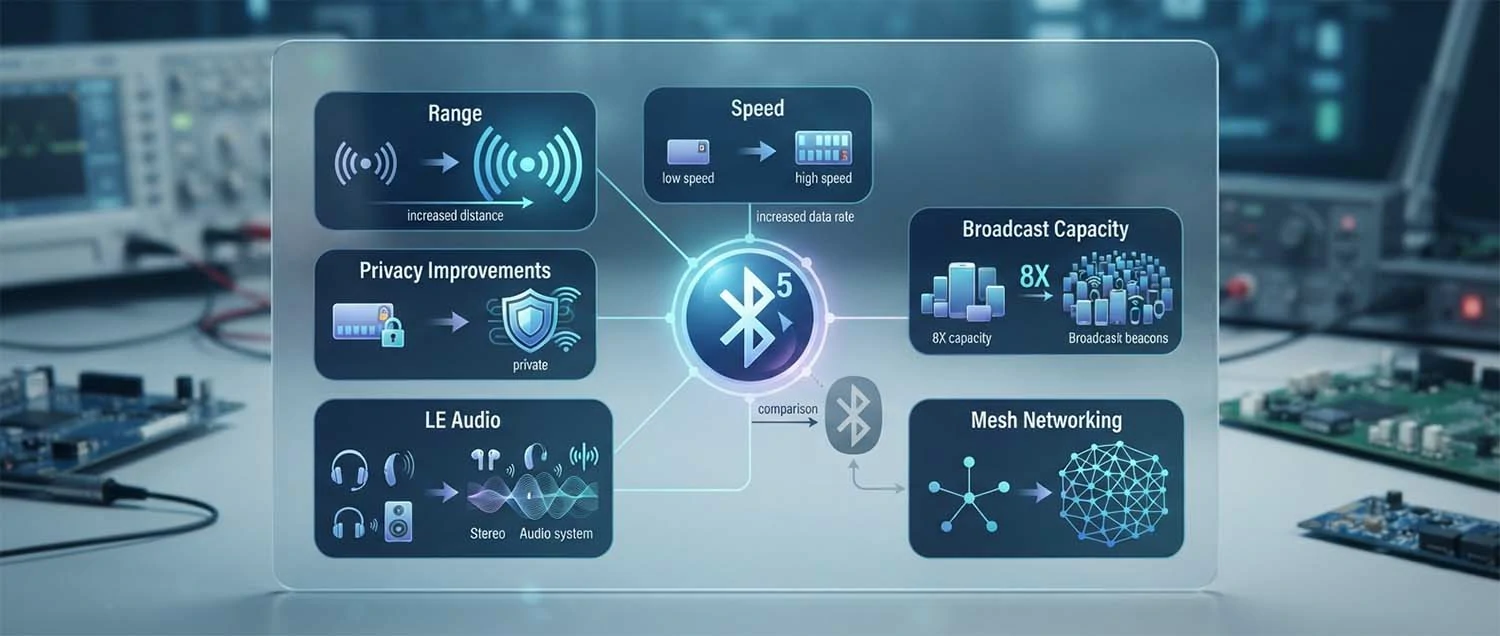

A comprehensive comparison of Bluetooth 5 and Bluetooth 4 covering speed, range, power consumption, data throughput, use cases, and practical guidance for choosing the right standard for your devices and applications.
Bluetooth 5 vs Bluetooth 4 Overview
Bluetooth technology has become an integral part of modern wireless communication, connecting billions of devices worldwide. The evolution from Bluetooth 4 to Bluetooth 5 represents a significant leap forward in capabilities, performance, and use cases. Understanding the differences between these two major versions is essential for consumers, developers, and businesses making decisions about wireless technology.
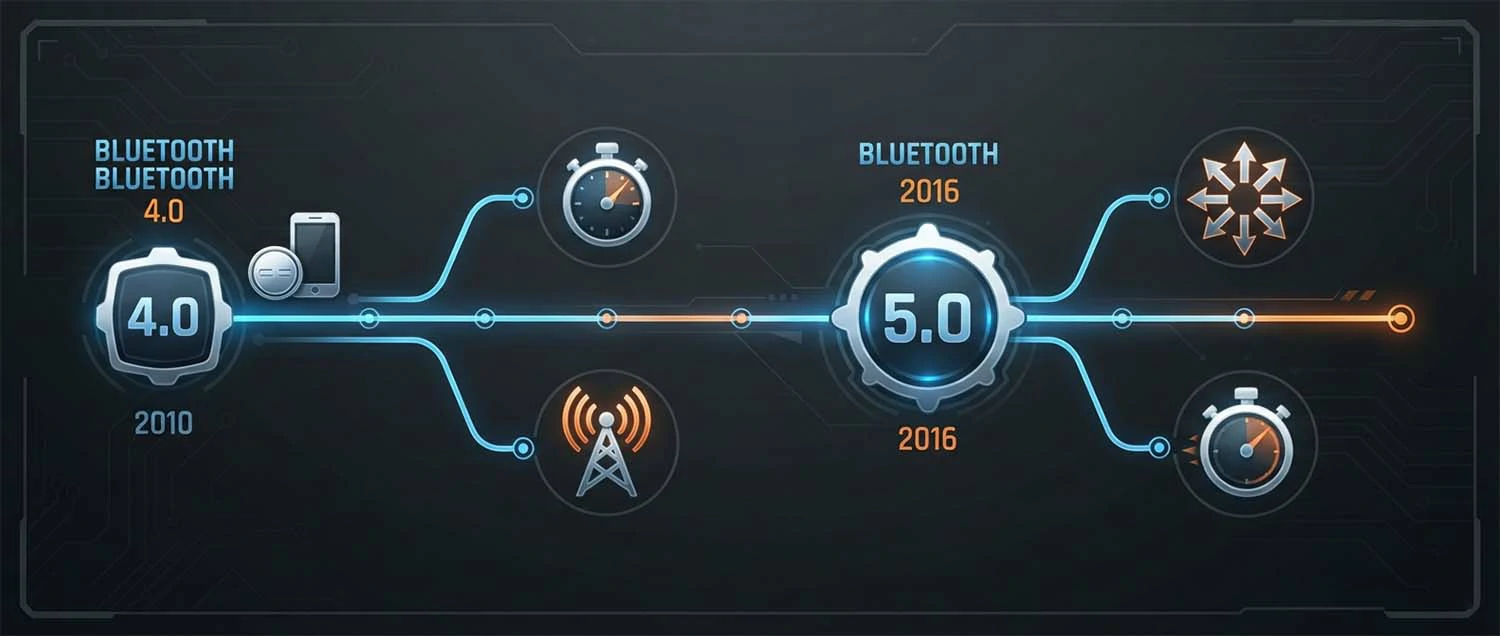
Bluetooth 4, introduced in 2010, brought low energy consumption to wireless connectivity through Bluetooth Low Energy. This breakthrough enabled a new generation of battery-powered devices from fitness trackers to smart sensors. Bluetooth 5, launched in 2016, built upon this foundation with substantial improvements in speed, range, and broadcast capacity while maintaining the low power characteristics that made BLE so valuable.
This guide provides a detailed comparison across every important dimension. Whether you are choosing a new smartphone, developing an IoT product, building a smart home ecosystem, or simply trying to understand which version your devices use, this resource will give you the knowledge you need to make informed decisions. For the version-numbered breakdown see our Bluetooth 4.0 vs 5.0 guide, and to understand complementary wireless standards explore the benefits of WiFi.
Data Transfer Speed Comparison
One of the most significant improvements in Bluetooth 5 is the dramatic increase in data transfer speed. This enhancement directly impacts how quickly devices can communicate and transfer information.
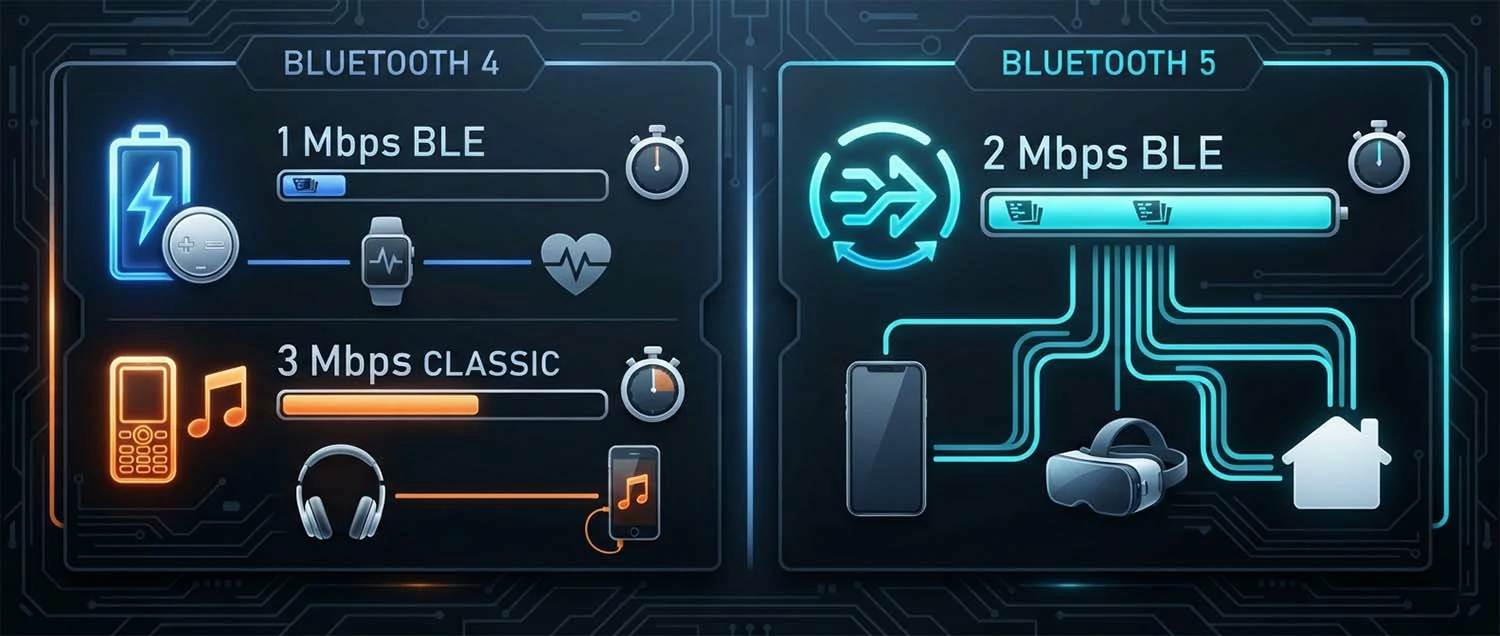
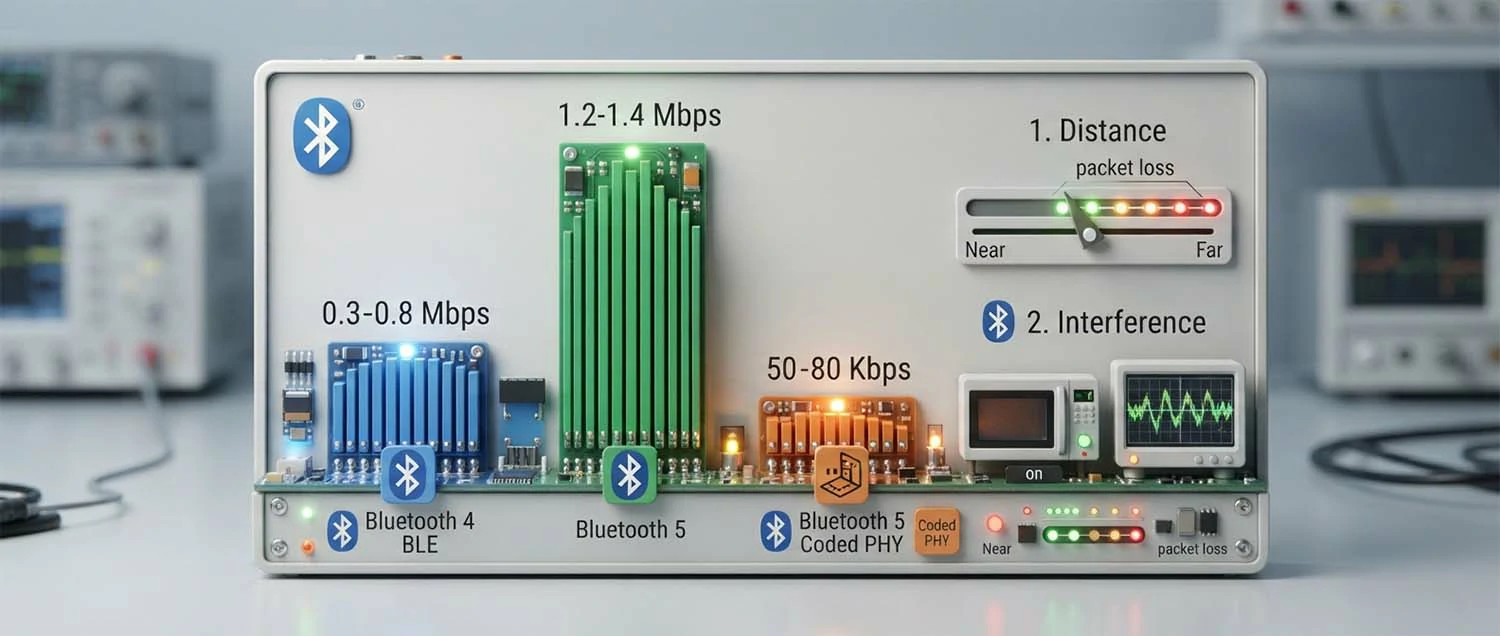
Bluetooth 4 Speed: Bluetooth 4 achieves a maximum data rate of 1 Mbps for Bluetooth Low Energy and up to 3 Mbps for Bluetooth Classic. In real-world conditions, effective throughput is typically lower due to protocol overhead, interference, and device limitations. For many early IoT applications, this speed was adequate for sensor data, notifications, and small file transfers. However, applications requiring larger data volumes struggled with the limited bandwidth.
Bluetooth 5 Speed: Bluetooth 5 doubles the BLE data rate to 2 Mbps, effectively halving the time required for data transfers. This improvement comes from changes to the physical layer that allow more efficient data encoding. In practice, 2 Mbps operation reduces power consumption for the same data volume because the radio spends less time active. The higher speed enables new use cases like audio streaming over BLE, faster firmware updates, and more responsive real-time applications.
Real-World Impact: The speed difference translates to meaningful real-world improvements. Over-the-air firmware updates that took minutes with Bluetooth 4 complete in seconds with Bluetooth 5. Audio streaming becomes viable over BLE rather than requiring Bluetooth Classic. Data-logging applications can transfer larger datasets in shorter connection windows. The combination of higher speed and lower power consumption enables more sophisticated wearable devices with richer data collection capabilities.
Wireless Range and Coverage
Range is a critical factor in wireless technology, determining how far apart devices can be while maintaining reliable communication. Bluetooth 5 introduced a remarkable improvement in range capabilities.
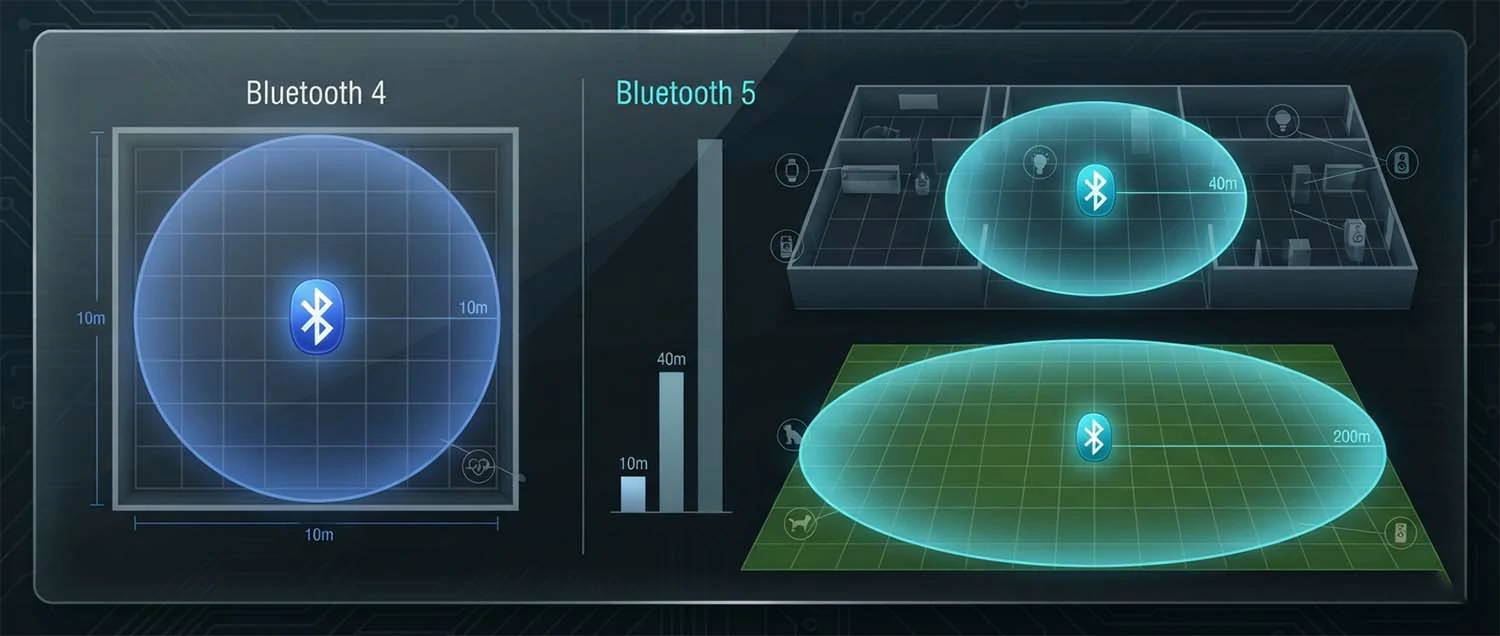
Bluetooth 4 Range: Bluetooth 4 typically offers a range of approximately 10 meters or 33 feet in indoor environments. This range varies based on obstacles, interference, and device antenna quality. In open outdoor environments, range can extend to around 30 meters or 100 feet. The limited range was sufficient for personal area network applications like connecting headphones to a phone in the same room but restrictive for whole-home or outdoor applications.
Bluetooth 5 Range: Bluetooth 5 extends range up to four times that of Bluetooth 4, reaching approximately 40 meters indoors and up to 200 meters outdoors in optimal conditions. This dramatic improvement comes from changes to the coding scheme at the physical layer. Bluetooth 5 introduces a coded PHY that adds forward error correction, allowing successful communication at lower signal levels. The range extension comes at the cost of reduced data rate, with the longest range mode operating at 125 Kbps.
Practical Implications: The extended range transforms what is possible with Bluetooth. Whole-home coverage becomes achievable with a single hub, enabling smart home devices in every room. Outdoor applications like garden sensors and perimeter monitoring become practical. Warehouse and industrial IoT deployments benefit from coverage across larger areas. Beacon-based location services work over greater distances with fewer infrastructure devices.
Power Consumption and Battery Life
Power efficiency is where Bluetooth technology has made its most profound impact. Both Bluetooth 4 and 5 excel at low-power operation, but there are important differences in how they manage energy consumption.
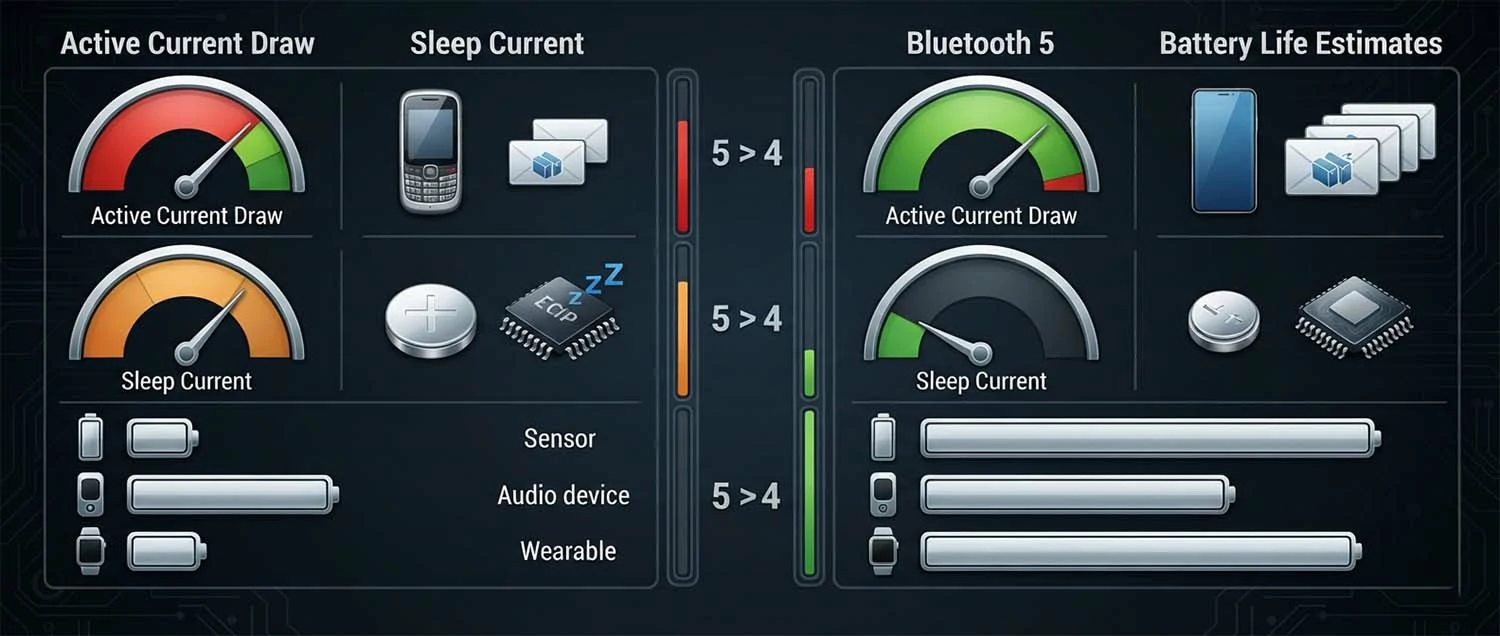
Bluetooth 4 Power: Bluetooth 4 Low Energy revolutionized wireless connectivity by enabling devices to operate for months or years on small batteries. Typical current consumption ranges from 5-15 mA during active transmission and drops to microamps in sleep mode. The protocol is designed for brief connection events followed by long sleep periods. This makes Bluetooth 4 ideal for applications like heart rate monitors that send small data packets periodically.
Bluetooth 5 Power: Bluetooth 5 maintains the same low-power foundation while offering options to optimize energy usage further. The higher data rate means the radio spends less time active for the same data volume, reducing overall energy consumption. However, the longer range modes consume more power per bit transmitted due to the coding overhead. Bluetooth 5 provides flexibility for developers to trade off between range, speed, and power based on application requirements.
Battery Life Comparison: For typical IoT sensor applications, Bluetooth 5 can achieve similar or better battery life compared to Bluetooth 4. A temperature sensor transmitting every minute might run for over two years on a coin cell battery with either standard. The ability to complete transmissions faster with Bluetooth 5 can extend battery life in data-intensive applications. Devices that leverage the longer range modes will see reduced battery life compared to the speed-optimized modes.
Broadcast and Advertising Capacity
Bluetooth advertising and broadcast capabilities determine how devices discover each other and communicate without establishing dedicated connections. This is fundamental for beacons, location services, and connectionless data transmission.
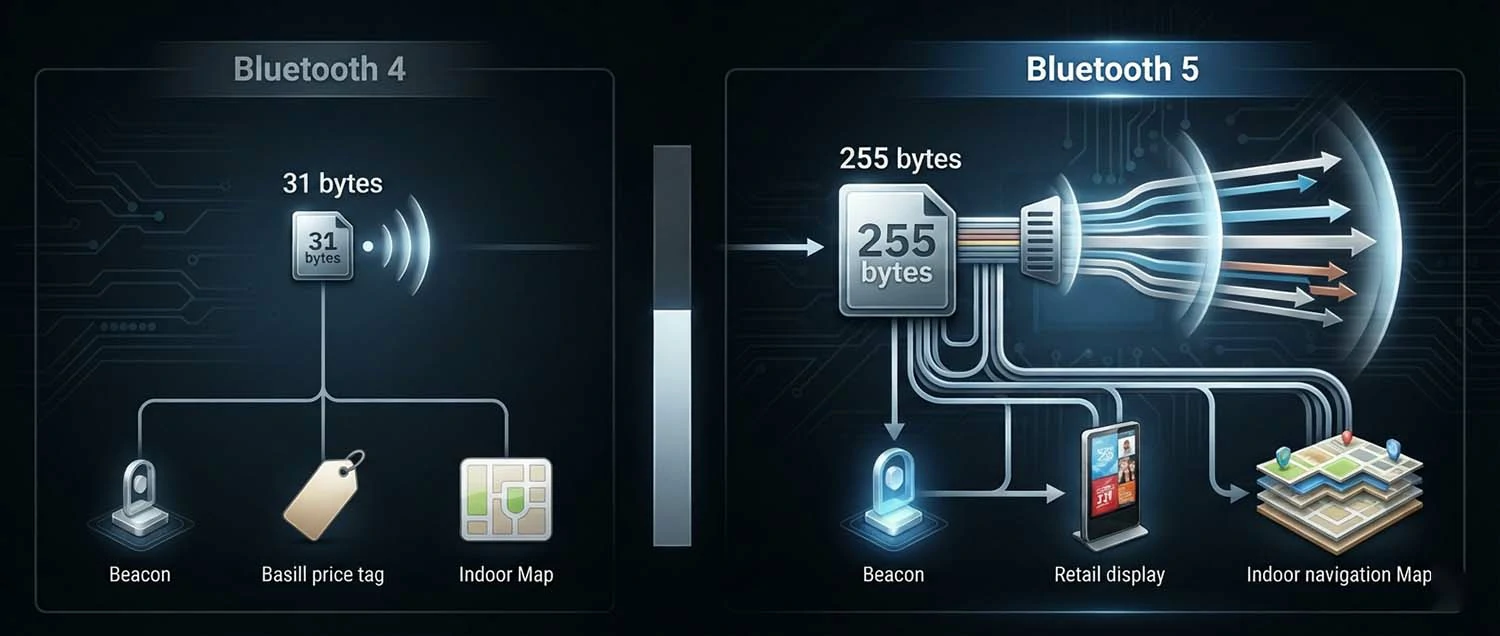
Bluetooth 4 Advertising: Bluetooth 4 supports advertising packets of up to 31 bytes of payload data. This limited capacity constrains the amount of information that can be broadcast without establishing a connection. For beacon applications, this means transmitting just an identifier and relying on the receiving device to look up additional information. Eddystone and iBeacon protocols were designed to work within these constraints.
Bluetooth 5 Advertising: Bluetooth 5 dramatically expands advertising capacity with support for extended advertising packets up to 255 bytes. This eight-fold increase enables much richer broadcast content. Beacons can transmit URLs, structured data, and even small images directly in advertisements. Extended advertising also supports periodic advertising where devices broadcast on scheduled intervals, allowing more efficient scanning by receivers.
Applications: The increased advertising capacity opens new possibilities. Retail beacons can transmit product information, prices, and promotions directly without needing an internet connection. Wayfinding systems can broadcast detailed location information for indoor navigation. Proximity marketing becomes more sophisticated with richer content delivery. IoT device configuration can be performed through advertising packets without establishing a connection.
Audio Quality and Streaming
Audio streaming is one of the most common Bluetooth use cases, and the evolution from Bluetooth 4 to 5 has brought meaningful improvements in audio quality and functionality.
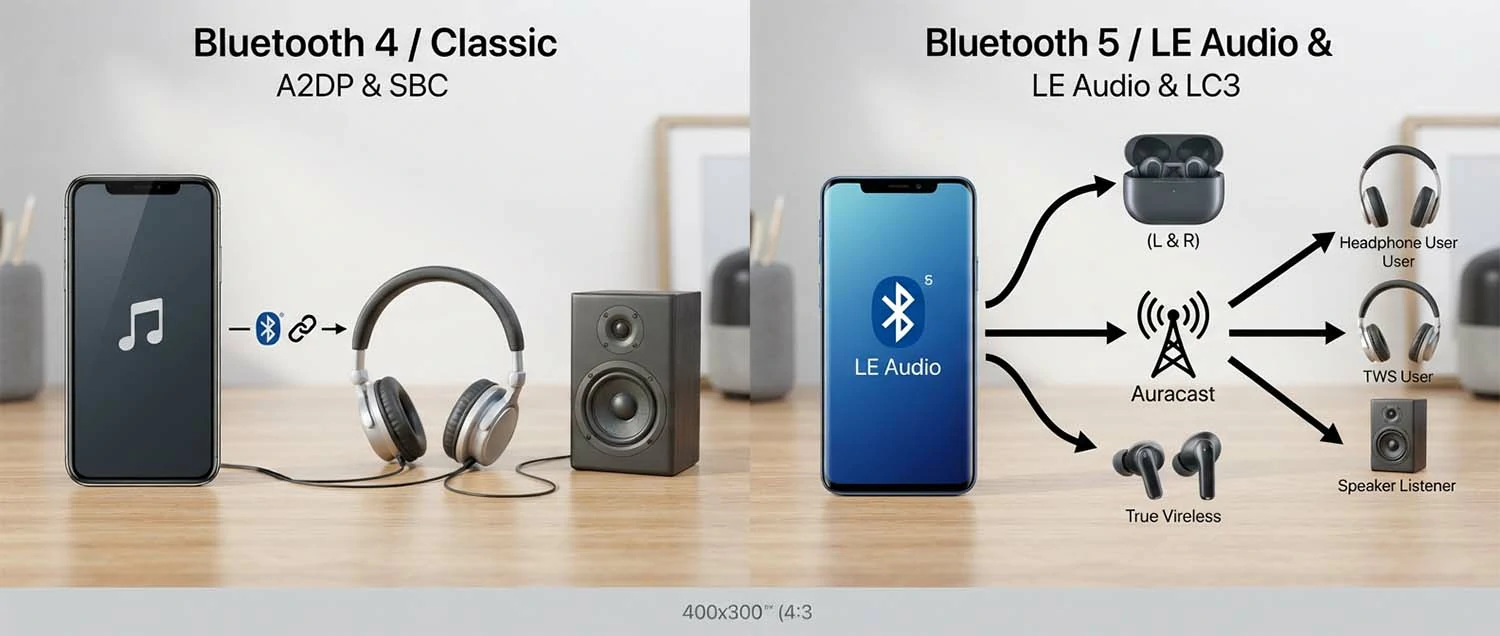
Bluetooth 4 Audio: Bluetooth 4 relies on Bluetooth Classic for high-quality audio streaming using A2DP profile. Bluetooth 4 BLE does not natively support audio streaming. The available codecs include SBC, AAC, aptX, and LDAC depending on device support. Audio quality is generally good for consumer use, with SBC providing adequate quality and aptX offering near-CD quality. Latency can be an issue, typically ranging from 100-300 milliseconds, which can cause audio-video sync problems.
Bluetooth 5 Audio: Bluetooth 5 introduced LE Audio, a major advancement that enables audio streaming over Bluetooth Low Energy instead of Classic. LE Audio uses the LC3 codec which provides better audio quality at lower bitrates compared to SBC. The Low Complexity Communications Codec is the new standard, offering equivalent quality at half the bitrate. This means better battery life for wireless headphones and speakers while maintaining audio quality.
Multi-Stream Audio: LE Audio supports multi-stream audio, allowing independent audio streams to each earbud rather than broadcasting to one earbud that relays to the other. This enables true stereo separation and improved synchronization. Auracast broadcast audio allows a single source to transmit to multiple receivers simultaneously, enabling applications like sharing audio with friends or public broadcast systems in venues.
Security and Encryption
Security is fundamental to Bluetooth communication, protecting data exchanged between devices from eavesdropping and tampering. Both Bluetooth 4 and 5 implement strong security, though there are important differences.
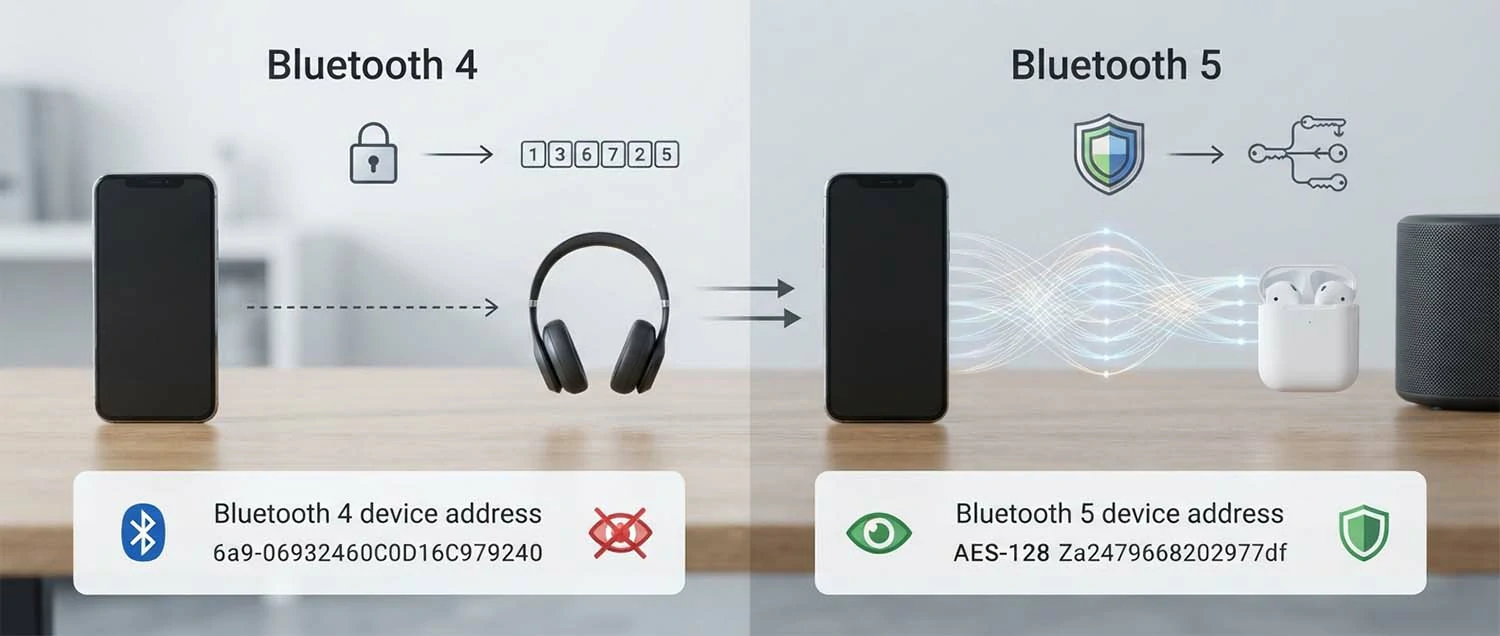
Bluetooth 4 Security: Bluetooth 4 uses AES-128 encryption for data confidentiality. The Secure Simple Pairing process provides protection against passive eavesdropping but had vulnerabilities to man-in-the-middle attacks on older implementations. Key exchange uses the Elliptic Curve Diffie-Hellman algorithm. Bluetooth 4.2 introduced LE Secure Connections with Federal Information Processing Standards compliant Elliptic Curve Cryptography, significantly improving security.
Bluetooth 5 Security: Bluetooth 5 inherits and enhances the security features introduced in Bluetooth 4.2. LE Secure Connections are mandatory, ensuring all BLE connections use strong encryption. Bluetooth 5 also improves privacy through address resolution, making it harder for attackers to track devices by their Bluetooth address. The LE Privacy feature allows devices to change their address periodically while trusted peers can still resolve the identity.
Practical Security: For most users, both versions provide adequate security for typical applications. Device pairing remains the primary security mechanism, and users should follow best practices like not pairing with unknown devices and keeping software updated. Enterprise and medical applications may require additional security layers beyond Bluetooth encryption.
IoT and Smart Home Applications
The Internet of Things represents one of the largest growth areas for Bluetooth technology. The choice between Bluetooth 4 and 5 significantly impacts IoT and smart home device capabilities.
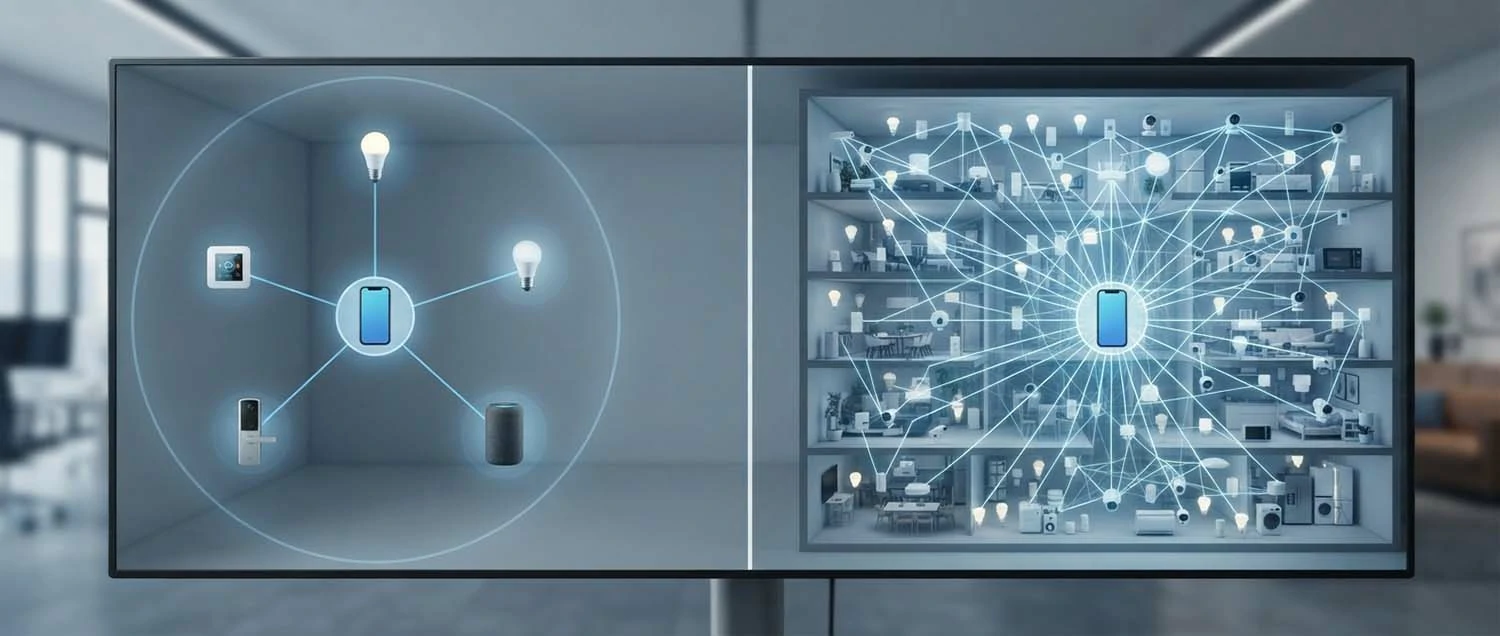
Bluetooth 4 in IoT: Bluetooth 4 enabled the first wave of consumer IoT devices. Smart lights, thermostats, locks, and sensors all leveraged BLE for low-power connectivity. The limited range meant devices needed to be relatively close to the controlling hub or phone. Network topology was primarily star-shaped with a central device connecting to multiple peripherals. Mesh networking was not supported at the Bluetooth level.
Bluetooth 5 in IoT: Bluetooth 5 transforms IoT possibilities with extended range, higher speed, and mesh networking support. Bluetooth Mesh enables large-scale device networks where messages can hop between devices to reach farther destinations. This makes Bluetooth viable for commercial building automation, hotel room control, and industrial sensor networks that plug into wider network infrastructure. The longer range means a single hub can cover an entire home for smart home devices.
Mesh Networking: Bluetooth Mesh is a major addition in the Bluetooth 5 ecosystem. Unlike traditional point-to-point Bluetooth, mesh allows many-to-many communication. Messages propagate through the mesh network, with each device relaying to neighbors. This creates self-healing networks that remain operational even when individual devices fail. Mesh supports thousands of nodes, making it suitable for large-scale deployments.
Location Services and Beacons
Bluetooth-based location services use signal strength and timing to determine device positions. The improvements in Bluetooth 5 significantly enhance location-based applications.
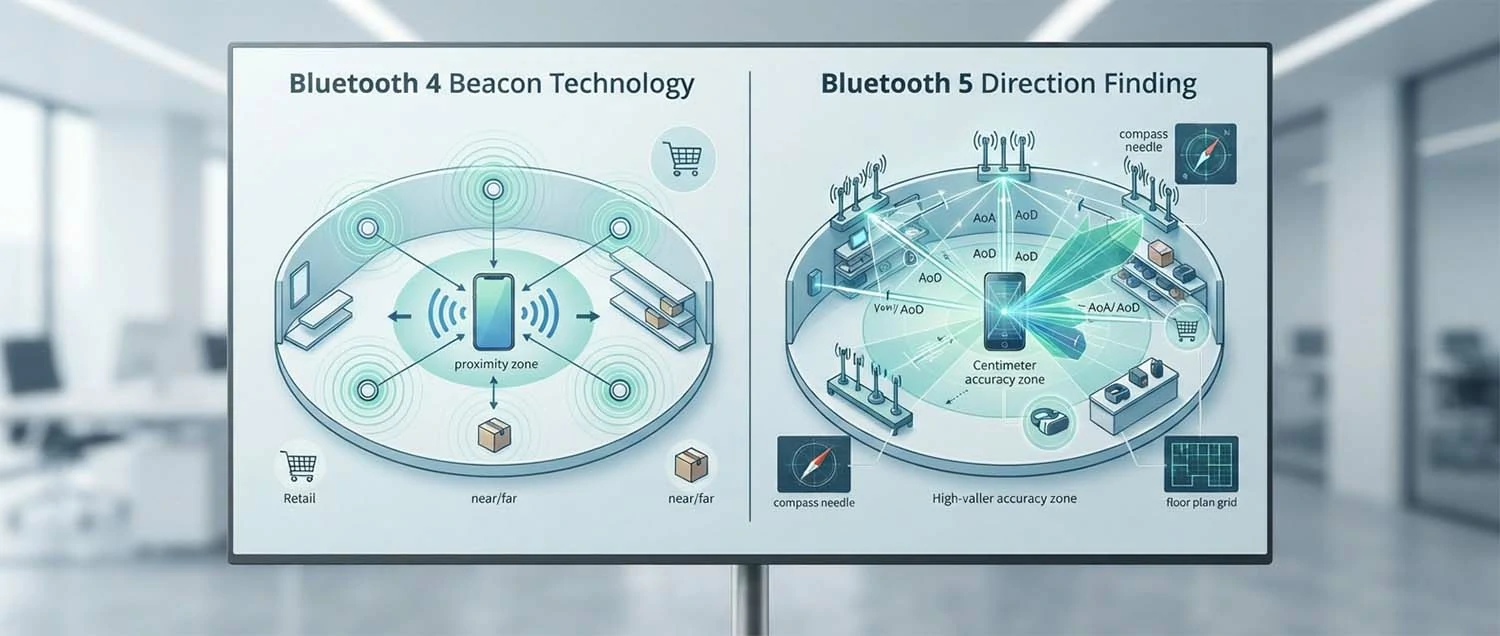
Beacon Technology: Both Bluetooth 4 and 5 support beacon technology where devices broadcast identifying information that receivers use to determine proximity. Bluetooth 4 beacons like iBeacon and Eddystone broadcast small identifiers that apps use to trigger location-based actions. The limited advertising payload restricted the information beacons could transmit directly. Bluetooth 5 beacons can broadcast richer data including URLs, structured messages, and configuration information.
Direction Finding: Bluetooth 5.1 introduced direction finding capabilities that enable precise location tracking. Angle of Arrival and Angle of Departure methods use antenna arrays to determine signal direction. This allows positioning accuracy down to centimeter level, compared to meter-level accuracy with signal strength methods alone. Direction finding enables indoor navigation with turn-by-turn directions, asset tracking in warehouses, and precise item location finding.
Real-World Applications: Bluetooth 5 location capabilities enable new applications. Smart retail uses precise location to send relevant offers based on exact aisle position. Airport navigation guides passengers to gates with turn-by-turn directions. Hospitals track equipment location for efficient utilization. Museums provide context-aware audio guides that activate near specific exhibits. Conference venues enable attendee networking based on proximity.
Backward Compatibility
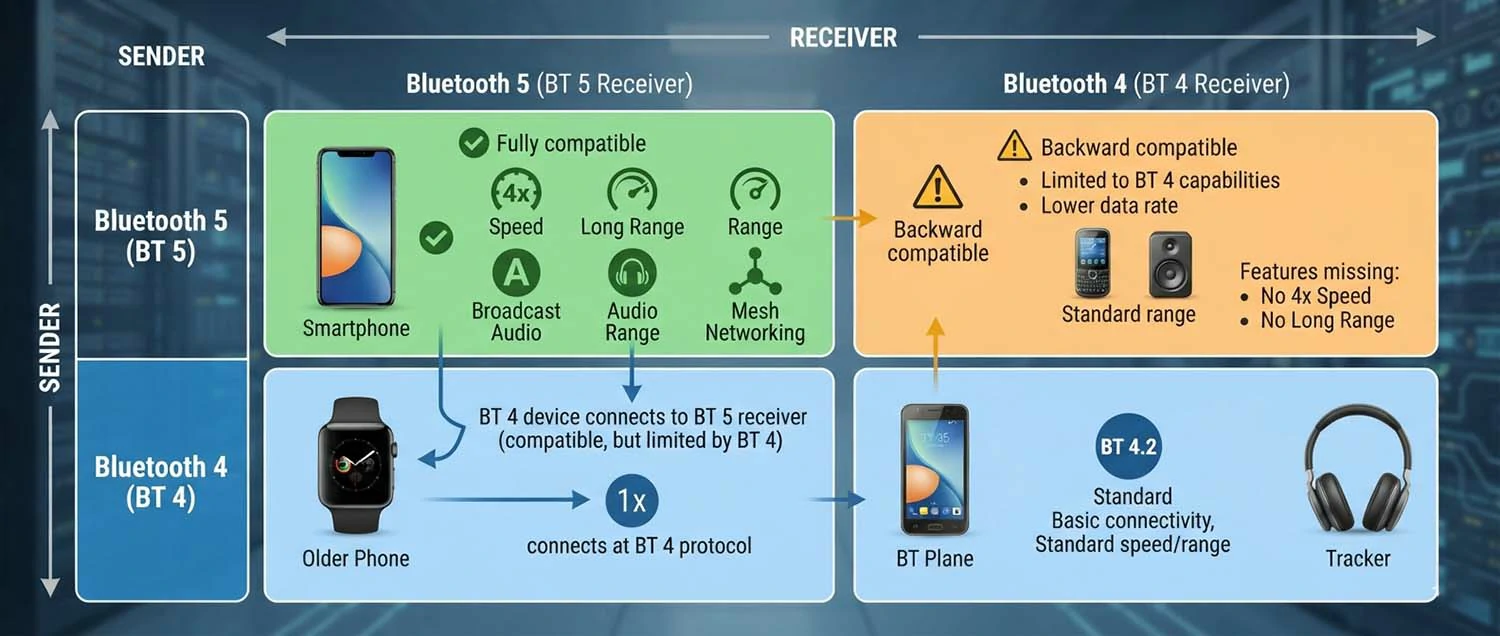
Backward compatibility is a crucial consideration when adopting new Bluetooth technology. Understanding how Bluetooth 5 interacts with Bluetooth 4 devices helps in planning upgrades and mixed-device environments.
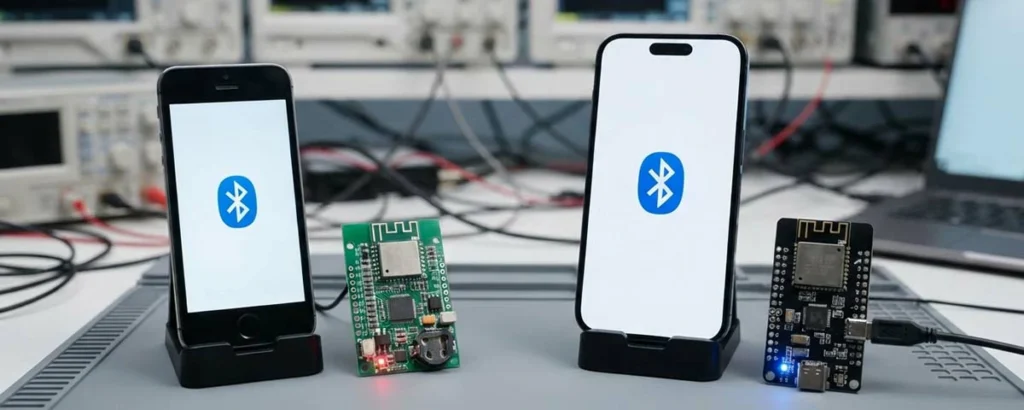
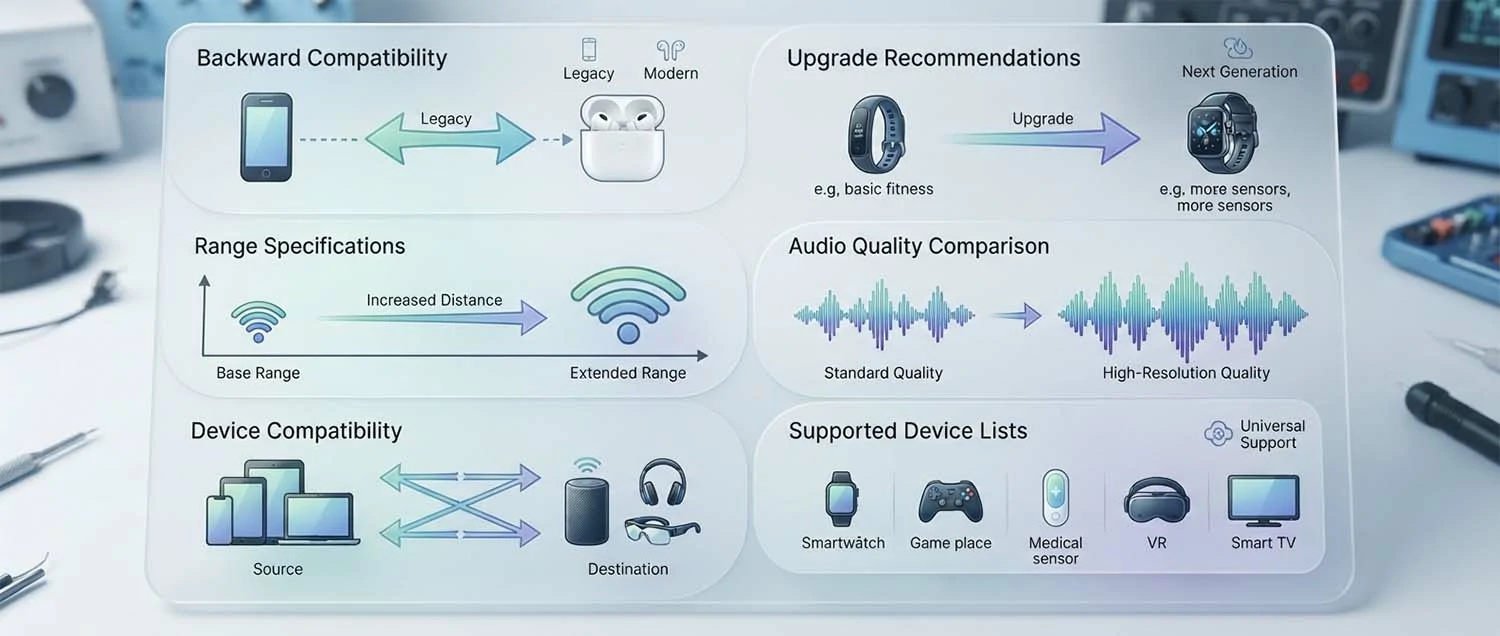
Bluetooth 5 with Bluetooth 4 Devices: Bluetooth 5 is fully backward compatible with Bluetooth 4 devices. A Bluetooth 5 smartphone can connect to Bluetooth 4 headphones, speakers, and wearables without issues. The connection will operate at Bluetooth 4 speeds using Bluetooth 4 protocols. The Bluetooth 5 device negotiates the highest mutually supported version during connection setup. This means users can upgrade their phone without worrying about existing accessory compatibility.
Bluetooth 4 with Bluetooth 5 Devices: A Bluetooth 4 device cannot take advantage of Bluetooth 5 features even when connected to a Bluetooth 5 device. The connection operates at Bluetooth 4 capabilities. This means the extended range, higher speed, and enhanced broadcast features are only available when both devices support Bluetooth 5. Users must ensure both the source and receiver support Bluetooth 5 to benefit from the improvements.
Mixed Environment Considerations: In environments with mixed Bluetooth versions, planning is important. Devices should be grouped by capability to maximize performance. Backward compatible modes may not support all Bluetooth 5 features. Testing with target devices before deployment is recommended. Firmware updates may enable Bluetooth 5 features on some devices originally shipped with Bluetooth 4 hardware.
Hardware Requirements and Chipset
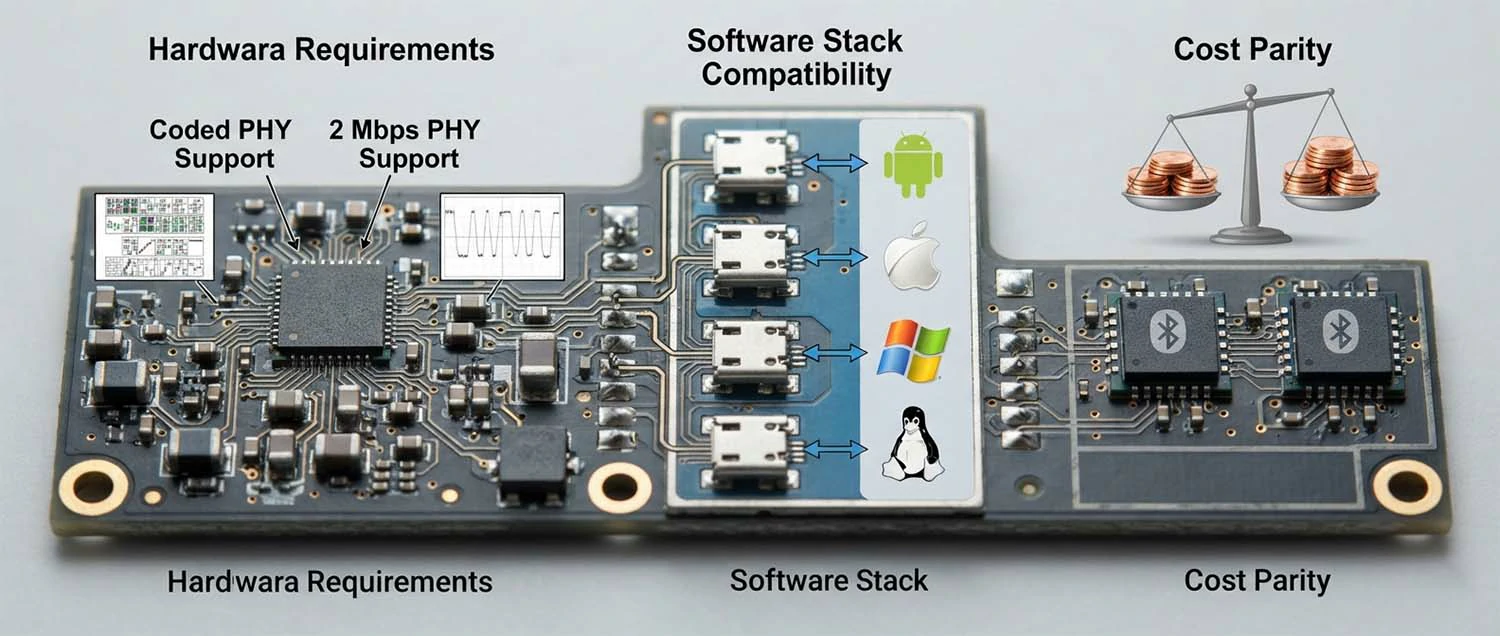
Moving from Bluetooth 4 to Bluetooth 5 requires hardware changes at the chipset level. Understanding the hardware implications helps in device selection and development planning.
Bluetooth 5 Chipset Requirements: Bluetooth 5 requires new radio hardware that supports the enhanced physical layer features. The coded PHY for extended range and the 2 Mbps PHY for higher speed require changes to the radio transceiver design. Most modern Bluetooth chipsets from major manufacturers like Nordic Semiconductor, Texas Instruments, Qualcomm, Broadcom, and Infineon support Bluetooth 5. These chips are now widely available at costs comparable to Bluetooth 4 chips.
Software Stack: Bluetooth 5 requires updated software stacks even on capable hardware. Operating system support is needed to expose Bluetooth 5 features to applications. Android added Bluetooth 5 support starting with Android 8. iOS has supported Bluetooth 5 since iPhone 8 and iOS 11. Windows supports Bluetooth 5 starting with Windows 10 version 1703. Linux support depends on the BlueZ stack version.
Cost Comparison: Bluetooth 5 chipsets are now priced similarly to Bluetooth 4 chipsets due to high volume production. The incremental cost of adding Bluetooth 5 support to a new product is minimal. Most new smartphones, tablets, laptops, and audio devices ship with Bluetooth 5. For IoT devices, the cost difference is negligible in volume quantities, making Bluetooth 5 the default choice for new product designs.
Backward Compatibility
Backward compatibility is a crucial consideration when adopting new Bluetooth technology. Understanding how Bluetooth 5 interacts with Bluetooth 4 devices helps in planning upgrades and mixed-device environments.
Bluetooth 5 with Bluetooth 4 Devices: Bluetooth 5 is fully backward compatible with Bluetooth 4 devices. A Bluetooth 5 smartphone can connect to Bluetooth 4 headphones, speakers, and wearables without issues. The connection will operate at Bluetooth 4 speeds using Bluetooth 4 protocols. The Bluetooth 5 device negotiates the highest mutually supported version during connection setup. This means users can upgrade their phone without worrying about existing accessory compatibility.
Bluetooth 4 with Bluetooth 5 Devices: A Bluetooth 4 device cannot take advantage of Bluetooth 5 features even when connected to a Bluetooth 5 device. The connection operates at Bluetooth 4 capabilities. This means the extended range, higher speed, and enhanced broadcast features are only available when both devices support Bluetooth 5. Users must ensure both the source and receiver support Bluetooth 5 to benefit from the improvements.
Mixed Environment Considerations: In environments with mixed Bluetooth versions, planning is important. Devices should be grouped by capability to maximize performance. Backward compatible modes may not support all Bluetooth 5 features. Testing with target devices before deployment is recommended. Firmware updates may enable Bluetooth 5 features on some devices originally shipped with Bluetooth 4 hardware.
Privacy Features Comparison
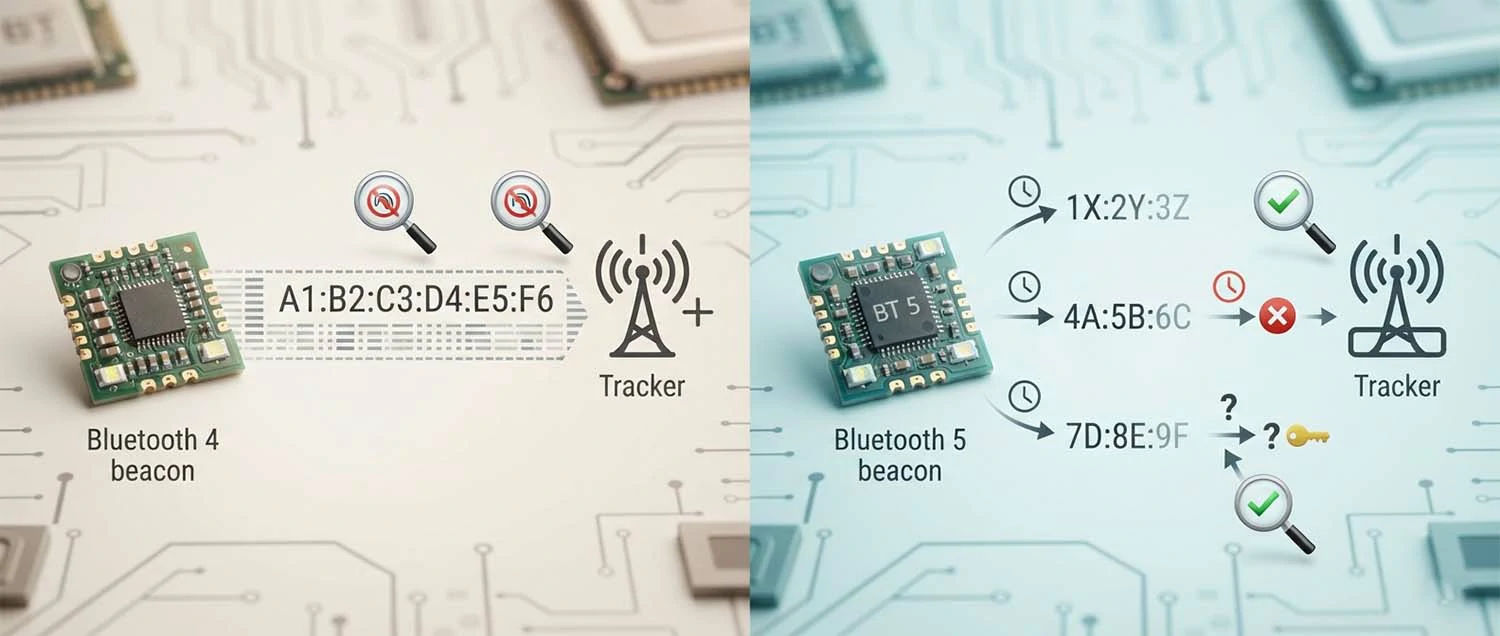
Privacy protection in Bluetooth technology determines how easily devices can be tracked and identified by unauthorized parties. Bluetooth 5 introduced significant privacy improvements.
Bluetooth 4 Privacy: Bluetooth 4 devices typically use static Bluetooth addresses that remain constant over time. This makes devices trackable as they move through different locations, since the same address is consistently broadcast. While Bluetooth 4.1 introduced limited privacy features, adoption was inconsistent. Many Bluetooth 4 devices still use static addresses, creating privacy concerns for users carrying Bluetooth-enabled devices.
Bluetooth 5 Privacy: Bluetooth 5 mandates LE Privacy 1.2 which includes private address resolution. Devices generate random addresses that change periodically, making it difficult for observers to track a device over time. The resolution process allows trusted paired devices to identify the device despite changing addresses. Privacy features are mandatory for certification, ensuring more consistent implementation across Bluetooth 5 devices.
Tracking Prevention: The enhanced privacy features in Bluetooth 5 help prevent unwanted tracking. Changing addresses prevent retail analytics systems from tracking individual customers across multiple stores. Device manufacturers can implement additional privacy features like disabling advertising when not in use.
Network Topology and Connectivity
Bluetooth network topology determines how devices connect and communicate within a network. The evolution from Bluetooth 4 to 5 brought fundamental changes to networking capabilities.
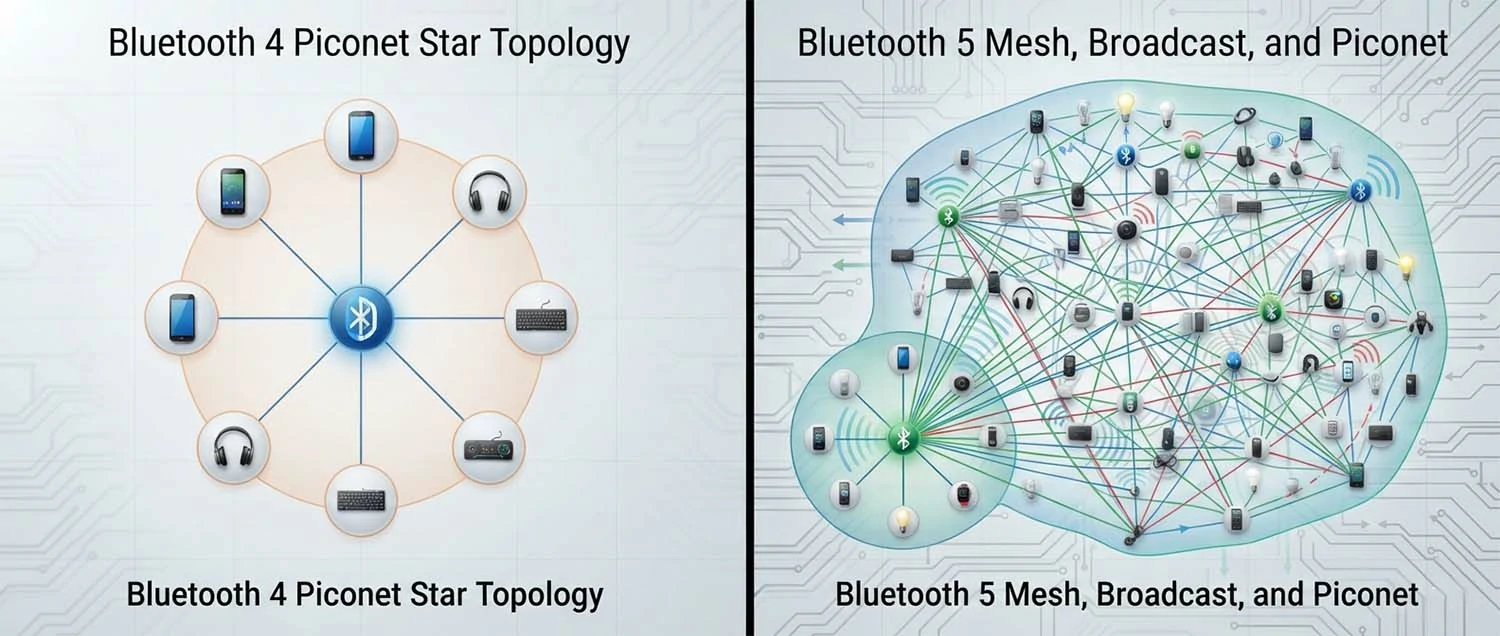
Bluetooth 4 Topology: Bluetooth 4 primarily supports piconet topology where one central device connects to up to seven active peripheral devices. All communication goes through the central device, creating a star network. This works well for personal area networks like a phone connecting to smartwatch, headphones, and fitness tracker. However, it limits coverage area and network size.
Bluetooth 5 Topology: Bluetooth 5 supports multiple topology options. Traditional piconet is still available for personal area networking. Bluetooth Mesh enables many-to-many communication across large device networks. Broadcast topology supports one-to-many communication without connection setup. Extended advertising enables more efficient device discovery. These options allow Bluetooth to serve more diverse use cases.
Connection Density: Bluetooth 5 increases the number of devices that can be active simultaneously. Bluetooth 4 supports up to 7 active connections from a central device. Bluetooth 5 increases this capacity through improved resource management. For mesh networks, thousands of devices can participate in a single network, making Bluetooth a key part of modern network solutions for commercial and industrial applications.
Latency and Connection Speed
Latency affects the responsiveness of Bluetooth connections, which is critical for real-time applications like gaming, audio, and interactive controls.
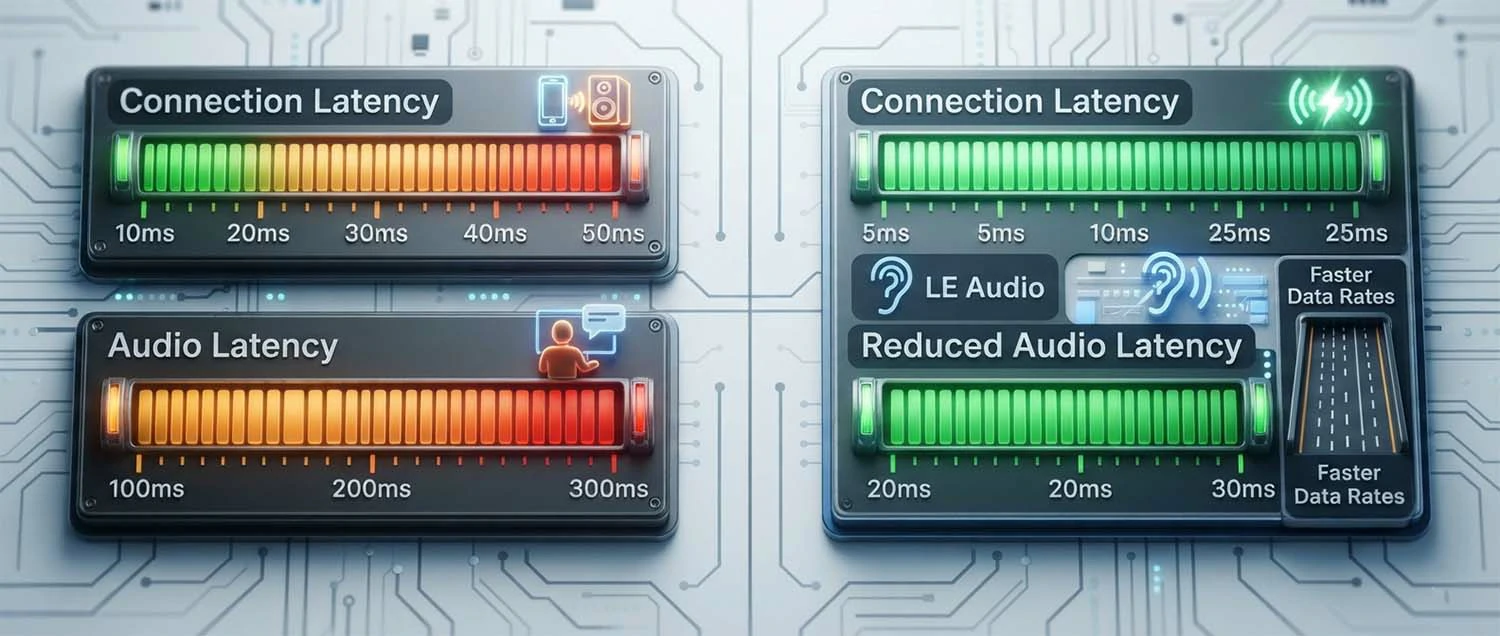
Bluetooth 4 Latency: Bluetooth 4 BLE has typical connection latency of 3-6 milliseconds in optimal conditions, but real-world latency often ranges from 10-50 milliseconds depending on connection interval settings. Scanning latency for device discovery can take several hundred milliseconds to several seconds. Audio latency over Bluetooth Classic A2DP typically ranges from 100-300 milliseconds, which can cause noticeable audio-video sync issues.
Bluetooth 5 Latency: Bluetooth 5 reduces latency through the higher data rate, which allows data exchanges to complete faster. The 2 Mbps PHY reduces transmission time by half compared to Bluetooth 4. LE Audio with LC3 codec significantly reduces audio latency to 20-30 milliseconds, making Bluetooth viable for real-time communication applications. Connection interval flexibility allows developers to optimize for lower latency at the cost of higher power consumption.
Impact on Applications: Lower latency enables new applications. Gaming controllers become more responsive with less perceptible delay between input and action. Hearing aids can provide real-time audio processing without noticeable lag. Two-way audio for hearing assistance becomes practical. Touch-based interactions with smart devices feel more natural. Live audio performance becomes viable over Bluetooth.
Interference and Coexistence
Bluetooth operates in the 2.4 GHz ISM band alongside Wi-Fi, Zigbee, and other wireless technologies. Managing interference is crucial for reliable operation.
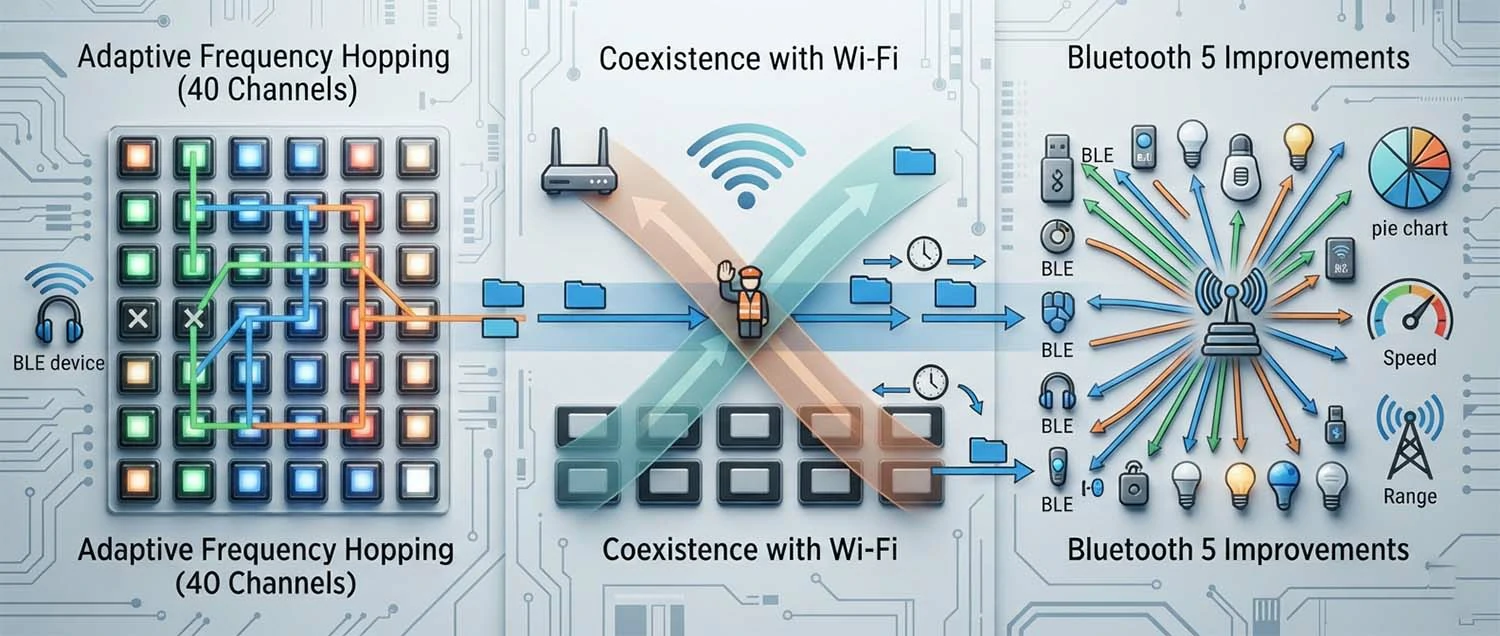
Frequency Hopping: Both Bluetooth 4 and 5 use adaptive frequency hopping to avoid interference. Bluetooth divides the 2.4 GHz band into 40 channels for BLE or 79 channels for Classic. The adaptive hopping algorithm identifies channels with interference and avoids them. Bluetooth 5 uses the same 40-channel scheme for BLE but with improved channel classification algorithms that better identify and avoid congested channels.
Coexistence with Wi-Fi: Bluetooth and Wi-Fi frequently operate in the same devices and environments. Both Bluetooth 5 and modern Wi-Fi implement coexistence mechanisms. Packet traffic arbitration gives priority to time-sensitive Bluetooth traffic. Channel avoidance steers Bluetooth away from Wi-Fi channels in use. Bluetooth 5 improved channel selection algorithms reduce collisions with Wi-Fi.
Dense Environments: In environments with many Bluetooth devices, interference increases. Bluetooth 5 improved handling of dense deployments through better timing and channel management. The extended advertising features help devices discover each other more reliably in crowded RF environments. Bluetooth Mesh in Bluetooth 5 uses managed flooding with message caching to reduce redundant transmissions.
Healthcare and Medical Applications
Bluetooth technology plays an increasingly important role in healthcare, from consumer fitness tracking to professional medical monitoring devices.
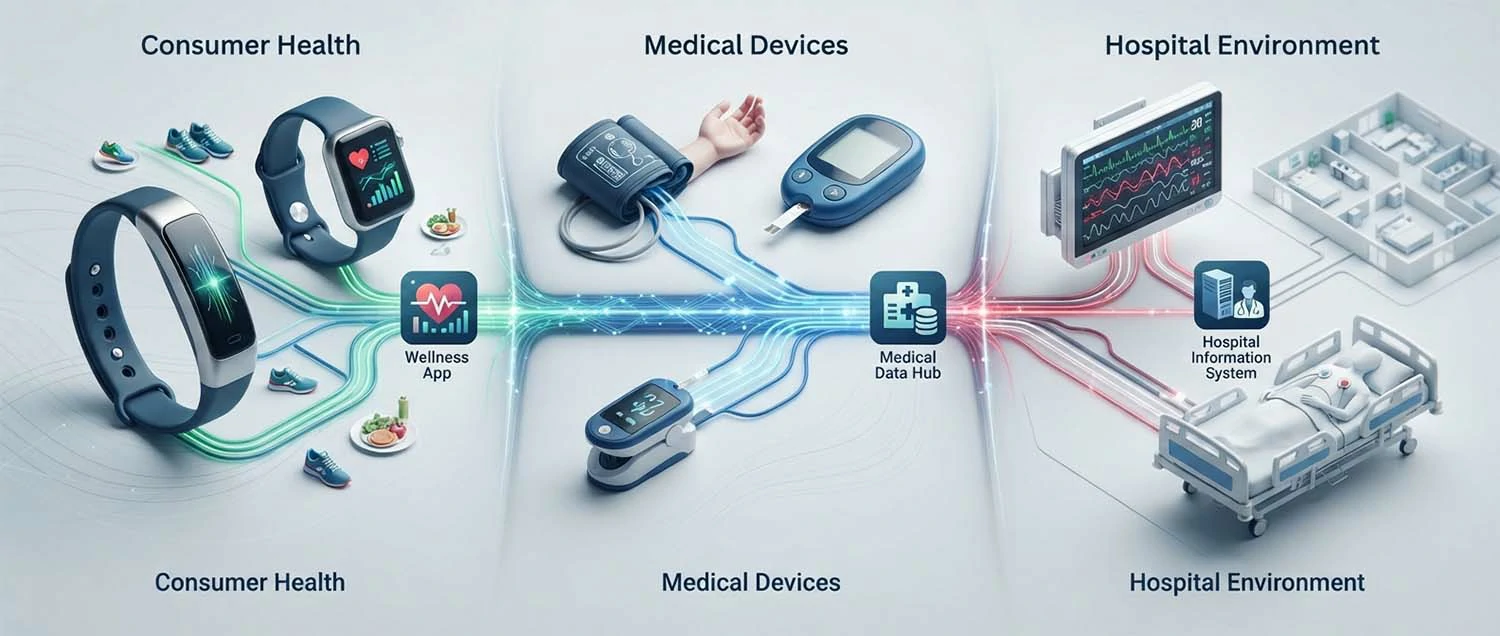
Fitness and Wellness: Bluetooth 4 enabled the first wave of fitness trackers and smartwatches. These devices collect heart rate, step count, sleep data, and activity information and transmit it to smartphones. Bluetooth 5 improves this experience with faster data sync, longer range for armband-to-phone communication, and richer broadcast data for gym equipment integration. Athletes benefit from more detailed real-time performance data.
Medical Devices: Medical Bluetooth devices require reliable, secure communication. Blood glucose monitors, continuous glucose monitors, blood pressure cuffs, pulse oximeters, and weight scales all use Bluetooth to transmit readings. Bluetooth 5 provides the reliability and security needed for medical applications. The extended range allows patients to move freely while their medical device maintains connection to a hub or phone.
Continuous Monitoring: Bluetooth 5 enables more sophisticated continuous monitoring. The higher data rate supports transmission of raw waveform data from ECG monitors. Extended range allows hospital patients to be monitored while moving throughout a ward. Mesh networking enables connected hospital environments where multiple monitoring devices communicate through a facility-wide network.
Automotive and In-Vehicle Use
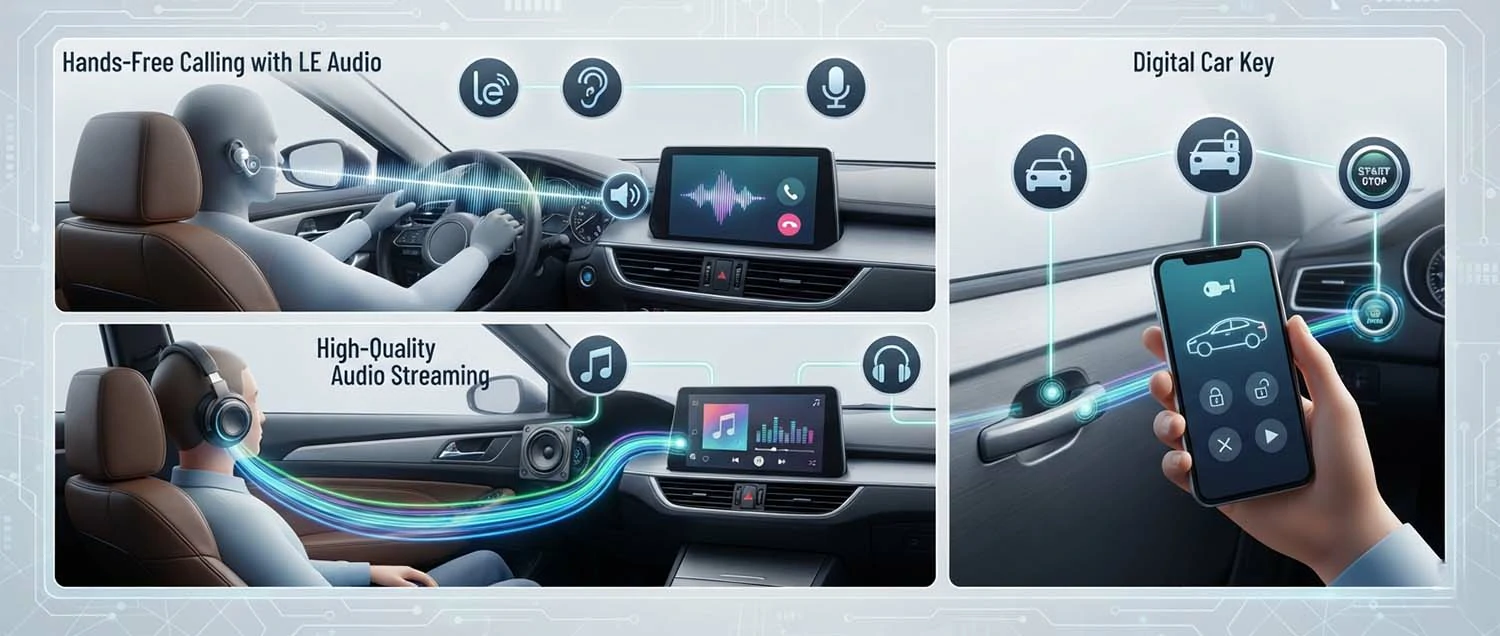
Bluetooth has become standard in modern vehicles for hands-free calling, audio streaming, and smartphone integration. Bluetooth 5 brings meaningful improvements to the automotive experience.
Hands-Free Calling: Bluetooth 4 enabled basic hands-free calling with adequate audio quality. Bluetooth 5 with LE Audio improves call quality through the LC3 codec, providing clearer voice transmission even in noisy vehicle environments. Multi-stream audio allows separate channels for incoming and outgoing audio, improving echo cancellation. Wideband speech support delivers more natural-sounding conversations.
Audio Streaming: Bluetooth 4 supports audio streaming using A2DP over Bluetooth Classic. Bluetooth 5 adds LE Audio streaming capability, offering better audio quality at lower bitrates. This reduces battery drain on phones during long drives. The improved range means devices remain connected even when placed in the back seat or trunk. Auracast enables sharing audio with multiple passengers simultaneously.
Digital Keys: Bluetooth 5 enables digital car key functionality defined by the Car Connectivity Consortium. Using Bluetooth 5 combined with UWB, phones can lock, unlock, and start vehicles without removing the phone from a pocket. The security features of Bluetooth 5 protect against relay attacks. Multiple digital keys can be shared with family members or temporarily with valet parking services.
Migrating from Bluetooth 4 to 5
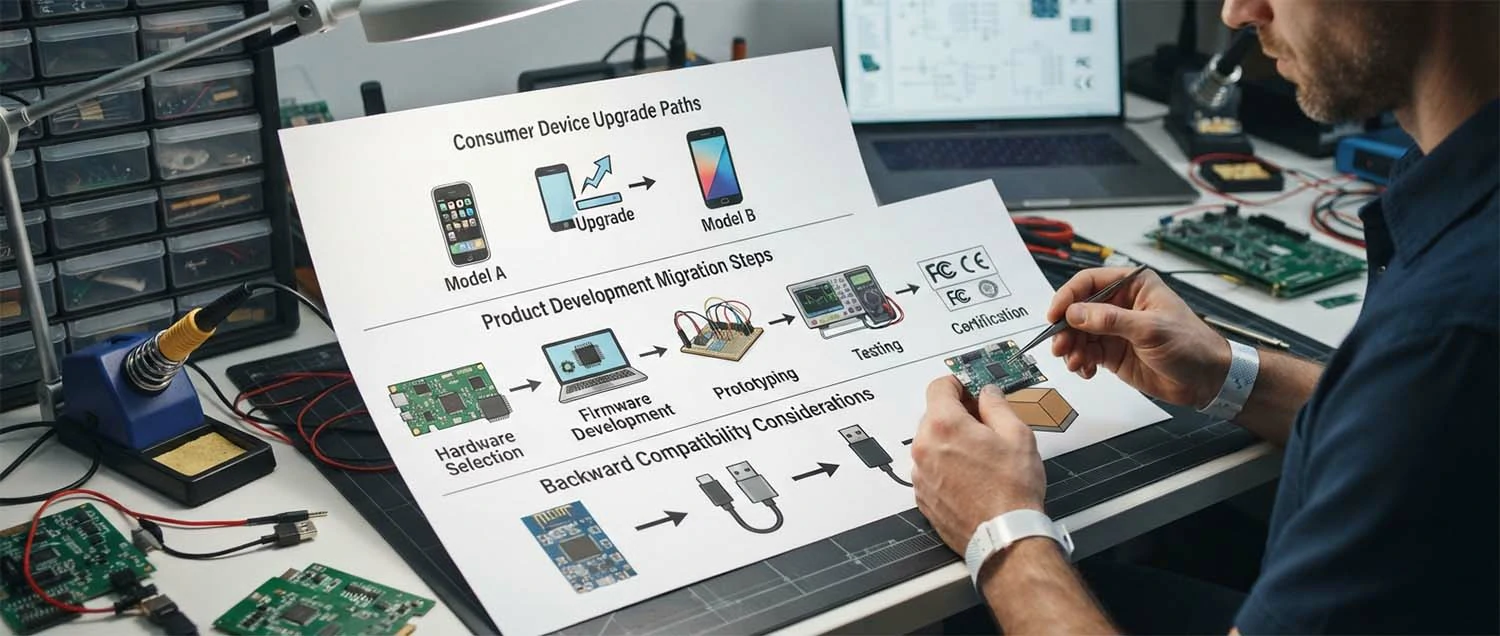
Migrating devices and products from Bluetooth 4 to Bluetooth 5 requires careful planning. Understanding the migration process helps minimize disruption and maximize benefits.
Consumer Device Migration: For consumers, migrating to Bluetooth 5 is straightforward. Most new smartphones, tablets, laptops, and audio devices already support Bluetooth 5. Users simply upgrade their devices and continue using existing accessories, which will work through backward compatibility. To benefit from Bluetooth 5 features, both the source and receiving device must support Bluetooth 5. Gradually replacing older accessories unlocks the full benefits.
Product Development Migration: For product developers, migrating to Bluetooth 5 involves hardware and software updates. New chipset selection should prioritize Bluetooth 5 capable components. Firmware updates may enable Bluetooth 5 on existing hardware if the chipset supports it. Software stack updates are required to expose Bluetooth 5 features. Testing should validate both Bluetooth 5 performance and backward compatibility with Bluetooth 4 devices.
Certification: Bluetooth 5 products require certification through the Bluetooth Special Interest Group to use the Bluetooth brand. The certification process verifies compliance with Bluetooth 5 specifications and interoperability with other devices. Testing covers RF performance, protocol compliance, and profile implementation. The certification cost is comparable to Bluetooth 4 certification.
Key Benefits of Bluetooth 5
Bluetooth 5 delivers meaningful improvements over Bluetooth 4 across multiple dimensions. Understanding the key benefits helps in making informed purchasing and development decisions.
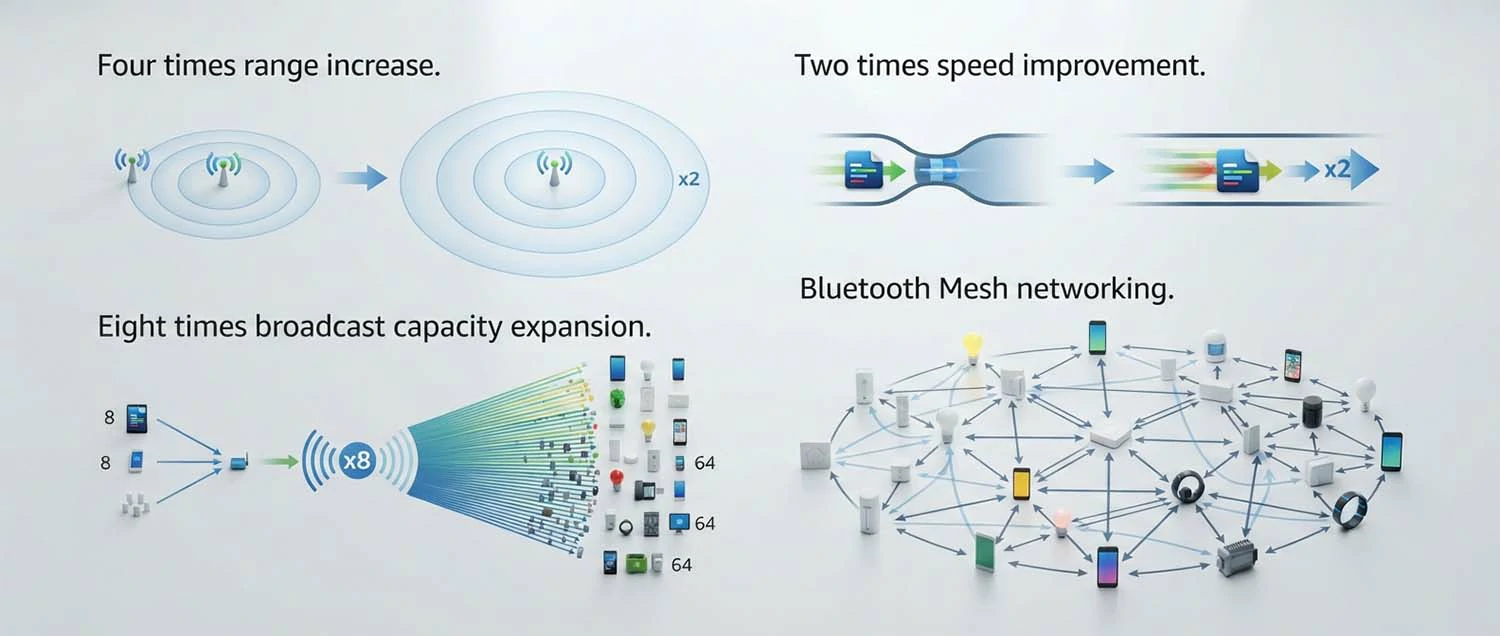
Four Times Range: The most impactful improvement for many users is the four-fold range increase. Devices that previously needed to be within 10 meters can now operate reliably at 40 meters. This means whole-home smart device coverage from a single hub, reliable connection to headphones while moving through a house, and outdoor device communication from inside buildings.
Two Times Speed: The doubled data rate reduces transmission time for the same data volume. Faster firmware updates, quicker file transfers, and more responsive device interactions result from higher throughput. Audio streaming benefits from lower latency and better quality at lower bitrates.
Eight Times Broadcast Capacity: The expanded advertising capacity enables richer broadcast content. Beacons can transmit more contextual information. Device configuration can be performed through advertising without connection setup. IoT device onboarding becomes faster and more reliable.
Mesh Networking: Bluetooth Mesh enables large-scale device networks for commercial and industrial applications. Smart buildings with hundreds of lights and sensors become practical. Industrial IoT with thousands of monitoring points becomes achievable. The self-healing nature of mesh networks improves reliability.
Future of Bluetooth Technology
Bluetooth technology continues to evolve with new features and capabilities being developed by the Bluetooth SIG. Understanding the roadmap helps in long-term planning.
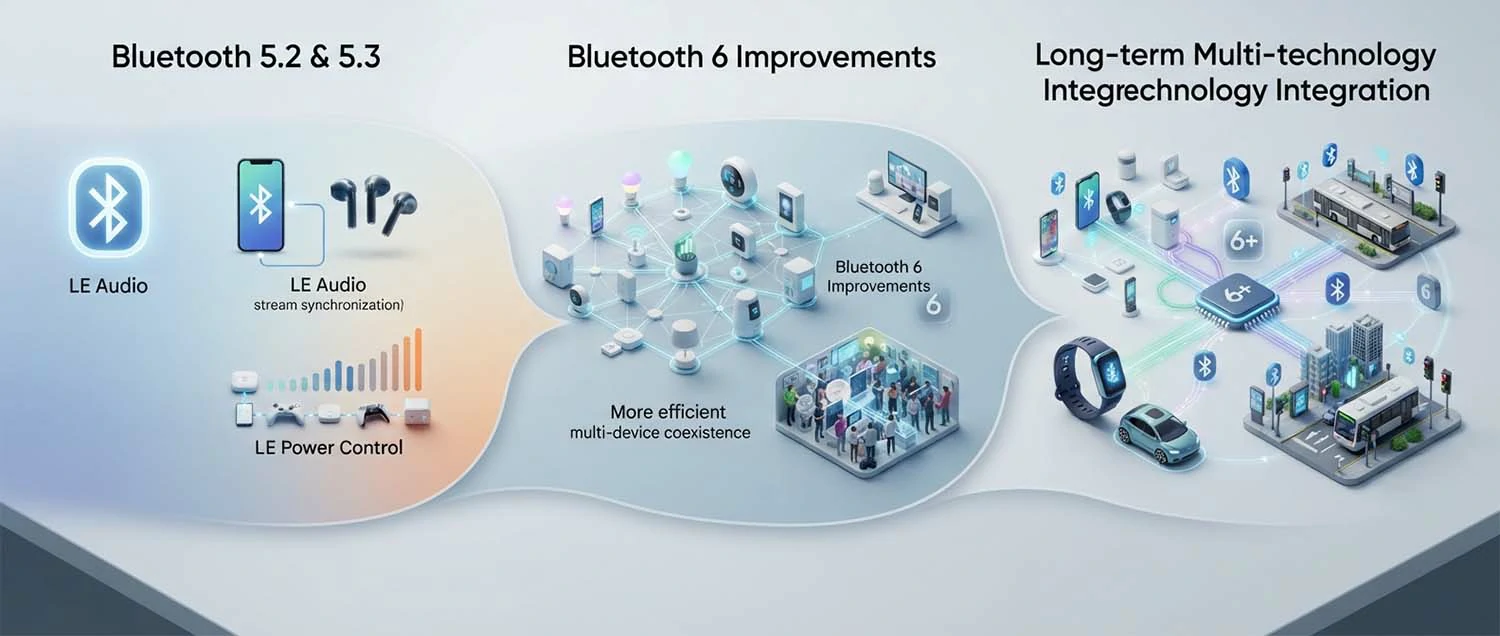
Bluetooth 5.2 and 5.3: Subsequent versions of Bluetooth 5 have added important features. Bluetooth 5.2 introduced LE Audio with LC3 codec, LE Power Control for adaptive transmission power, and the Enhanced Attribute Protocol for faster service discovery. Bluetooth 5.3 improved LE encryption key size control, connection subrating for faster role switches, and periodic advertising interval improvements.
Bluetooth 6: The next major version of Bluetooth is expected to bring further improvements. Higher data rates approaching 10 Mbps for specific use cases are anticipated. Improved direction finding for sub-centimeter accuracy could enable new applications. Enhanced mesh networking with better scalability and efficiency is under development. Lower power consumption through improved protocol efficiency will extend battery life further.
Long-Term Trends: Several long-term trends will shape Bluetooth evolution. Integration with other wireless technologies like UWB for precise positioning will become more common. AI-optimized Bluetooth management for better power and performance tradeoffs will emerge. Standardized application layers for specific industries will simplify development. Enhanced security for emerging threats will be incorporated.
Side-by-Side Technical Comparison
A direct side-by-side comparison of Bluetooth 4 and Bluetooth 5 specifications helps clarify the exact differences across every technical dimension.
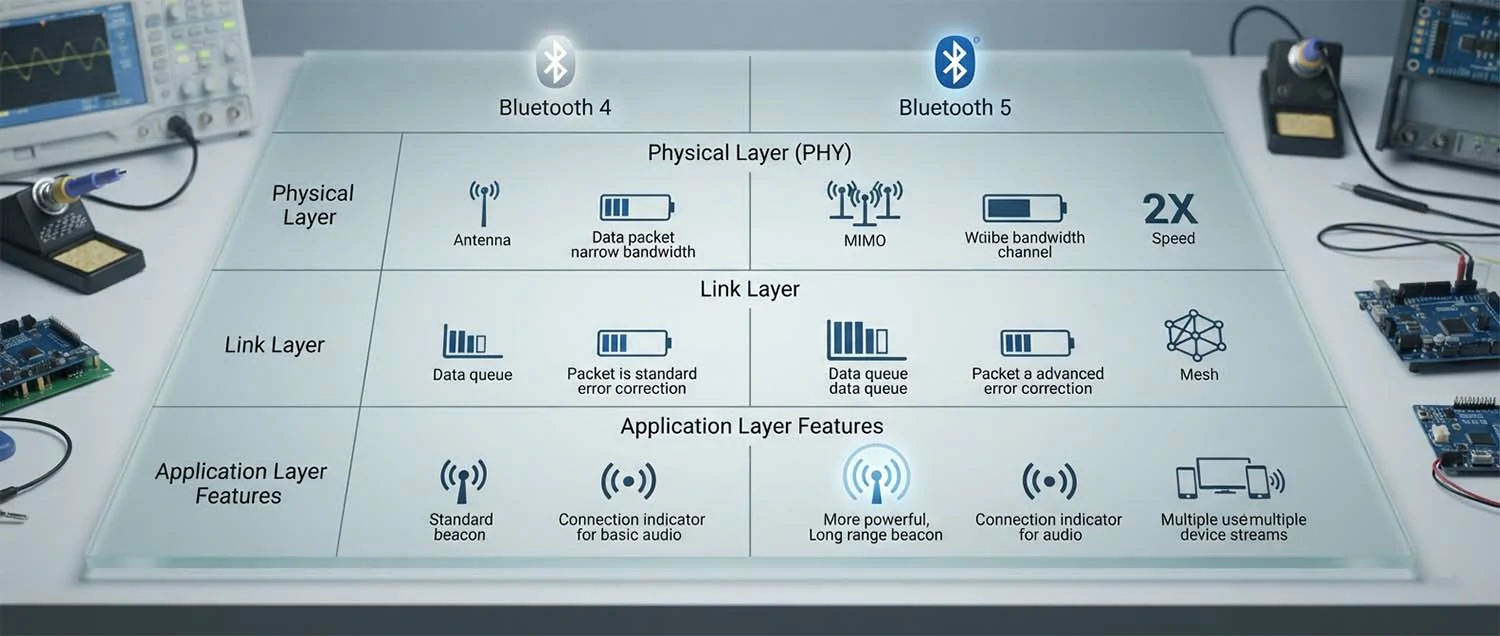
Physical Layer: Bluetooth 4 uses GFSK modulation at 1 Mbps for BLE. Bluetooth 5 adds two new PHY modes: the 2 Mbps PHY using GFSK with shorter symbol duration, and the coded PHY using FEC with S=2 (500 Kbps) or S=8 (125 Kbps) coding. The 2 Mbps PHY enables faster data transfers while the coded PHY enables extended range. Bluetooth 4 has only 40 RF channels for BLE versus Bluetooth 5 which maintains the same 40-channel structure but with improved channel utilization.
Link Layer: The link layer in Bluetooth 5 adds several improvements over Bluetooth 4. Extended advertising allows larger payloads in advertising packets. Periodic advertising enables scheduled broadcasts for more efficient scanning. Channel selection algorithm 2 improves resistance to interference by distributing transmissions across channels more evenly. Data length extensions allow up to 251 bytes per packet compared to 27 bytes in Bluetooth 4, significantly improving efficiency.
Application Layer: Bluetooth 5 provides richer capabilities at the application layer. GATT improvements enable faster service discovery. The L2CAP layer supports larger packet sizes for efficient data transfer. Bluetooth 5 profiles take advantage of new lower-layer features to provide better user experiences. LE Audio profiles enable audio streaming over BLE. Mesh profiles enable large-scale device networking.
Bluetooth 5 Development Considerations
Developers building Bluetooth 5 products need to consider several factors specific to the new standard. Proper planning ensures successful implementation.
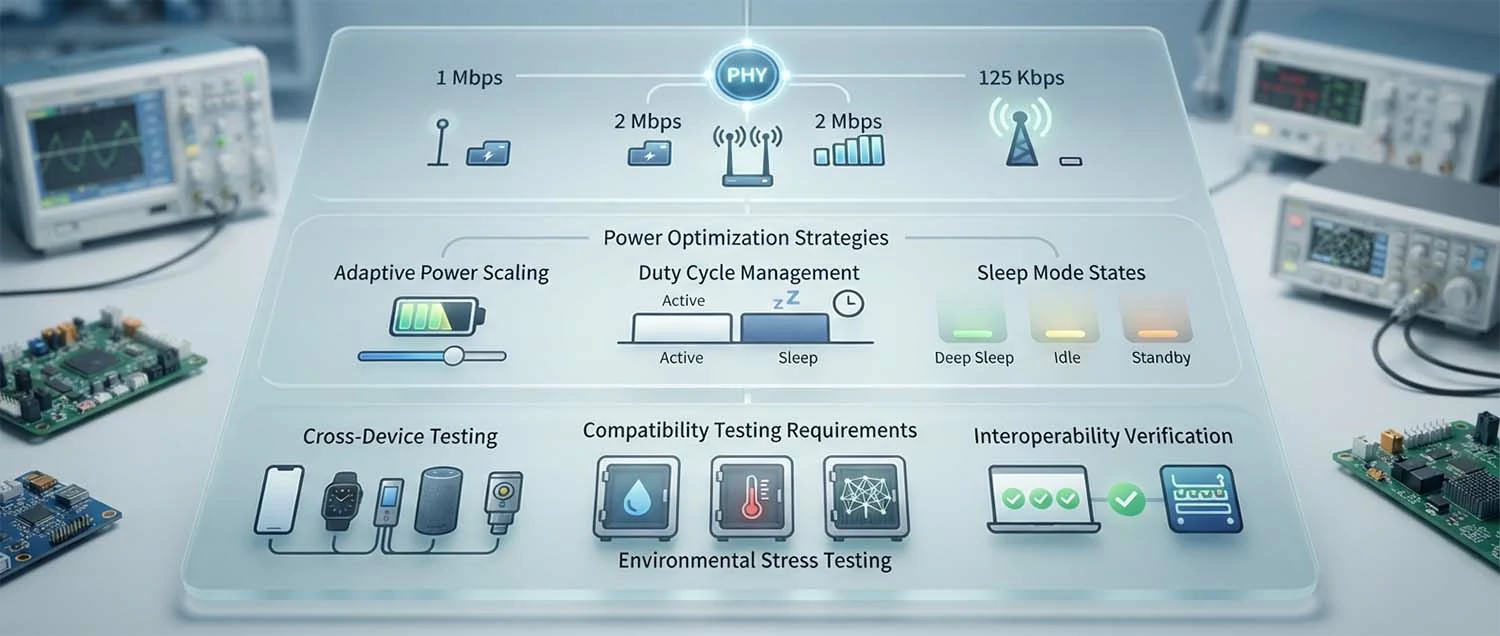
PHY Selection: Choosing the right PHY mode is one of the most important decisions in Bluetooth 5 development. The 1 Mbps PHY provides balanced performance and is mandatory for all Bluetooth 5 devices, ensuring backward compatibility. The 2 Mbps PHY is ideal for applications prioritizing speed where range requirements are modest. The 125 Kbps coded PHY maximizes range for applications where throughput is less critical. Developers should implement PHY switching to adapt to changing conditions.
Power Optimization: Bluetooth 5 offers several options for optimizing power consumption. The higher data rate reduces active radio time for the same data volume. Extended advertising allows devices to broadcast less frequently while maintaining discoverability. Periodic advertising synchronization enables receivers to wake only at scheduled transmission times. Connection parameters should be tuned based on application latency requirements.
Compatibility Testing: Thorough testing is essential for Bluetooth 5 products. Test with Bluetooth 4 devices to ensure backward compatibility. Test with multiple Bluetooth 5 devices from different manufacturers to verify interoperability. Test at various ranges to validate PHY switching behavior. Test in environments with RF interference to verify channel selection algorithm effectiveness.
How to Choose Between Bluetooth 4 and 5
Choosing between Bluetooth 4 and 5 depends on your specific requirements, use cases, and constraints. This decision framework helps guide the selection process.
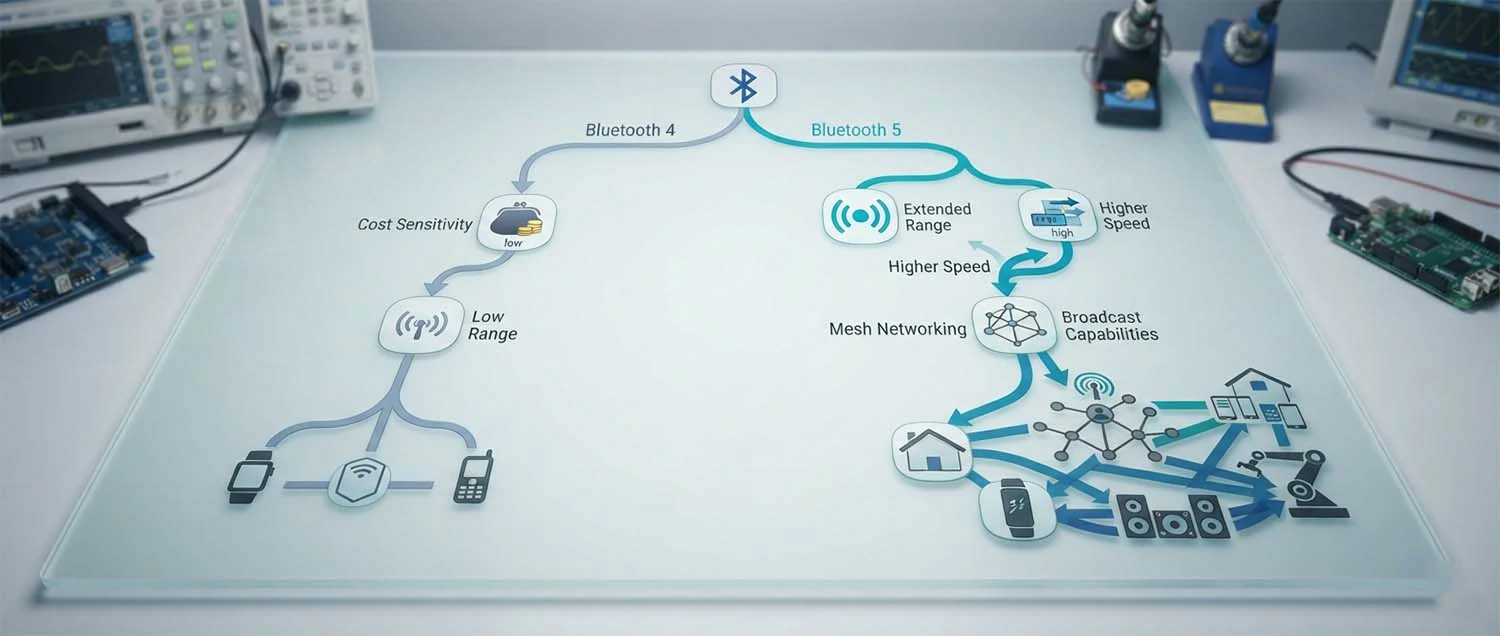
When to Choose Bluetooth 4: Bluetooth 4 remains a viable choice in specific scenarios. For ultra-low-cost devices where every cent matters, Bluetooth 4 chips can still be slightly cheaper. For applications with minimal data requirements where range is not a concern, Bluetooth 4 is sufficient. For products that must interoperate with a legacy ecosystem of Bluetooth 4 devices, staying with Bluetooth 4 simplifies testing. For coin-cell battery devices where the absolute lowest power consumption is required, Bluetooth 4 may still have a slight edge.
When to Choose Bluetooth 5: Bluetooth 5 is the better choice in most scenarios. For any new product design, Bluetooth 5 provides future-proofing and better performance. For applications requiring whole-home or extended outdoor range, Bluetooth 5 coded PHY is essential. For products that need faster data transfer, the 2 Mbps PHY delivers significant improvements. For rich beacon content and location services, the expanded advertising capacity is transformative. For building-scale deployments, Bluetooth Mesh is a game-changer.
Decision Framework: Consider these questions when choosing. What is the required range? If more than 10 meters, Bluetooth 5 is recommended. What data throughput is needed? If larger than 100 Kbps sustained, Bluetooth 5 helps. Does the application need broadcast data larger than 31 bytes? If yes, Bluetooth 5 is required. Is mesh networking needed? Only Bluetooth 5 supports it. What is the product cost target? The Bluetooth 5 cost premium is minimal for most products.
Frequently Asked Questions
Is Bluetooth 5 backward compatible with Bluetooth 4?
Yes, Bluetooth 5 is fully backward compatible with Bluetooth 4. A Bluetooth 5 device can connect to and communicate with Bluetooth 4 devices. However, the connection will operate at Bluetooth 4 capabilities and speeds. Both devices must support Bluetooth 5 to benefit from its improvements.
Do I need to upgrade from Bluetooth 4 to 5?
For most consumers, upgrading happens naturally when purchasing new devices. If your current Bluetooth 4 devices work satisfactorily, there is no urgent need to replace them. However, for new purchases, choosing Bluetooth 5 products provides better performance and future compatibility.
What is the real range of Bluetooth 5?
Bluetooth 5 range depends on the PHY mode used. In 2 Mbps mode, range is approximately 40 meters indoors and 100 meters outdoors. In 125 Kbps coded mode, range extends to approximately 200 meters outdoors. Actual range varies based on obstacles, interference, and device antenna quality.
Does Bluetooth 5 sound better than Bluetooth 4?
Bluetooth 5 with LE Audio and the LC3 codec can provide better audio quality at the same bitrate compared to Bluetooth 4 SBC. However, audio quality also depends on the audio codecs supported by both devices and the quality of the audio hardware. High-quality codecs like aptX and LDAC work on both versions.
Can I use Bluetooth 5 headphones with a Bluetooth 4 phone?
Yes, Bluetooth 5 headphones will work with a Bluetooth 4 phone. The connection will operate using Bluetooth 4 protocols, so you will not get the extended range or other Bluetooth 5 benefits. Basic audio playback and call functionality will work normally.
What devices support Bluetooth 5?
Most modern smartphones, tablets, laptops, and wireless audio devices support Bluetooth 5. Apple has included Bluetooth 5 since iPhone 8. Android devices have supported it since Android 8. Windows 10 and later support Bluetooth 5. Most wireless headphones and earbuds released after 2020 include Bluetooth 5.
Bluetooth 5 is the Clear Winner
The evolution from Bluetooth 4 to Bluetooth 5 represents a significant advancement in wireless technology. With four times the range, two times the speed, eight times the broadcast capacity, and the addition of mesh networking, Bluetooth 5 enables applications and experiences that were not possible with its predecessor.
For consumers, the choice is clear. New devices should support Bluetooth 5 for the best performance and longest useful life. Backward compatibility ensures existing accessories continue to work, and the benefits of Bluetooth 5 become available as accessories are upgraded.
For developers and businesses, Bluetooth 5 provides the features needed to build the next generation of wireless products. The combination of improved performance, enhanced privacy, mesh networking, and LE Audio creates a versatile platform for innovation across consumer, commercial, and industrial applications.