


Pay only for results, and let partners grow your reach. Learn how to run an affiliate program that motivates affiliates, protects your brand, and acquires customers profitably.
Quick Answer
What is affiliate marketing, and how do you run it?
Affiliate marketing is a performance-based channel where partners called affiliates promote your product and earn a commission for the customers or sales they drive. Affiliates use their own audiences and channels to send you customers—usually through unique tracking links—and you pay them a share of the results they generate. Because you pay only for actual results, affiliate marketing is a low-risk, scalable way to acquire customers: you extend your reach through many affiliates promoting you, tapping their audiences and trust, and your cost is tied directly to the value they produce, so it costs nothing unless affiliates actually drive customers.
You run it by setting commissions that are attractive enough to motivate affiliates yet sized to keep acquisition profitable, finding quality affiliates whose audiences overlap with your target customers, supporting them with what they need to promote you well, and managing the program with reliable tracking, payment, and oversight. Balance commission against customer lifetime value to stay profitable, focus on affiliates with engaged, relevant audiences over sheer numbers, treat affiliates as valued partners you help succeed, and set clear guidelines while monitoring for fraud or misleading tactics. Aligned incentives—affiliates motivated to drive real results, you acquiring customers profitably—are what make an affiliate program work.
This guide covers the whole subject: what affiliate marketing is and how it works, why to use it, setting commissions, finding affiliates, supporting them, what makes a program successful, managing risks, common mistakes, and a practical workflow. The aim is a clear, actionable approach to building an affiliate program that grows your reach through motivated partners, pays only for performance, protects your brand, and acquires customers profitably.

Follow the guide from how it works to results
Table of contents
- What is affiliate marketing, and how do you run it?
- Follow the guide from how it works to results
- Pay for performance, grow through partners
- Step 1: Understand how it works
- Step 2: See why it is worth doing
- Step 3: Set commissions that work
- Step 4: Find quality affiliates
- Step 5: Support your affiliates
- Step 6: Manage risks and protect your brand
- Step 7: Measure and optimize the program
- How affiliate marketing differs from referrals
- Partner with content creators who fit
- Use the right tools and networks
- Grow your program over time
- Common affiliate marketing mistakes to avoid
- A practical workflow for affiliate marketing
- Affiliate marketing checklist
- Practical answers about affiliate marketing
- Grow through performance, pay for results
- Verify with primary guidance
Pay for performance, grow through partners
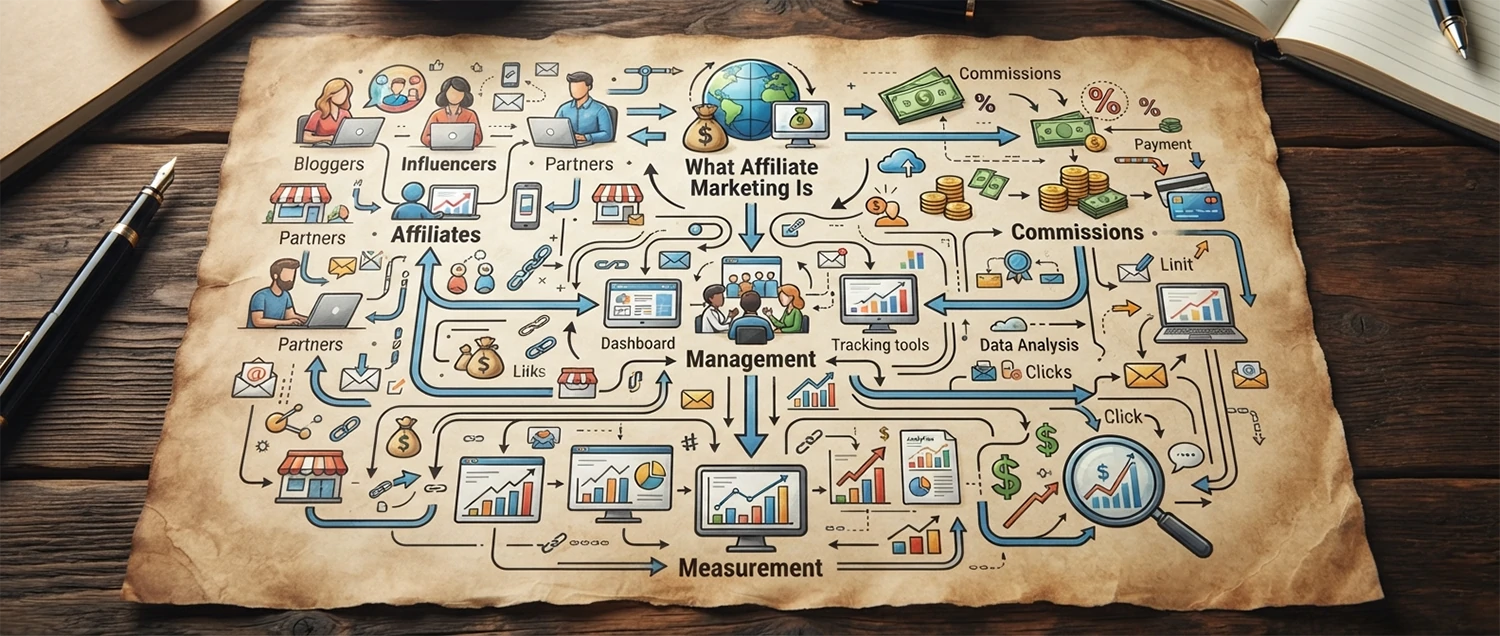
Affiliate marketing is a performance-based channel where partners called affiliates promote your product and earn a commission for the customers or sales they drive. Its defining feature is that you pay for performance: rather than paying upfront for reach or effort, you pay affiliates a share of the results they actually generate. Affiliates use their own audiences and channels to send you customers, and only when a referred customer converts does the affiliate earn a commission. This ties your cost directly to the value produced, which is what makes affiliate marketing distinctive.
Because it is performance-based, affiliate marketing is inherently low-risk and scalable. You are not spending money on the hope of results; you are paying only when results happen, so an affiliate who drives nothing costs you nothing. And you can extend your reach through many affiliates at once, each promoting you to their own audience, without a proportional upfront investment. This lets you tap into a wide network of promoters efficiently, with your cost scaling with your results rather than ahead of them—an appealing structure for acquiring customers.
Affiliate marketing also leverages affiliates' audiences and trust. Affiliates promote you to people who already follow and trust them, so their recommendation carries weight a cold message would not—you reach new audiences through partners who have earned their attention. This makes affiliate marketing both efficient and effective: efficient because you pay only for results, effective because those results come through trusted recommendations. Combining performance-based payment, scalability, and access to affiliates' trusting audiences, affiliate marketing is a powerful, low-risk way to grow. This guide is about running an affiliate program that realizes these benefits well.

Step 1: Understand how it works
Affiliate marketing works by giving affiliates a way to refer customers to you—usually unique tracking links—and paying them a commission for the customers or sales those links generate. An affiliate promotes your product to their audience through content, reviews, recommendations, or other means, including their unique link. When someone clicks that link and converts, the system attributes the conversion to that affiliate, who then earns a commission on the result. This tracking and attribution is the mechanism that makes performance-based payment possible.
The structure aligns everyone's incentives. Because affiliates earn only when they drive real results, they are motivated to promote you effectively and to send you genuine, converting customers, not just clicks. You, in turn, pay only when they succeed, so your interests and theirs point the same way—both want conversions. The practical requirements are a reliable way to track referrals, attribute conversions to the correct affiliate, and pay commissions accordingly, whether you build this yourself or use an affiliate platform or network. Once this mechanism is in place, affiliates promote, referrals are tracked, conversions are credited, and commissions are paid—a self-reinforcing loop where affiliates are rewarded for the results they produce. Understanding this performance-based, tracked, incentive-aligned structure is the foundation for running affiliate marketing well.

Step 2: See why it is worth doing
Affiliate marketing is worth doing because it is low-risk and scalable. You pay only for results, so the channel costs nothing unless affiliates actually drive customers—there is no large upfront spend at risk, only commissions on real outcomes. And you can extend your reach through many affiliates without a proportional upfront cost, scaling your promotional reach across a whole network of partners. This combination of paying only for performance and scaling reach efficiently makes affiliate marketing an unusually favorable structure for acquiring customers, with cost tied to value rather than gamble.
It also taps into affiliates' audiences and trust, reaching people through partners who already have their attention. Affiliates bring their own engaged audiences, and their recommendations carry the trust they have earned—so affiliate marketing reaches new, relevant people effectively, not just cheaply. This access to trusting audiences, granted through affiliates, is a genuine advantage over cold outreach, giving your product credible introductions to people predisposed to listen. It extends your reach through others' relationships rather than requiring you to build every relationship yourself.
And because affiliates are motivated by commission, they actively work to drive results. The performance-based structure means affiliates have a direct incentive to promote you well and send converting customers, aligning their effort with your success. You gain a network of motivated promoters whose interests match yours. Combining low risk, scalability, access to trusting audiences, and built-in motivation, affiliate marketing is an attractive, efficient acquisition channel. It complements the results-focused thinking of your paid advertising with a pay-for-performance model.

Step 3: Set commissions that work
Commissions must attract affiliates while keeping acquisition profitable. Consider these factors and structures.
| Factor | What to weigh | Why it matters |
|---|---|---|
| Attractiveness | Enough to motivate affiliates | Too low, and no one promotes |
| Profitability | Cost vs. customer value | Too high, and you lose money |
| Percentage | A share of each sale | Scales with order value |
| Fixed amount | A set fee per customer | Simple and predictable |
| Tiered | Higher rates for more results | Rewards top performers |
Compare your commission cost against customer lifetime value to ensure profitability. The goal is a commission that both attracts good affiliates and keeps your affiliate acquisition worthwhile.

Step 4: Find quality affiliates
You find affiliates by looking for people and businesses with audiences that overlap with your target customers—content creators, publishers, influencers, and others whose followers would be interested in your product. The best affiliates are those whose audiences genuinely fit what you offer, because their promotion reaches people likely to convert. Reach out to promising affiliates with a compelling offer, make it easy to join your program, and consider affiliate networks that connect you with affiliates looking for products to promote. The aim is to attract affiliates who can actually drive results for you.
Focus on quality over quantity. A few affiliates with engaged, relevant audiences will produce far better results than many with audiences that do not fit or do not trust them—affiliate numbers alone mean little if the affiliates cannot drive conversions. Seek affiliates whose audiences are both relevant to your product and genuinely engaged, and who are motivated to promote you well. Approach them the way you would any partner: with a clear, appealing reason to join and a focus on mutual benefit. Building a program of quality affiliates whose audiences fit your product is what makes affiliate marketing produce real results, rather than a long list of affiliates who send you little. Choose fit and engagement over raw numbers, and your program performs. This mirrors finding good partners.

Step 5: Support your affiliates
You support affiliates by giving them what they need to promote you effectively—clear information about your product, promotional materials, tracking links, timely commission payments, and good communication. The easier and more rewarding you make it for affiliates to promote you, the better they will do it, which benefits you both. Affiliates who have to figure everything out themselves, or who are paid late or left uninformed, promote you less and less well; affiliates who are well-equipped and well-treated become your most productive promoters. Enabling affiliates is directly investing in your results.
Treat affiliates as valued partners, not just a channel to extract results from. Help them succeed by providing the materials, information, and support they need; pay their commissions reliably and on time, which builds trust and keeps them promoting; respond to their needs and questions; and communicate well, so they feel like partners rather than afterthoughts. Good relationships with affiliates lead to more and better promotion, because affiliates naturally favor the programs that treat them well. Investing in enabling and communicating with your affiliates directly improves the results your program produces—well-supported affiliates promote you more, more effectively, and more loyally. Support your affiliates as the partners they are, and they will drive far more for you than neglected ones ever would.

Step 6: Manage risks and protect your brand
Affiliate marketing carries risks worth managing. Low-quality affiliates may use poor or misleading tactics that harm your brand; some may commit fraud or game the commission system; and affiliates may promote you in ways that misrepresent your product. Poorly set commissions can also make acquisition unprofitable. These risks are real, but they are manageable—left unaddressed they can damage your brand and drain your budget, but with proper oversight, affiliate marketing stays beneficial. Awareness of the risks is the first step to controlling them.
Manage these risks with clear standards and active oversight. Choose your affiliates carefully, favoring reputable ones with quality audiences over anyone willing to sign up. Set clear guidelines for how affiliates may promote you—what they can and cannot say, and how they should represent your product—so your brand is protected. Monitor for fraud, gaming, and inappropriate behavior, and address problems promptly. And ensure your commissions keep acquisition profitable, so the program does not lose money. Good management and clear standards keep affiliate marketing beneficial rather than harmful: you get the reach and results while protecting your brand and budget. Treat oversight as an essential part of the program, not an afterthought, and affiliate marketing remains a safe, productive channel. Vigilance protects the value the program creates.

Step 7: Measure and optimize the program
Because affiliate marketing is inherently trackable, measure how your program performs and use it to improve. Track the customers, sales, and revenue affiliates drive, the commissions you pay, and the resulting profitability, along with which affiliates produce the most. This shows you the overall return of your affiliate program and which affiliates are your best performers, so you can see whether the channel is working and where the results come from. Measurement turns affiliate marketing into an accountable channel you can evaluate and refine.
Use the data to focus and optimize. Identify your top affiliates and invest more in supporting and growing those relationships; find affiliates who are underperforming or promoting poorly and help them improve or part ways; and confirm your commissions keep the program profitable, adjusting if needed. Concentrating on your best affiliates and the tactics that work, while pruning what does not, steadily improves your program's return. Ensure you are attributing results correctly so you pay for genuine conversions, and watch for any fraud the data reveals. Measuring the program's performance, focusing on your best affiliates, and keeping it profitable is what turns affiliate marketing into a well-run, high-return channel rather than a set-and-forget arrangement. Let the results guide who you invest in and how you refine. Sound attribution keeps the crediting accurate.

How affiliate marketing differs from referrals
Affiliate marketing and referral programs are related—both reward people for bringing you customers—but they differ in an important way. Referral programs typically reward your existing customers for referring people they know, drawing on personal relationships and genuine satisfaction. Affiliate marketing rewards partners, often content creators or publishers, for promoting you to their audiences, drawing on their reach and platform rather than personal relationships. Referrals are usually customer-to-friend and relationship-driven; affiliate marketing is partner-to-audience and reach-driven. Both are performance-based, but they tap different sources of promotion.
Understanding the difference helps you use each well and together. Referrals bring the strong trust of a personal recommendation from someone the prospect knows, while affiliate marketing brings scale and reach through partners who can promote to many people at once. They complement each other: referrals harness your happy customers' personal networks, affiliates harness promoters' audiences, and running both extends your word-of-mouth-style growth across both personal and public channels. Recognizing that affiliate marketing is about partnering with promoters for their reach, distinct from customers referring friends, lets you design each program appropriately and use them together to grow through both trusted personal recommendations and broad affiliate promotion. Your referral guide covers the customer-driven side.

Partner with content creators who fit
Some of the most effective affiliates are content creators—bloggers, reviewers, video makers, and others who produce content their audiences trust. When a creator whose audience genuinely fits your product recommends it within their content, that recommendation carries real weight, because it comes woven into content their followers already value and rely on. This kind of affiliate promotion—embedded in trusted, relevant content—often converts far better than a bare ad, because it reaches interested people through a source they trust, in a context where a recommendation feels natural.
Seek out content creators whose content and audience align with what you offer. The best fit is a creator who covers topics related to your product for an audience that would genuinely benefit from it, so their recommendation is authentic and relevant rather than forced. Support these affiliates especially well, since quality content promotion takes real effort and produces strong results, and build genuine relationships with the creators who perform. A creator who authentically likes and recommends your product to a fitting audience is among the most valuable affiliates you can have. Focusing on content creators whose audiences truly fit, and enabling them to promote you authentically within their content, is a powerful way to make affiliate marketing produce credible, converting results. It ties into your content strategy from the other side.

Use the right tools and networks
Running an affiliate program well requires infrastructure—reliable tracking of referrals, accurate attribution of conversions, and dependable commission payments—and you generally do not need to build all of this yourself. Affiliate software and platforms handle the tracking, attribution, reporting, and payment that a program needs, letting you run it efficiently without engineering it from scratch. Affiliate networks go further, connecting you with a pool of affiliates looking for products to promote and handling much of the administration. Choosing the right tools or network lets you focus on the strategy and relationships rather than the mechanics.
Choose your infrastructure to fit your needs and stage. Software or a platform gives you control to run your own program, while a network offers access to ready affiliates and handled administration in exchange for less direct control and some fees. Consider what matters most to you—control, ease, access to affiliates, cost—and pick accordingly; many businesses use dedicated affiliate software, a network, or a combination. Whatever you choose, reliable tracking and payment are non-negotiable, because affiliates must trust that their results are counted and their commissions paid. Good tools and networks make the mechanics of affiliate marketing dependable and efficient, freeing you to focus on attracting good affiliates, supporting them, and growing the program. Get the infrastructure right, and the rest of the program can flourish.

Grow your program over time
An affiliate program is not a one-time setup but something that grows and improves over time. As you learn which affiliates and approaches work, you can recruit more affiliates like your best ones, deepen relationships with top performers, refine your commissions and support, and steadily build a larger, more productive program. The program compounds: successful affiliates and a good reputation attract more good affiliates, and the relationships and processes you build make each addition easier. Treating your program as something to cultivate and expand, rather than launch and leave, is what turns it into a significant channel.
Invest in growth deliberately. Keep recruiting quality affiliates, especially ones resembling your proven performers; nurture your best affiliates so they promote you more and stay loyal; use what you learn to improve your commissions, materials, and support; and manage the growing program well so quality does not slip as numbers rise. A program that starts small can grow into a substantial source of customers as you add affiliates, improve the offering, and build a reputation as a good program to partner with. The most valuable affiliate programs are grown patiently over time, expanding their network of motivated promoters while maintaining the quality, support, and profitability that make them work. Cultivate your program continually, and it becomes an increasingly powerful engine of performance-based growth. It can become a core part of your go-to-market.

Common affiliate marketing mistakes to avoid
Unprofitable commissions
Losing money
A commission above customer value loses money.
Chasing numbers
Quality over quantity
Many poor-fit affiliates drive little of value.
Neglecting affiliates
Poor support
Unsupported affiliates promote you less.
No guidelines
Brand risk
Without rules, affiliates can misrepresent you.
Ignoring fraud
Gamed system
Unwatched programs invite gaming and fraud.
Set and forget
No management
Programs need active management to perform.
Most affiliate mistakes come from unprofitable commissions, chasing numbers, or neglect. Keep commissions profitable, favor quality, support affiliates, set guidelines, watch for fraud, and manage.

A practical workflow for affiliate marketing
Phase 1
Set up and recruit
Set profitable commissions and tracking, then recruit quality affiliates whose audiences fit.
Phase 2
Support and protect
Give affiliates what they need to succeed, and set guidelines that protect your brand.
Phase 3
Measure and optimize
Track results, focus on your best affiliates, and keep the program profitable.
Start by setting profitable commissions and recruiting quality affiliates. Everything else—supporting, protecting, measuring—follows from a sound structure and the right affiliates.

Affiliate marketing checklist
✅ You have reliable tracking and attribution
✅ Your commissions attract affiliates
✅ Your commissions keep acquisition profitable
✅ You compare commission to customer value
✅ You recruit affiliates with relevant audiences
✅ You favor quality over quantity
✅ You make joining easy
✅ You give affiliates materials and links
✅ You pay commissions reliably and on time
✅ You communicate well with affiliates
✅ You set clear promotion guidelines
✅ You monitor for fraud and misuse
✅ You track the program's results
✅ You focus on your best affiliates
✅ You manage the program actively
Work through this as you build your affiliate program. It comes down to profitable commissions, quality affiliates, good support, brand protection, and active management.

Frequently Asked Questions
Practical answers about affiliate marketing
Grow through performance, pay for results
Affiliate marketing lets you grow through a network of partners who promote you to their audiences, paid only for the results they drive—a low-risk, scalable, performance-based channel. Set commissions that are attractive enough to motivate affiliates yet sized to keep acquisition profitable, comparing them against customer lifetime value. Recruit quality affiliates whose engaged audiences fit your product, favoring the right affiliates over sheer numbers. And support your affiliates as valued partners, giving them the materials, links, timely payments, and communication they need to promote you well.
Above all, manage the program actively—set clear guidelines that protect your brand, monitor for fraud and misuse, measure the results, and focus on your best-performing affiliates while keeping the program profitable. Do this, and affiliate marketing becomes an efficient, low-risk engine for growth: motivated partners extending your reach, trusted recommendations reaching new audiences, and your cost tied directly to the value produced. Align everyone's incentives, treat affiliates well, protect your brand, and pay for performance—and a well-run affiliate program can steadily and safely grow your business through the efforts of many motivated promoters.
Verify with primary guidance
Analytics, content, and accessibility practices have authoritative references. Confirm current guidance as you run and measure your program.