ERP Integration Services for Seamless Business Operations
Transform your business operations with expert ERP integration. We connect your systems, automate workflows, and unify your data for unprecedented efficiency and growth.

What is ERP Integration?
Enterprise Resource Planning integration connects your business applications, enabling seamless data flow and automated processes across your entire organization.
The Foundation of Modern Business
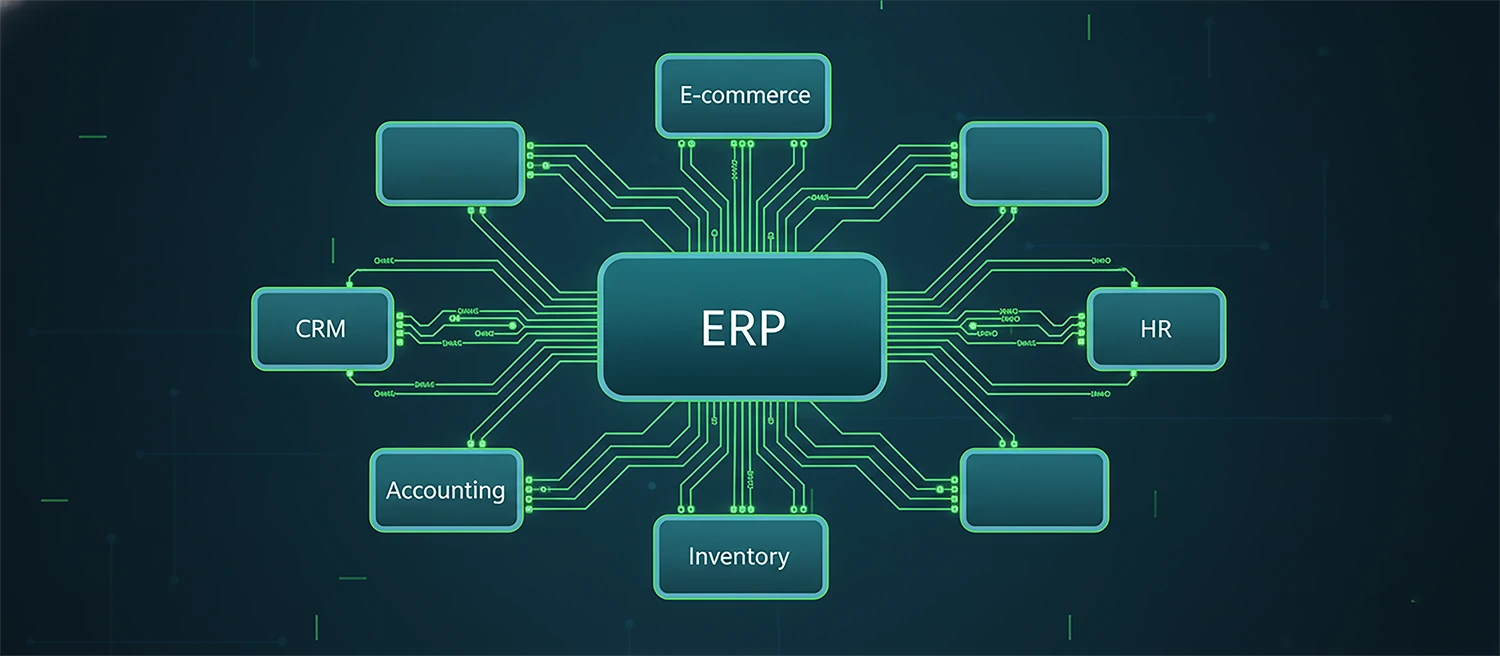
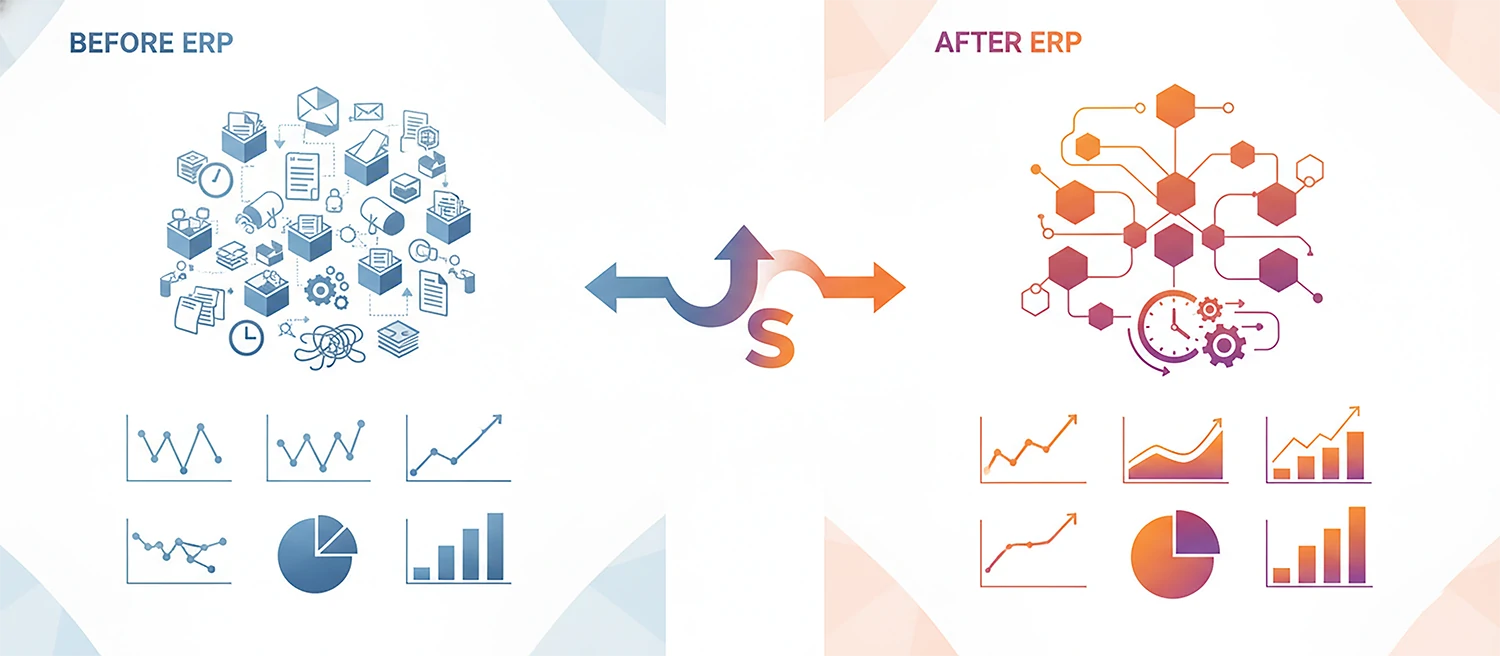
ERP integration is the process of connecting your Enterprise Resource Planning system with other business applications, databases, and third-party services. This creates a unified ecosystem where data flows seamlessly between all your business functions, eliminating silos and reducing manual data entry.
In today's fast-paced business environment, organizations use multiple software solutions for different functions - CRM for sales, accounting software for finances, HR systems for personnel management, e-commerce platforms for online sales, and more. Without integration, these systems operate in isolation, leading to data inconsistencies, duplicated efforts, and missed opportunities.
ERP integration bridges these gaps, creating a single source of truth for your business data. When a customer places an order on your e-commerce site, that information automatically flows to your inventory system, accounting software, shipping department, and CRM - all in real-time, without any manual intervention.
Unified Business Operations
Connect all your business systems into one cohesive platform
Why ERP Integration is Critical for Your Business
In an era where data drives decisions, integrated systems are no longer optional - they're essential for competitive advantage.
Real-Time Data Access
Eliminate data silos and get instant access to accurate, up-to-date information across all departments. Make decisions based on real-time data, not outdated reports.
Automated Workflows
Reduce manual tasks and human errors by automating repetitive processes. Your team can focus on high-value activities that drive business growth.
Cost Reduction
Cut operational costs by eliminating duplicate data entry, reducing errors, and streamlining processes. Save thousands of hours annually through automation.
Improved Scalability
Build a flexible infrastructure that grows with your business. Add new systems and capabilities without disrupting existing operations.
Enhanced Customer Experience
Deliver consistent, personalized experiences across all touchpoints. Better data visibility means better service and stronger customer relationships.
Better Compliance & Security
Maintain better control over sensitive data with centralized access controls and audit trails. Ensure compliance with industry regulations.
Comprehensive ERP Integration Services
End-to-end integration solutions tailored to your unique business requirements and technology stack.
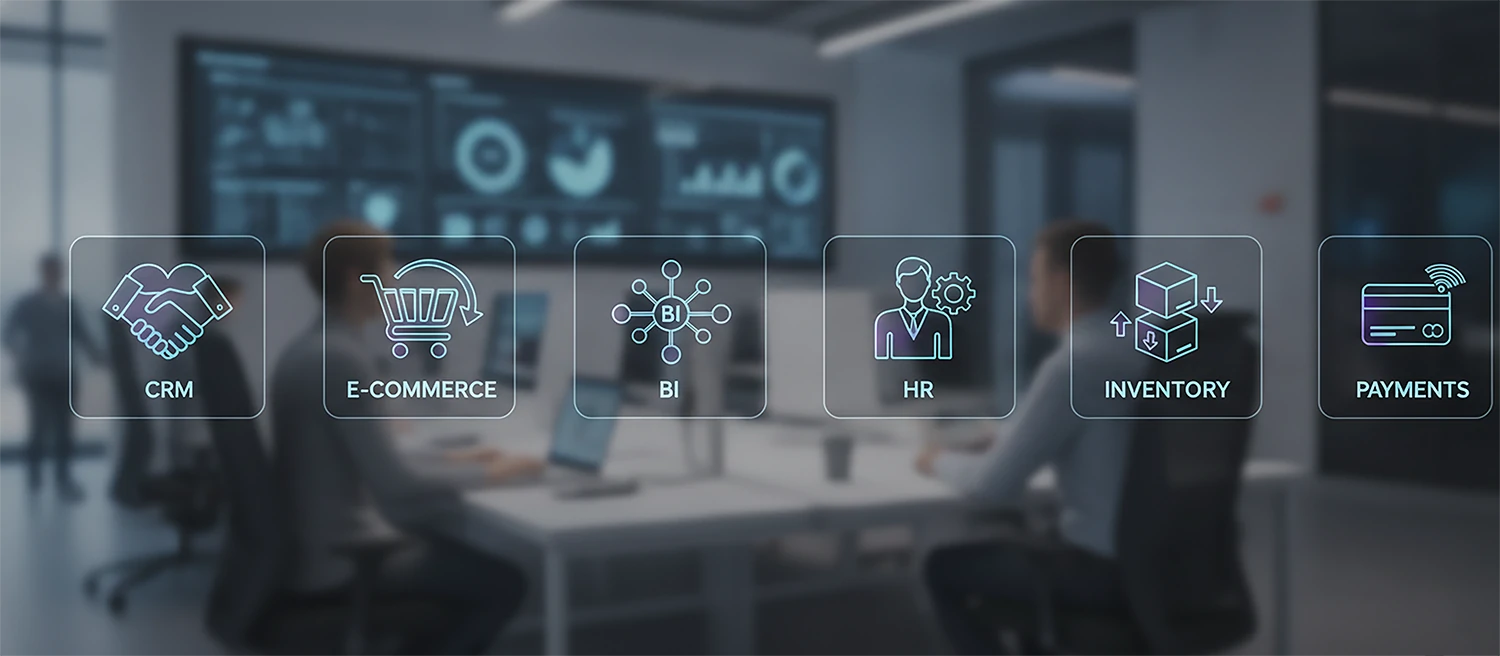
ERP to CRM Integration
Seamlessly connect your ERP system with CRM platforms like Salesforce, HubSpot, Zoho, or Microsoft Dynamics. Sync customer data, orders, invoices, and communication history in real-time for a complete 360-degree view of every customer interaction.
- ✓ Bidirectional data synchronization
- ✓ Custom field mapping
- ✓ Real-time order sync
- ✓ Lead scoring integration
E-commerce Integration
Integrate your ERP with popular e-commerce platforms including Shopify, WooCommerce, Magento, BigCommerce, and custom solutions. Automate order processing, inventory management, and customer data synchronization.
- ✓ Automatic order imports
- ✓ Real-time inventory sync
- ✓ Shipping label generation
- ✓ Refund processing automation
Business Intelligence Integration
Connect your ERP with BI tools like Tableau, Power BI, Looker, or custom dashboards. Create unified data warehouses and generate actionable insights from consolidated business data.
- ✓ Custom dashboard development
- ✓ Automated reporting
- ✓ Data warehouse setup
- ✓ Predictive analytics
HR & Payroll Integration
Integrate your ERP with HR management systems like Workday, BambooHR, Gusto, ADP, or custom solutions. Synchronize employee data, time tracking, benefits, and payroll processing.
- ✓ Employee data sync
- ✓ Time tracking integration
- ✓ Payroll automation
- ✓ Benefits management
Inventory & Warehouse Management
Connect your ERP with inventory management systems, warehouse management solutions, and supply chain tools. Achieve real-time visibility into stock levels, movements, and fulfillment operations.
- ✓ Real-time stock updates
- ✓ Multi-location sync
- ✓ Auto reorder triggers
- ✓ Barcode scanning integration
Payment Gateway Integration
Seamlessly integrate payment processors like Stripe, PayPal, Square, Authorize.net, or custom payment solutions. Automate payment processing, reconciliation, and financial reporting.
- ✓ Multi-payment support
- ✓ Automatic reconciliation
- ✓ Refund processing
- ✓ PCI compliance
ERP Integration Methods We Use
We employ multiple integration strategies to ensure the best fit for your technical environment and business requirements.
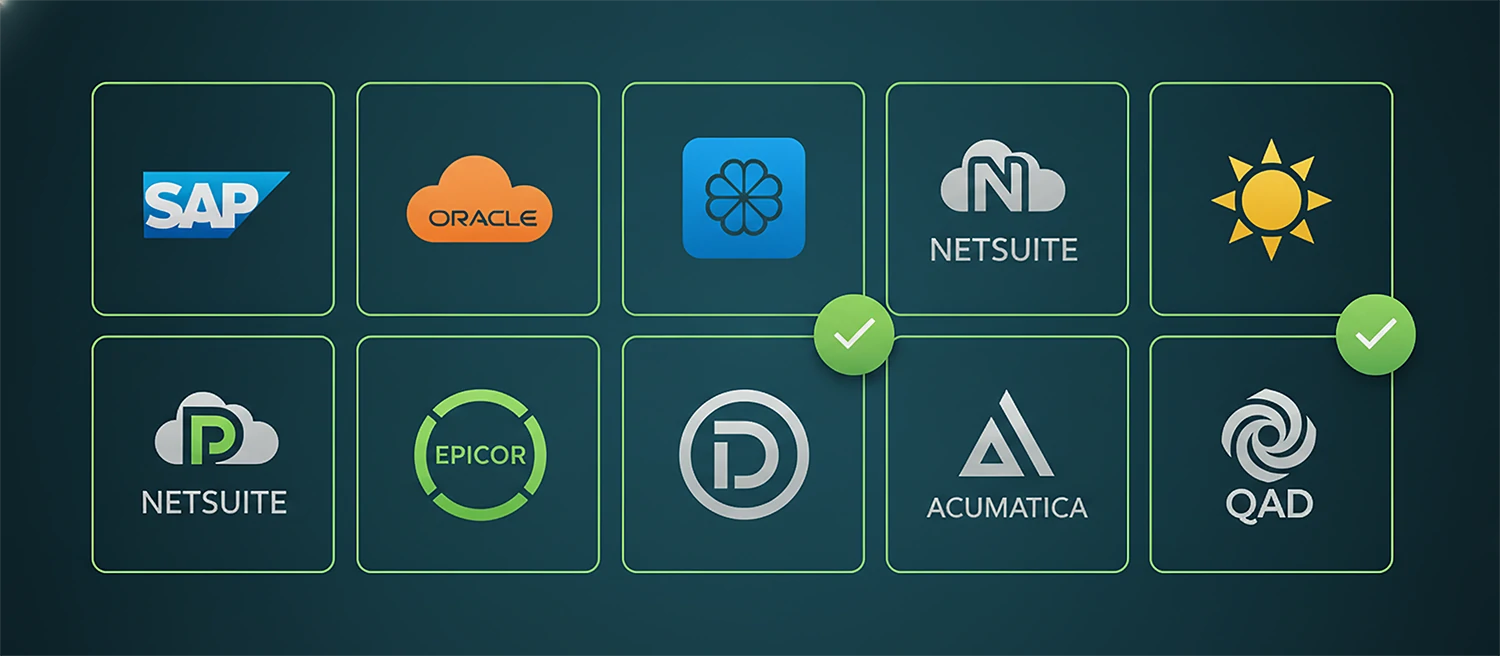
ERP Platforms We Integrate With
We have extensive experience working with all major ERP systems and can connect them with your preferred technology stack.
SAP
SAP S/4HANA, SAP Business One, SAP ECC integrations
Oracle
Oracle ERP Cloud, Oracle NetSuite integrations
Microsoft
Dynamics 365, Business Central integrations
Infor
Infor LN, CloudSuite integrations
Odoo
Odoo Community & Enterprise integrations
Sage
Sage 100, Sage 300, Sage Intacct
QuickBooks
QuickBooks Online & Desktop integrations
Custom ERP
Custom & legacy ERP system integrations
Our ERP Integration Process
A systematic approach ensuring successful integration delivery every time.
Discovery
We analyze your current systems, requirements, and business processes to develop a comprehensive integration strategy.
Design
Our team creates detailed technical specifications, architecture diagrams, and implementation roadmaps.
Develop
We build custom connectors, APIs, and integration components tailored to your specific requirements.
Test
Rigorous testing ensures data accuracy, performance, security, and error handling across all integration points.
Deploy
We deploy the integration with zero downtime and provide comprehensive documentation and training.
Benefits of Professional ERP Integration
Unlock the full potential of your business systems with our expert integration services.
Save 20+ Hours Weekly
Eliminate manual data entry and reduce repetitive tasks. Your team can focus on strategic initiatives instead of data reconciliation.
99.9% Data Accuracy
Automated data sync eliminates human errors and ensures all systems reflect the same accurate information in real-time.
30% Faster Operations
Streamlined workflows and automated processes significantly reduce cycle times across all business operations.
Enterprise-Grade Security
Industry-standard security protocols, encryption, and compliance measures protect your sensitive business data.
Business Impact
Our Integration Success Stories
Real-world examples of how we've transformed businesses through ERP integration.
Advanced Integration Solutions
Beyond basic integration, we offer sophisticated solutions for complex business requirements.
Data Migration & Transformation
When implementing new systems or consolidating multiple ERPs, data migration becomes critical. Our team handles complex data migration projects with careful planning, validation, and transformation to ensure data integrity while moving from legacy systems to modern platforms.
We use advanced ETL (Extract, Transform, Load) tools and custom scripts to map data between different formats, clean up duplicate and inconsistent data, and validate migrated information against source systems. Our migration approaches include parallel running, phased migration, and big-bang deployment strategies depending on your business requirements.
- → Legacy system data extraction and cleansing
- → Data mapping and transformation rules
- → Validation and reconciliation testing
- → Zero-downtime migration strategies
Real-Time Analytics & Reporting
Unlock the power of your business data with real-time analytics and reporting capabilities. We build comprehensive data pipelines that aggregate information from all your integrated systems into centralized data warehouses or data lakes.
Our analytics solutions include custom dashboards, automated report generation, KPI tracking, and predictive analytics capabilities. We implement tools like Power BI, Tableau, Looker, or custom solutions that provide actionable insights to decision-makers across your organization.
- → Custom dashboard development
- → Automated report scheduling
- → KPI and metric tracking
- → Predictive analytics models
Integration Best Practices & Considerations
Key factors to consider for successful ERP integration projects.
Security Considerations
Enterprise integration requires robust security measures. We implement encryption for data in transit and at rest, OAuth 2.0 and API key authentication, role-based access controls, comprehensive audit logging, and compliance with GDPR, HIPAA, SOC 2, and other regulations.
Our security-first approach ensures your sensitive business data remains protected throughout the integration ecosystem.
Scalability Planning
As your business grows, your integration infrastructure must scale accordingly. We design systems with horizontal and vertical scalability in mind, implement load balancing, design for high availability with redundancy, and plan for future expansion.
Our architectural decisions consider your projected growth and ensure the integration can handle increasing data volumes and transaction rates.
Maintenance & Support
Integration systems require ongoing maintenance to ensure continued reliability. We provide comprehensive support packages including 24/7 monitoring, proactive issue detection, regular security updates, performance optimization, and dedicated support teams.
Our maintenance plans ensure your integrations remain stable, secure, and performant over the long term.
Industries We Serve
Our ERP integration expertise spans multiple industries with specialized solutions for each sector.
Manufacturing
Retail
Healthcare
Finance
Logistics
Education

Flexible Integration Packages
Transparent pricing tailored to your project scope and business requirements.
Starter
✓ Single system integration
✓ API development
✓ Basic testing
✓ 30-day support
Enterprise
✓ Full ecosystem integration
✓ Complex architecture
✓ Comprehensive testing
✓ 24/7 dedicated support
Frequently Asked Questions
How long does an ERP integration project take?
Project duration varies based on complexity. Simple single-system integrations typically take 4-8 weeks, while complex multi-system enterprise integrations can take 3-6 months. We provide detailed timelines during the discovery phase after understanding your specific requirements.
What ERP systems do you work with?
We have extensive experience with all major ERP platforms including SAP (S/4HANA, Business One), Oracle (ERP Cloud, NetSuite), Microsoft Dynamics 365, Infor, Sage, Odoo, QuickBooks, and custom/legacy ERP systems. Our team can integrate virtually any system that offers API access or data export capabilities.
Will integration disrupt our current operations?
We implement integrations with minimal disruption through careful planning, phased deployments, and thorough testing. Most implementations are done while your systems remain operational, with zero or near-zero downtime. We also provide rollback plans in case any issues arise during the transition.
How do you ensure data security during integration?
We follow industry-leading security practices including end-to-end encryption, OAuth 2.0 authentication, role-based access controls, comprehensive audit logging, and compliance with relevant regulations (GDPR, HIPAA, SOC 2). Our development team follows secure coding practices and we conduct regular security assessments.
Do you provide ongoing support and maintenance?
Yes, we offer comprehensive support and maintenance packages tailored to your needs. This includes 24/7 monitoring, proactive issue detection, security updates, performance optimization, and dedicated support teams. We provide flexible support plans that scale with your business requirements.
Can you integrate cloud-based and on-premise systems?
Absolutely. We have extensive experience integrating cloud-to-cloud, cloud-to-on-premise, and on-premise-to-on-premise systems. Our team uses secure VPN connections, API gateways, and hybrid integration approaches to ensure seamless data flow regardless of where your systems are hosted.
How do you handle API rate limits and throttling?
We implement intelligent throttling and retry mechanisms that respect API limits while maximizing throughput. Our integration framework includes exponential backoff strategies, request queuing, load distribution across time windows, and caching for frequently accessed data. We also work with you to negotiate higher rate limits where possible from your ERP vendors.
What happens if an integration fails or data is lost?
Our integration architecture includes robust error handling, automatic retry logic, and data recovery mechanisms. Failed transactions are queued for retry, and critical data is backed up before processing. We implement dead letter queues to capture failed messages for manual review. Our monitoring systems alert your team immediately when issues occur, allowing quick remediation before they impact business operations.
Can you integrate our custom-built systems?
Absolutely. We have extensive experience integrating custom-built applications and legacy systems. We'll work with your development team to understand your system's architecture, expose necessary APIs or data access methods, and create custom integration components. We can also help modernize legacy applications during the integration process.
How do you handle different data formats between systems?
We implement robust data transformation layers that convert data between different formats - CSV to XML, JSON to database records, EDI to API formats, and more. Our transformation engine includes data mapping, validation, enrichment, and cleansing capabilities. We maintain detailed data dictionaries that document how data maps between systems.
What's the difference between point-to-point and hub-and-spoke integration?
Point-to-point integration connects two systems directly, which works well for simple scenarios but becomes complex as you add more systems. Hub-and-spoke (or middleware-based) integration uses a central platform that connects to all systems, making it easier to add new integrations, monitor all connections from one place, and maintain consistent security policies. We typically recommend hub-and-spoke for organizations with more than 3-4 systems to integrate.
Still have questions? Contact us!
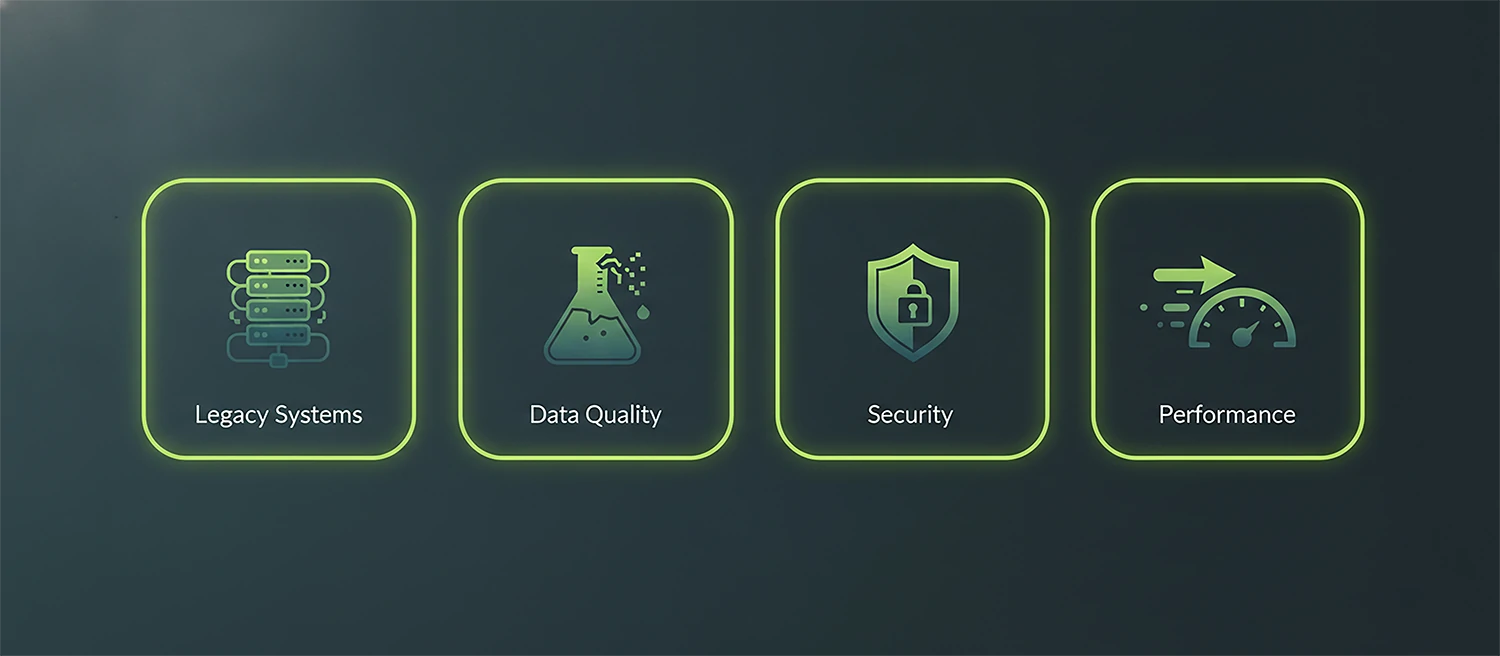
Common ERP Integration Challenges We Solve
Every integration project comes with unique challenges. Our expertise helps you overcome them efficiently.
Legacy System Compatibility
Many businesses struggle with older systems that lack modern API capabilities. We develop custom adapters and wrapper layers that enable seamless communication between legacy systems and modern platforms without requiring expensive system replacements.
- → Custom API development for legacy systems
- → Protocol translation middleware
- → Data format transformation
- → Gradual modernization strategies
Data Quality & Consistency
Poor data quality can derail even the best-designed integrations. We implement robust data validation, cleansing, and synchronization processes that ensure data consistency across all connected systems.
- → Data validation rules and checkpoints
- → Duplicate detection and merging
- → Real-time data reconciliation
- → Automated data cleansing workflows
Security & Compliance
Integrating multiple systems increases security complexity. We implement enterprise-grade security measures that protect sensitive data while maintaining compliance with industry regulations.
- → End-to-end encryption
- → Multi-factor authentication
- → Role-based access controls
- → Audit trail and compliance reporting
Performance & Scalability
As your business grows, your integration must handle increasing loads. We design scalable architectures that maintain performance under heavy loads while preparing for future growth.
- → Load balancing and caching
- → Horizontal scaling capabilities
- → Performance monitoring
- → Capacity planning
Real-World Integration Use Cases
Practical examples of how businesses leverage ERP integration to transform their operations.
Use Case 1: Automated Order-to-Fulfillment Pipeline
A wholesale distribution company needed to automate their order processing workflow. Previously, orders from multiple e-commerce sites, EDI feeds, and phone orders required manual entry into their SAP ERP system, causing delays and errors.
We implemented a unified integration platform that automatically pulls orders from all sources, validates inventory availability in real-time, creates sales orders in SAP, triggers warehouse picking processes, generates shipping labels, updates customer tracking information, and syncs inventory levels across all channels.
Results:
90% reduction in order processing time, 99.8% accuracy in fulfillment, 40% decrease in shipping errors, and 3x faster customer response times.
Use Case 2: Financial Consolidation for Multi-Entity Organizations
A healthcare organization with 15 different entities (hospitals, clinics, diagnostic centers) struggled with monthly financial close processes that took 15 days due to manual data collection and reconciliation.
We built a real-time financial integration layer connecting each entity's separate ERP instances to a centralized consolidation platform. The system automatically collects transactions, applies consolidation rules, handles inter-company eliminations, generates consolidated financial statements, and provides real-time visibility into each entity's performance.
Results:
Monthly close reduced from 15 days to 3 days, 100% audit accuracy, real-time financial visibility, and annual cost savings of $1.2M in manual processes.
Use Case 3: Customer 360 with Unified Service Experience
A manufacturing equipment company had customer data scattered across their ERP (for orders and billing), CRM (for sales interactions), Field Service system (for equipment maintenance), and Support ticketing system.
We created a unified customer data platform that continuously synchronizes information across all systems. Service representatives can now see complete customer history - equipment purchased, warranty status, service history, open tickets, and recent orders - in a single screen.
Results:
35% improvement in first-call resolution, 50% reduction in customer escalation, 28% increase in upsell success rate, and Net Promoter Score improved by 22 points.
Building Your Integration Roadmap
A strategic approach ensures successful integration outcomes aligned with your business goals.
Phase 1: Assessment & Planning (Weeks 1-2)
Every successful integration begins with a thorough understanding of your current state and desired future state. During this phase, we conduct comprehensive discovery sessions with stakeholders from all departments that will be impacted by the integration. We document all existing systems, data flows, pain points, and integration requirements. This information forms the foundation for our integration strategy.
Our assessment includes technical infrastructure review, data inventory and classification, security and compliance requirements, performance and scalability expectations, budget and timeline constraints, and change management considerations. By the end of this phase, you'll have a detailed project charter and implementation roadmap.
Phase 2: Architecture & Design (Weeks 3-4)
With a clear understanding of requirements, our solution architects design the integration architecture that will serve as the blueprint for implementation. This includes system topology diagrams, data flow mappings, API specifications, security architecture, error handling strategies, and performance optimization approaches.
We present multiple architecture options with trade-offs, enabling informed decision-making based on your priorities. The design phase produces comprehensive technical documentation including integration requirements document, solution architecture document, API design specifications, data mapping documents, and testing strategy.
Phase 3: Development & Integration (Weeks 5-12)
Our development team builds the integration components according to the approved architecture. We follow agile development practices with bi-weekly sprints, ensuring regular feedback incorporation and continuous improvement throughout the development process.
Development includes custom API development and testing, middleware configuration and deployment, data transformation logic implementation, webhook and event-driven components, security implementation, and error handling and retry mechanisms. Each component undergoes rigorous unit testing and code review before moving to integration testing.
Phase 4: Testing & Quality Assurance (Weeks 13-14)
Quality assurance is critical for integration success. We conduct multiple rounds of testing to ensure all components work correctly individually and as a unified system. Our testing approach includes unit testing, integration testing, end-to-end scenario testing, performance and load testing, security penetration testing, and user acceptance testing.
We document all test results and address any issues before production deployment. Our QA team simulates real-world scenarios and edge cases to ensure the integration can handle various conditions gracefully.
Phase 5: Deployment & Go-Live (Week 15)
Our deployment strategy ensures minimal disruption to your operations. We use a phased approach that starts with lower-risk integrations and gradually moves to more critical systems. We prepare comprehensive rollback plans in case any issues arise during deployment.
Post-deployment, we actively monitor all integration points for the first 30 days to ensure stability. Our team remains on standby to address any issues quickly. We also provide detailed documentation, training sessions, and knowledge transfer to ensure your team can manage the integration independently.
Ready to Transform Your Business Operations?
Let's discuss how ERP integration can streamline your operations, reduce costs, and accelerate growth.
No commitment required. Free consultation available.
Related guides and services
Use these paths to continue with the closest practical topic, service, or decision guide.
All ERP Integration services
- ADA WCAG Compliance
- API and Third-Party Integration
- Backup and Restore
- Bug Fixing and Optimization
- Business Website Development
- Chatbot and Live Chat Integration
- CMS and Plugin Updates
- CMS Migration
- CMS Website Development
- Code Cleanup
- CRM and ERP Integration
- CRM Integration
- Custom CMS Development
- Database Integration
- Django Development
- dotNET Development
- Drupal Website Development
- Ghost CMS Development
- Joomla Website Development
- Laravel Development
- Node.js Development
- Payment Gateway Integration
- PHP Development
- RESTful API Development
- Ruby on Rails Development
- Social Media Integration
- Squarespace Website Design
- Webflow Website Development
- Website Accessibility Audit
- Website Content Updates
- Website Design
- Wix Website Development
- WordPress Web Design
Why clients trust Pro Pixel
Try the work on your own files before you commit, and know what you'll pay before anything starts.
-
Free trial first
Send a sample and see the result on your own material before you pay for anything.
-
Quote within 24 hours
A personalized estimate for your project within a day, with the price agreed up front.
-
Satisfaction guarantee
Every plan includes revision rounds, and our work is backed by a satisfaction guarantee.
-
Confidential by default
Your files stay on secure systems, and we sign confidentiality agreements on request.
What Our Clients Say
Real feedback from businesses we have worked with.
“The ROI came faster than expected. Within 6 months, we recouped our investment through efficiency gains. Outstanding support and maintenance.”
“Our new website doubled our leads in the first month! Pro Pixel Agency understood our business and delivered exactly what we needed. Highly recommend!”
“Professional, responsive, and talented. They transformed our outdated site into a modern, fast website that our customers love. The best investment we've made.”