


Projects rarely fail because the work was bad. They fail because two parties held different pictures of what was being made, and nobody discovered the gap until the deadline made it expensive.
The short answer
Write down what is included, what is not, and how many rounds of revision the price covers-then say it out loud at kickoff, because a document nobody read is not an agreement. Name one decision-maker on the client side. Send a short status update on a fixed day even when there is nothing to report, since silence is read as trouble. Price changes when they are requested rather than at the end. And treat the moment you first feel uneasy as the moment to raise it, because every problem in client work is cheaper to discuss early than to explain late.
What this guide covers
Table of contents
- What this guide covers
- 1. Projects fail on expectations, not on craft
- 2. Writing scope that survives contact with the project
- 3. The kickoff conversation
- 4. Establishing who actually decides
- 5. Status updates, especially when there is nothing to say
- 6. Change requests without the confrontation
- 7. Approvals, revisions, and stopping the loop
- 8. When the client is the thing holding it up
- 9. Difficult conversations
- 10. Closing a project properly
- 11. What to run internally
- 12. Common mistakes
- Where to start
- Frequently asked questions about client projects
- How do I stop scope creep without seeming difficult?
- How many revision rounds should a project include?
- What do I do when the client causes the delay?
- Should I send updates when there is no progress to report?
- How do I handle contradictory feedback from several stakeholders?
- What if a senior stakeholder rejects work that was already approved?
- When should I tell a client about a delay?
- Should I track time on fixed-price projects?
- How do I end a project cleanly?
- How we can help
- Conclusion
- Where to look further
1. Projects fail on expectations, not on craft
Ask anyone who has run client work for a few years about their worst projects, and the stories are rarely about incompetence. They are about a client who expected something different, a scope that grew without anyone acknowledging it, a decision that kept being reversed, or three weeks of silence that turned a small problem into a lost relationship.
The underlying mechanism is that both parties hold a picture of the finished thing, and those pictures are never identical. The client's picture is built from what they need, what they have seen elsewhere, and things they have not said because they seem too obvious to mention. Yours is built from the brief and your professional judgement. The gap between them is invisible until something concrete exists to compare against.
Nearly every practice in this guide is a mechanism for finding that gap earlier, while it is still cheap. Written scope surfaces it before work starts. A kickoff conversation surfaces what the document missed. Regular status updates and early drafts surface it while there is still time to change direction. Approval gates surface it before the next stage is built on a misunderstanding.

This reframing matters because it changes what you spend effort on. A team that believes projects fail on execution invests in working faster. A team that understands they fail on expectations invests in communication, and finds that the same amount of work produces far fewer disasters.
It also explains why the same project can be a success with one client and a nightmare with another, using identical deliverables. The work was the same; the alignment was not.
2. Writing scope that survives contact with the project
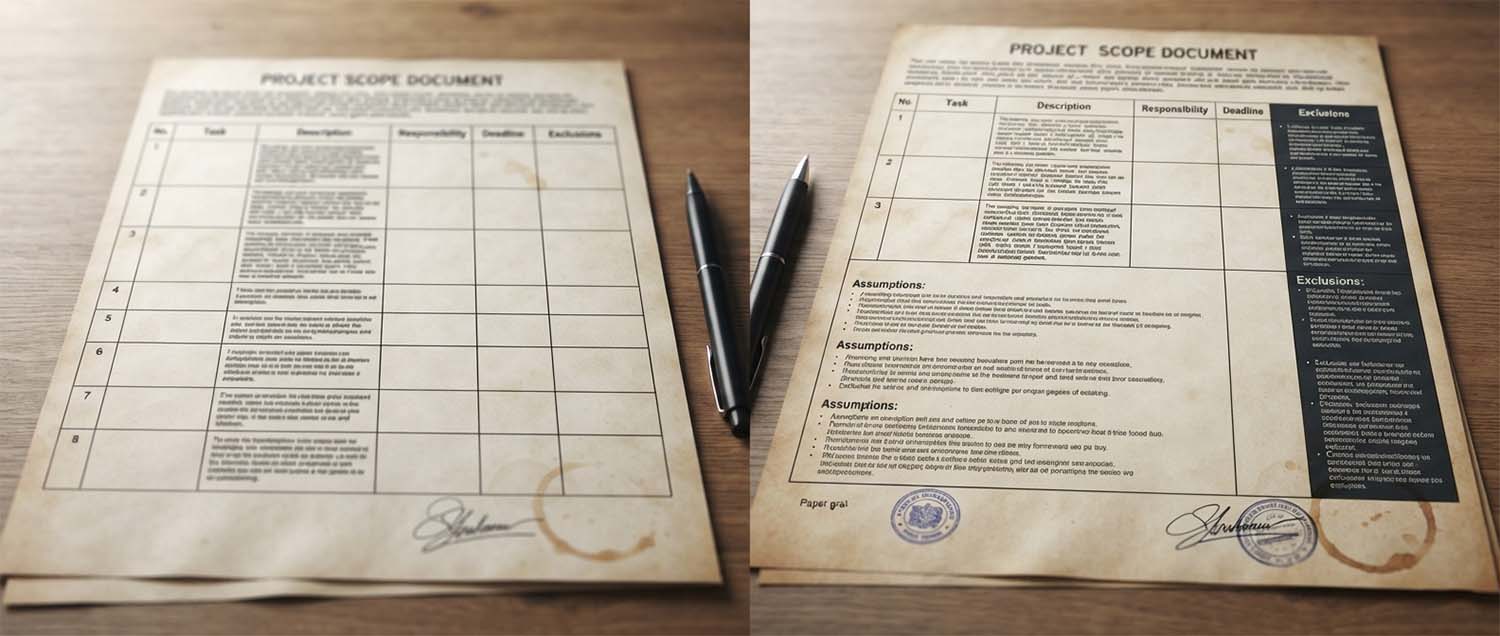
Most scope documents describe what will be delivered. The useful ones also describe what will not, and that second half prevents more disputes than the first.
Exclusions feel awkward to write. Listing what you are not doing seems negative, and there is a worry it draws attention to gaps. In practice it does the opposite: it is where the client discovers they assumed something you never intended to provide, and the discovery happens now rather than in week six. A line saying “copywriting is not included; we will lay out text you supply” either confirms the arrangement or starts a conversation that had to happen anyway.
Be concrete about quantities. “A website” is not a scope; “eight unique page templates, with up to twenty content pages built from those templates” is. “Product photography” is not a scope; “forty products, three angles each, on white” is. Numbers convert a vague expectation into something both parties can check against.
What a workable scope states
• Deliverables with quantities and formats-what exactly lands, and in what file types.
• What is explicitly excluded, especially the things clients commonly assume.
• How many rounds of revision the price includes, and what happens after that.
• What you need from the client, by when, for the timeline to hold.
• Who approves, and how long they have to respond.
• What happens to the timeline and cost if any of the above slips.
Revision rounds deserve particular care because they are the most common source of unbilled work. Define what a round is: one consolidated set of feedback from the client, delivered together, not a stream of individual comments over two weeks. Without that definition, three rounds becomes thirty small changes, and nobody can point at the moment it went wrong.
Write it in language a non-specialist can check. A scope full of terms only you understand cannot function as a shared reference, which is its entire purpose. If the client cannot read it and confirm it matches their expectation, it protects nobody.
3. The kickoff conversation
A signed scope document is not shared understanding. Clients sign things they have skimmed, and they are not being careless—they are trusting you to have written something reasonable. The kickoff exists to convert a document into an actual agreement.
Walk through the scope out loud, including the exclusions. This feels redundant and is not: saying “so to be clear, we are not writing the copy—you will send that to us by the fifteenth” produces a reaction. Sometimes the reaction is “wait, we thought you were doing that,” and you have just saved the project.
Then ask what success looks like to them. The answer is frequently different from the brief. A client commissioning a website redesign might actually need the sales team to stop being embarrassed when they send the link. Knowing that changes a hundred small decisions and gives you a real criterion when judging your own work.
Ask about the last project like this that went badly. People will tell you, and it is the single most useful question in the meeting. Their answer names the thing they are quietly worried about, and addressing it directly buys an enormous amount of goodwill.

Establish the working arrangements while everyone is in the room: which channel is for what, how often you will update them, who attends reviews, and how long they have to respond at each stage. These sound like details and they determine how the next three months feel.
Send a short written summary afterwards. Not minutes-five bullet points covering what was agreed, what each side owes, and the dates. This becomes the reference everyone actually uses, and it costs ten minutes.
4. Establishing who actually decides
The most damaging project structure is one where nobody is authorised to say yes. Feedback arrives from four people with different priorities, none of them can settle a disagreement, and every decision is provisional until someone more senior sees it-usually late, and usually reversing things.
Ask directly at kickoff: who signs this off? Not who is involved, not who will have opinions—who has the authority to approve and to overrule other opinions. If the answer is a person not in the room, that is important information, and you should be asking how their input gets in early rather than at the end.
The classic failure is the absent executive. Work proceeds for six weeks with a project manager, everything is approved, and then a director sees it for the first time and dislikes the direction. Nobody did anything wrong procedurally, and a month of work is now in question. The preventable version involves getting that person to see and react to something in week one, even something rough.
Ask for consolidated feedback
Multiple stakeholders is normal; multiple channels of contradictory feedback is not. Ask the client to gather internal views and send one set, with conflicts already resolved on their side.
When they cannot, you get to see the disagreement—and the right response is to name it: “these two comments point in opposite directions, which would you like us to follow?” Resolving it yourself means guessing, and being wrong on someone else's behalf.
Watch for the pattern where feedback arrives from someone new midway through. It usually means a stakeholder was not consulted at the start, and their arrival often resets decisions everyone thought were settled. It is legitimate to say that incorporating a new perspective at this stage is a change to the project, with an effect on time and cost.
Keep a light record of what was decided and when. Not to win arguments-to answer the honest question “why did we do it this way?” three months later, when nobody remembers and the reasoning was good.

5. Status updates, especially when there is nothing to say
Silence is the most expensive thing in client work, and it is free to avoid. A client who has not heard from you in ten days does not conclude that work is progressing smoothly. They conclude that something is wrong, or that they have been deprioritised—and by the time they ask, mild anxiety has become a difficult conversation.
Send a short update on a fixed day. Same day each week, whether or not there is news. Three or four sentences: what happened, what is next, anything you need from them, and whether the timeline still holds. It takes five minutes and it removes an entire category of relationship problem.
The counterintuitive part is that the update matters most in the weeks when nothing visible happened. “This week was backend work with nothing to show; next Tuesday you will see the first screens” converts invisible progress into visible progress. Skipping the update because there is nothing to show is exactly backwards—those are the weeks the client is most likely to worry.
Include the things you need from them, every time, with dates. Clients do not track their own dependencies, and a standing reminder is more effective and less awkward than an escalating series of chasing emails later.

Report bad news immediately rather than at the scheduled update. A delay discovered on Monday and reported on Friday looks like concealment, even when it was only inconvenient timing. Clients forgive problems far more readily than they forgive finding out late.
Keep the substantive record in writing even when you work by phone. Verbal decisions evaporate, and a one-paragraph follow-up email after a call is the cheapest insurance available in this entire guide.
6. Change requests without the confrontation
Scope creep is rarely one big request. It is a series of small ones, each individually reasonable, each easier to absorb than to discuss—and by week eight the project is a third larger than what was priced, with no single moment anyone can point to.
The mechanism is that saying yes is socially easy and saying “that is outside scope” feels confrontational. So the additions accumulate silently until they become a resentment on your side that the client has no idea exists.
The fix is to make pricing a change routine rather than exceptional. Not a negotiation, not a complaint—a normal administrative response. “Happy to add that. It is about six hours, so it would be an extra four hundred and push delivery to the eighteenth. Shall I proceed?” Neutral, immediate, and it converts an ambiguous request into a decision the client makes with full information.
Price it when it is asked, not at the end
A change accepted in week two and invoiced in week ten feels to the client like a surprise charge, however justified. The same amount quoted the day it was requested is a decision they made. Identical money, completely different reception.
Absorb small things deliberately rather than by default. Some requests genuinely take ten minutes, and pricing them is more expensive than doing them. Do those without ceremony, and say so lightly-“that one is quick, no charge”-because it makes clear that a boundary exists and you are choosing to be generous within it, which is different from having no boundary at all.
Watch for the change that is really a reversal. A client who asks to go back to an approach abandoned three weeks ago is not requesting an addition; they are asking you to redo work. That needs naming explicitly, because it is the version most likely to be assumed free.
When a project has accumulated many changes, stop and reset rather than continuing to accrete. A short conversation-“we have added five things since we started, here is where that leaves the timeline and budget”-is uncomfortable once and prevents a much worse conversation at delivery.

7. Approvals, revisions, and stopping the loop
Revision cycles that never end are usually a structural problem rather than an indecisive client. Either the approval gates are not real, or feedback is arriving on the wrong things at the wrong time.
Make gates meaningful by staging the work. Get direction approved before detail. Get structure approved before visual design. Get design approved before build. Each gate is a point where the client confirms the foundation, and reopening it afterwards is explicitly a change rather than a revision.
This is also why presenting work at the wrong fidelity causes trouble. A polished mockup invites comments about button colours when you needed a decision about structure. Showing rough work early feels risky and is the reliable way to get structural feedback while structural change is still cheap—a point our design critique guide covers in more depth.
Frame each review by saying what you need decided. “We are looking for a decision on the layout approach today-typography and colour come later” directs attention and makes the approval specific enough to hold.

When revisions exceed what was agreed, say so at the time. “This is our third round, which is what the project included. I am happy to make these changes-additional rounds after this would be billed at our hourly rate.” Stated calmly and in advance, this is almost never contentious. Discovered on an invoice, it is.
If revisions keep circling without converging, stop revising and have a conversation instead. Endless small changes usually mean something fundamental is unresolved—the client dislikes the direction and is trying to fix it incrementally. Twenty minutes on the phone resolves what another three rounds will not.
8. When the client is the thing holding it up
A large share of late projects are late because the client did not send content, did not respond to a review, or could not get an internal approval. This is awkward to raise, and failing to raise it means the delay quietly becomes yours.
The pattern is predictable. Copy was due on the tenth and arrives on the twenty-eighth. You compress the remaining work to protect the launch date, deliver something rushed, and the client experiences a project that felt hurried at the end. Nobody records that the eighteen-day gap originated on their side.
Prevent it by making dependencies explicit from the start and visible every week. The status update lists what you are waiting for, from whom, and since when. This is not blame; it is a factual record that makes the situation obvious without anyone needing to say anything pointed.
State the consequence, once, in advance
“If we have the content by Friday, we stay on the fourteenth. After that, delivery moves out by roughly the same number of days, because the team is booked on other work from the following week.” This is not a threat—it is how scheduling actually works, and clients respond well to knowing it before the deadline rather than after.
Make it easy to unblock. A client who has not sent copy is often stuck rather than unwilling—they do not know what to write, or they are waiting on someone else. Offering a template, a list of exactly what is needed, or a thirty-minute call to draft it together frequently resolves in one conversation what three chasing emails did not.
Keep working on what you can while blocked, but do not silently absorb the whole delay. If a two-week client delay is invisible in your reporting, you have taught them that dates are soft—and the next project will run the same way.
For chronic cases, restructure rather than repeat. Shorter stages with smaller deliverables, or a schedule that assumes their real response time rather than the agreed one, produces a project that works with the client you have.

9. Difficult conversations
Every project has a moment where something needs saying that nobody wants to say. You are going to miss a date. The direction they approved is not working. They are unhappy and you are not sure why. The instinct is to wait and hope it resolves, and it essentially never does.
Raise it early, in the plainest terms available. “We are not going to make the fourteenth. Here is why, here is the new date, and here is what we are doing to limit the impact.” Delivered a week before the deadline, this is a manageable problem. Delivered on the day, it is a broken commitment.
Lead with the situation, not the excuse. Clients need to know what is happening and what you propose; the internal reason is secondary and, offered first, reads as defensiveness. One sentence of explanation is enough.
When a client is unhappy, find out about what before responding. The stated complaint is often not the real one-“I do not like the homepage” may mean they are being pressured internally, or that they never got the direction they wanted three weeks ago and have been accumulating discomfort since. Ask what they were expecting and what changed for them.

Switch to a call when a thread starts going wrong. Written exchanges about disagreements escalate reliably-tone is unreadable, and both sides reread messages and find implications that were not there. A phone call resolves in ten minutes what email will make worse over two days.
Own mistakes plainly when they are yours. “We got that wrong, we are fixing it at our cost, it will be done by Thursday” ends the conversation. Partial acknowledgement wrapped in justification extends it, and clients can tell the difference immediately.
Some relationships should end. A client who is abusive to your team, who will not pay, or who has made a project impossible through repeated reversals is costing more than the revenue. Ending it professionally-completing a defined stage, handing over cleanly, invoicing what is owed-is better than a slow deterioration that damages both parties.
10. Closing a project properly
Projects often do not end; they trail off. The main deliverable ships, a few small requests continue, the final invoice sits unsent because it feels premature, and three months later you are still answering occasional questions for free with no clear sense of whether the project concluded.
Define completion in the scope, then declare it. A short message-here is everything delivered, here is what was agreed, this completes the project-marks the boundary. Without that moment, there is no boundary, and the relationship drifts into unpaid open-ended support.
Hand over properly. Source files, credentials, documentation, and anything the client needs to work with what you built. This is the stage most often rushed, and doing it well is disproportionately memorable-clients tell other people about suppliers who left them able to continue independently.
Say what happens next
The client will need something in three months. Tell them now what that costs and how to ask: an hourly rate for ad hoc work, a support arrangement, or simply how to get in touch. Ambiguity here produces the awkward exchange where they assume small changes are still free and you assume the project ended.
Ask what could have gone better, and mean it. Most clients will not volunteer criticism unprompted, and the answers are specific and actionable in a way that general satisfaction scores are not. Ask a fortnight after delivery rather than on the final day, when everyone is being polite.
This is also the right moment to ask for a testimonial, a case study, or a referral-immediately after a successful delivery, while the result is fresh. Asking six months later gets a weaker response, and most suppliers never ask at all.
Then keep in contact lightly. A note when something relevant happens, or a check-in a few months on, keeps you present without pestering. Repeat work is far cheaper to win than new work, and it mostly goes to whoever the client thought of first.

11. What to run internally
Everything so far concerns the client-facing side. A few internal practices determine whether that side is sustainable, and they are what separate a business that runs projects from one that is run by them.
Track time, even on fixed-price work. Especially on fixed-price work. Without it you cannot tell which projects were profitable, which clients consume three times the estimate, or whether your pricing reflects reality. Most people discover their most demanding client is also their least profitable, and they had no idea. Our pricing guide covers turning that data into rates.
Know your capacity before promising dates. A timeline that assumes full availability breaks the moment anything else happens. Committing to roughly seventy percent of theoretical capacity leaves room for the revision round that runs long and the client who reappears after three weeks of silence-both of which are certainties rather than risks.
Hold a short internal review after each project. What did we underestimate, what surprised us, what would we scope differently? Fifteen minutes, written down. This is how estimates improve, and skipping it means repeating the same misjudgement indefinitely.

Standardise the repeatable parts. Scope templates, kickoff agendas, status formats, handover checklists. Most client work repeats structurally even when the deliverables differ, and reinventing the paperwork each time is where the discipline slips-usually on the busiest projects, which are the ones that most need it.
Notice which clients you dread. That feeling is data. It usually correlates with unprofitability, and it costs the team more than the revenue justifies. Some of those relationships can be repaired with better structure; others should end at the next natural boundary.
12. Common mistakes
Scope with no exclusions. Listing deliverables without listing what is not included leaves every assumption unresolved until it becomes a dispute.
Assuming a signature means agreement. Clients sign documents they skimmed. Walk through the scope aloud, or you have a signature rather than an understanding.
No named decision-maker. Feedback from four people with no one authorised to settle disagreements produces decisions that keep reversing.
Going quiet. Silence is read as trouble. The weeks with nothing visible to show are exactly when the update matters most.
Absorbing changes to avoid awkwardness. Each small yes is easier than a conversation, and eight of them is a third of a project delivered free with an unspoken resentment attached.
Invoicing changes at the end. The same amount quoted when requested is a decision the client made; presented at delivery it is a surprise charge.
Polishing work before the direction is agreed. High fidelity invites detail feedback when you needed a structural decision, and it makes changing direction expensive.
Absorbing client delays silently. A two-week wait that never appears in reporting teaches the client that dates are negotiable, and the compressed delivery looks like your failure.
Delaying bad news. A problem known Monday and reported Friday reads as concealment. Clients forgive problems more readily than late disclosure.
Never formally closing. Without a declared end, projects drift into unpaid open-ended support and the final invoice never quite feels due.

Where to start
Pick the two changes with the best ratio of effort to effect: add an exclusions section to your scope template, and start sending a weekly status update on a fixed day. Both take under an hour to set up and between them they prevent most of what goes wrong in client work.
Then add the kickoff walkthrough. Reading the scope aloud, including what is excluded, and asking what success looks like takes twenty minutes and surfaces the mismatches that would otherwise appear in week six.
Once those are habits, work on the change request response. Have a sentence ready-“happy to add that, it would be roughly X and move delivery to Y, shall I proceed?”-so that pricing a change is a reflex rather than a decision you have to make while feeling awkward. This is the single practice that most protects margin.
Finally, start tracking time and holding a fifteen-minute review after each project. Neither improves the current job; both compound. After a handful of projects you will know which work you are systematically underpricing, which is information almost no small studio actually has.
The instinct worth trusting
The moment you first feel uneasy-about a request, a silence, a date, a direction-is the cheapest moment to raise it. That discomfort is nearly always accurate, and every week you wait makes the same conversation harder and the available options fewer.
Frequently asked questions about client projects
How do I stop scope creep without seeming difficult?
Make pricing a change routine rather than exceptional. “Happy to add that—it is about six hours, so an extra four hundred, and delivery moves to the eighteenth. Shall I proceed?” Neutral and immediate, it turns an ambiguous request into an informed decision. Quote it when asked, never at the end.
How many revision rounds should a project include?
Two or three is common, but the number matters less than the definition. Specify that a round is one consolidated set of feedback delivered together-otherwise three rounds becomes thirty scattered comments over two weeks and nobody can identify when it went wrong.
What do I do when the client causes the delay?
Make dependencies visible weekly-what you are waiting for, from whom, since when—so the record is factual rather than accusatory. State the consequence once in advance: if content arrives after Friday, delivery moves by roughly the same number of days. Also make it easy to unblock, since a stuck client is more common than an unwilling one.
Should I send updates when there is no progress to report?
Especially then. Silence is read as trouble, not as smooth progress. “This week was backend work with nothing visible; you will see screens next Tuesday” converts invisible progress into visible progress and removes an entire category of client anxiety.
How do I handle contradictory feedback from several stakeholders?
Ask for consolidated feedback with conflicts resolved on their side. When that fails, name the contradiction rather than resolving it yourself: “these two comments point in opposite directions—which would you like us to follow?” Choosing for them means guessing, and being wrong on someone else's behalf.
What if a senior stakeholder rejects work that was already approved?
Treat it as a change, because it is one. The prevention is structural: find out at kickoff who has final authority, and if that person is not in the room, get something in front of them in week one-even something rough. Six weeks of approved work overturned by a first viewing is the classic version of this failure.
When should I tell a client about a delay?
As soon as you know, not at the next scheduled update. A slip discovered Monday and reported Friday looks like concealment even when the timing was innocent. Lead with the situation and the new date; one sentence of explanation is enough.
Should I track time on fixed-price projects?
Yes—that is where it matters most. Without it you cannot tell which projects were profitable or which clients consume three times the estimate. Most people who start tracking discover their most demanding client is also their least profitable, and they had no idea.
How do I end a project cleanly?
Declare it. Send a message listing everything delivered against what was agreed, stating that this completes the project. Hand over source files and credentials, and say explicitly what future work costs and how to request it. Without that boundary, projects drift into unpaid open-ended support.
How we can help
We work as a supplier to agencies and in-house teams, which means the practices in this guide are ones we operate on both sides of-and we try to be the vendor that makes a project easier to run.
Predictable production capacity
Image editing and design production at agreed turnaround times, so your client-facing dates rest on something you can rely on.
White-label overflow work
Absorbing volume when a project scales beyond your capacity, without you having to renegotiate the timeline you already promised.
Clear scopes and handovers
Written deliverables, defined revision terms, and organised file handover—the supplier-side half of the practices described above.
Conclusion
Client project management is often treated as administrative overhead—the paperwork surrounding the real work. It is closer to the opposite. The scope document, the kickoff conversation, the weekly update, and the change request response are the mechanisms that let good work actually reach a client without being distorted on the way.
All of them do the same job: they surface the gap between two pictures of the finished thing while that gap is still cheap to close. Written exclusions surface it before work begins. The kickoff surfaces what the document missed. Staged approvals surface it before the next stage is built on a misunderstanding. Weekly updates surface it before it becomes a grievance.
None of this requires a methodology or software. It requires writing things down, saying them out loud, and raising discomfort early rather than hoping it resolves. The projects that go wrong are almost never the ones where somebody spoke up too soon.
Where to look further
Client work varies enormously by sector and size, so the most useful sources are practitioner accounts and your own records rather than general methodology.
• Your own tracked hours against estimates-the authoritative record of what you systematically underprice, and more useful than any industry benchmark.
• Standard contract templates from professional bodies in your field, which encode terms learned from disputes rather than invented from scratch.
• Published studio and agency operations writing, where practitioners describe what they changed after specific failures.
• A lawyer, once, on your standard contract and terms—a one-off cost that covers every project afterwards.
More useful paths
Use these paths to continue with the closest practical topic, service, or decision guide.
Was this article helpful?
Pro Pixel Agency
Want this done for you? Try us free.
Send a sample, get the finished result back, and only then decide. Clear prices, no commitment.