


An audience consumes; a community connects. Learn how to turn followers into members who belong, participate, support each other, and stay for years.
Quick Answer
How do you build an online community?
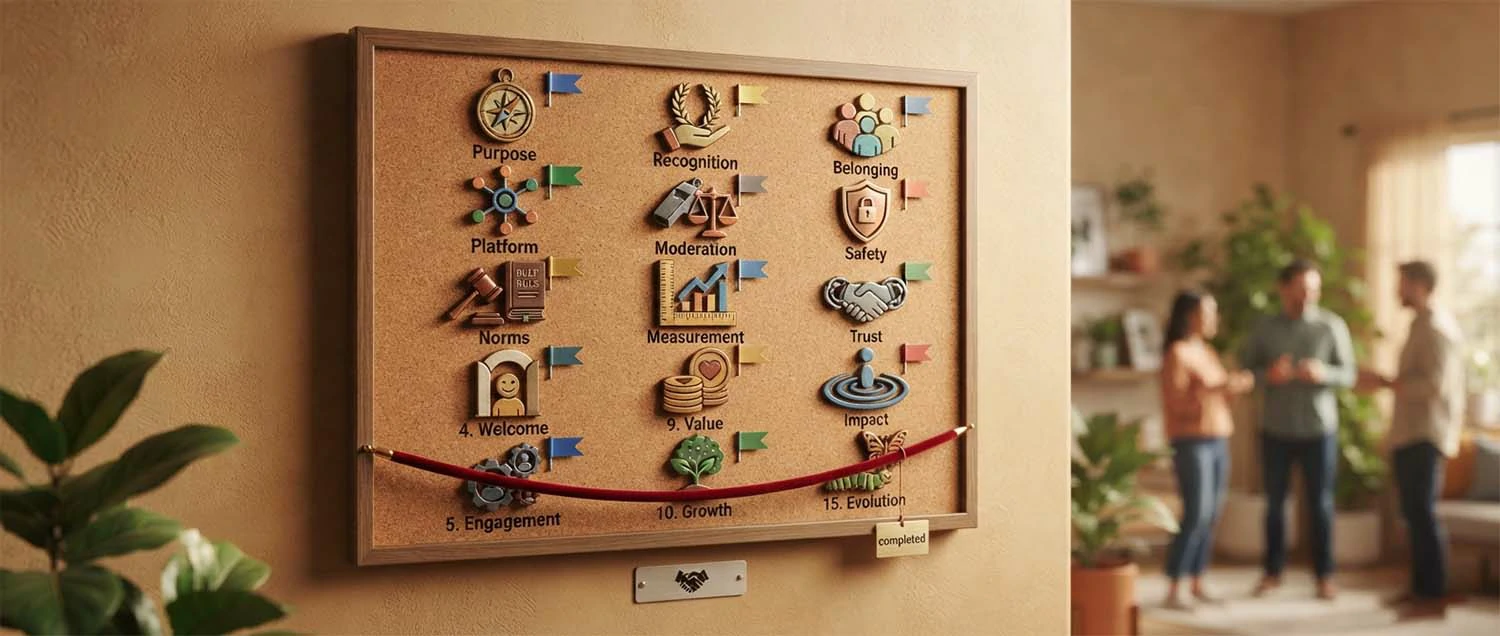
You build an online community by giving people with a shared interest, goal, or identity a place to connect with each other and with you—then nurturing that space so belonging grows. It starts with a clear purpose that answers "why should these people gather here," a platform that fits your members, and a warm welcome. It sustains through consistent stewardship: seeding conversation, facilitating connections, setting norms, moderating fairly, and recognizing contributions so members feel it is worth their while to participate.
The key distinction is participation. An audience consumes what you publish; a community talks to one another, helps each other, and forms relationships. That shift from broadcast to belonging is what makes a community so valuable—and so different from other channels. People stay for the relationships and the sense of belonging, which are far harder for anyone to replicate than content or reach, making a healthy community a durable, defensible asset.
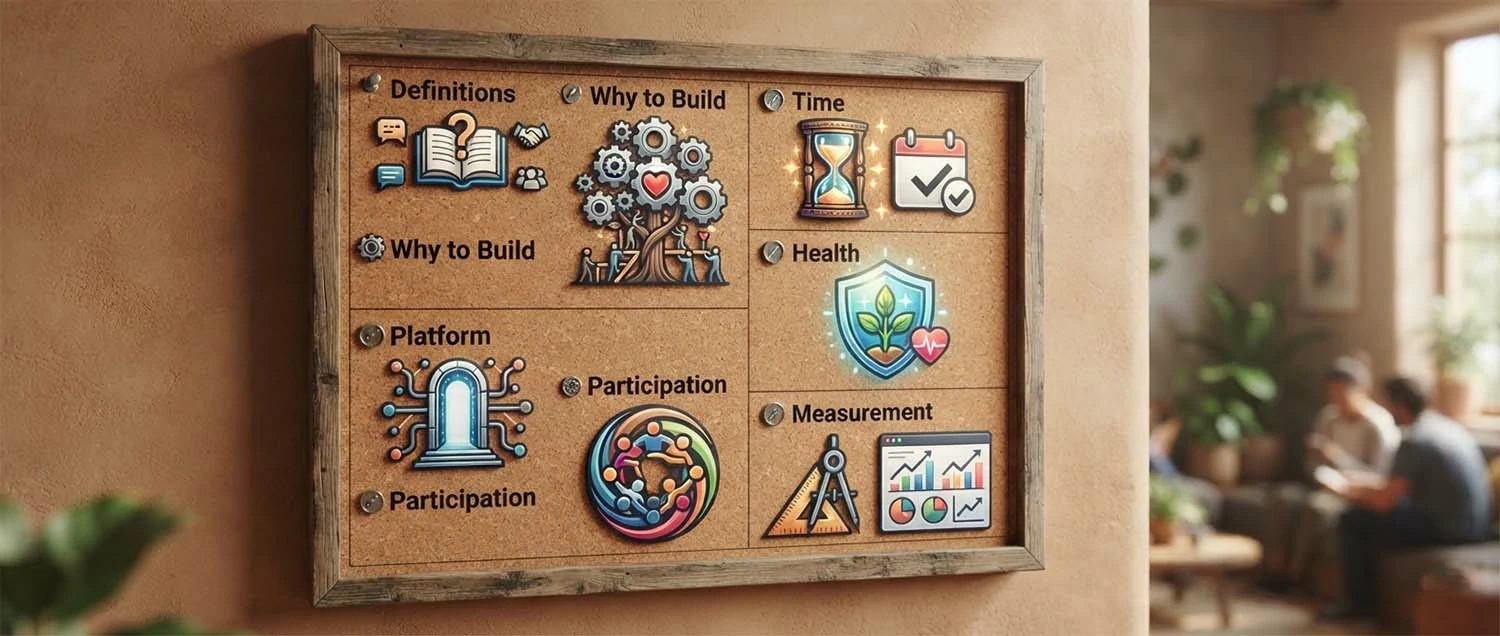
This guide covers why to build a community, how to define its purpose and choose a platform, how to attract and welcome members, how to foster genuine engagement and belonging, how to moderate and keep it healthy, and how to measure and sustain it. The aim is a living, participatory community that serves its members and grows in value over time.
Follow the guide from purpose to sustained belonging
Table of contents
- How do you build an online community?
- Follow the guide from purpose to sustained belonging
- A community is participation, not just an audience
- Why an online community is worth the effort
- Step 1: Define a clear purpose and identity
- Step 2: Choose the right platform
- Step 3: Attract the right early members
- Step 4: Welcome new members and lower the barrier to participate
- Step 5: Foster genuine engagement
- Step 6: Recognize contributions and grow leaders
- Step 7: Set norms and moderate fairly
- Step 8: Measure what matters, beyond member count
- Common mistakes to avoid
- Step 9: Create rituals and shared experiences
- Step 10: Grow without losing what made it special
- A practical workflow to build your community
- Online community checklist
- Practical answers about building a community
- Build a place where people belong
- Learn from foundational thinking
- Handle conflict and difficult members with care
- Connect the community to real value—for members first
- Resource the community and avoid burnout
- Why community matters more in a noisy world

A community is participation, not just an audience
The essential difference between an audience and a community is direction. An audience faces you: people receive what you publish, and the relationships run between you and each individual. A community faces inward: members connect with one another, help each other, and build relationships among themselves, with you as host and facilitator rather than sole source. That web of member-to-member connection is what creates the belonging a broadcast channel never can.
This changes what your role is. In an audience, you are the performer; in a community, you are the host of a gathering. Your job shifts from producing all the value to enabling members to create value for each other—asking good questions, making introductions, setting a welcoming tone, and stewarding the space. The community's strength comes from the connections between members, and your success is measured by how well those connections form and thrive.
Understanding this distinction shapes every decision that follows. You are not building a bigger audience; you are cultivating a place where people belong and participate. That is harder than broadcasting, but it produces something far more durable: relationships and belonging that keep people invested in a way that content alone cannot.

Why an online community is worth the effort
A community delivers value that other channels struggle to match. It deepens relationships and loyalty, because people who belong are invested in a way passive followers are not. It provides a constant source of feedback, support, and ideas, as members help each other and tell you what they need. It creates belonging that keeps people coming back, and it turns some members into advocates who bring others in. These effects compound the longer the community thrives.
A community is also unusually defensible. Content can be copied and reach can be bought, but the relationships and belonging within a genuine community are extremely hard for a competitor to replicate. People do not leave a place where they have friends, get help, and feel they belong. For businesses, this makes a healthy community one of the most durable assets you can build—provided you are willing to invest the real, ongoing effort it requires and to serve members genuinely rather than extract from them.

Step 1: Define a clear purpose and identity
Every thriving community answers a simple question: why should these people gather here, together, rather than anywhere else. Define that purpose clearly—a shared interest, a common goal, a professional bond, a mutual challenge, or an identity people want to belong to. The clearer and more meaningful the reason to gather, the stronger the community, because people join and stay for a purpose that resonates with them, not for a vague space with no center.
Purpose shapes everything else: who belongs, what conversations happen, what norms make sense, and what value members get. A community trying to be for everyone usually feels like it is for no one. Be specific about who it serves and what it is for, and let that identity guide your decisions. A well-defined community with a strong sense of "this is our place, for people like us, about this" will always outperform a broad, purposeless gathering, however large the latter starts.

Step 2: Choose the right platform
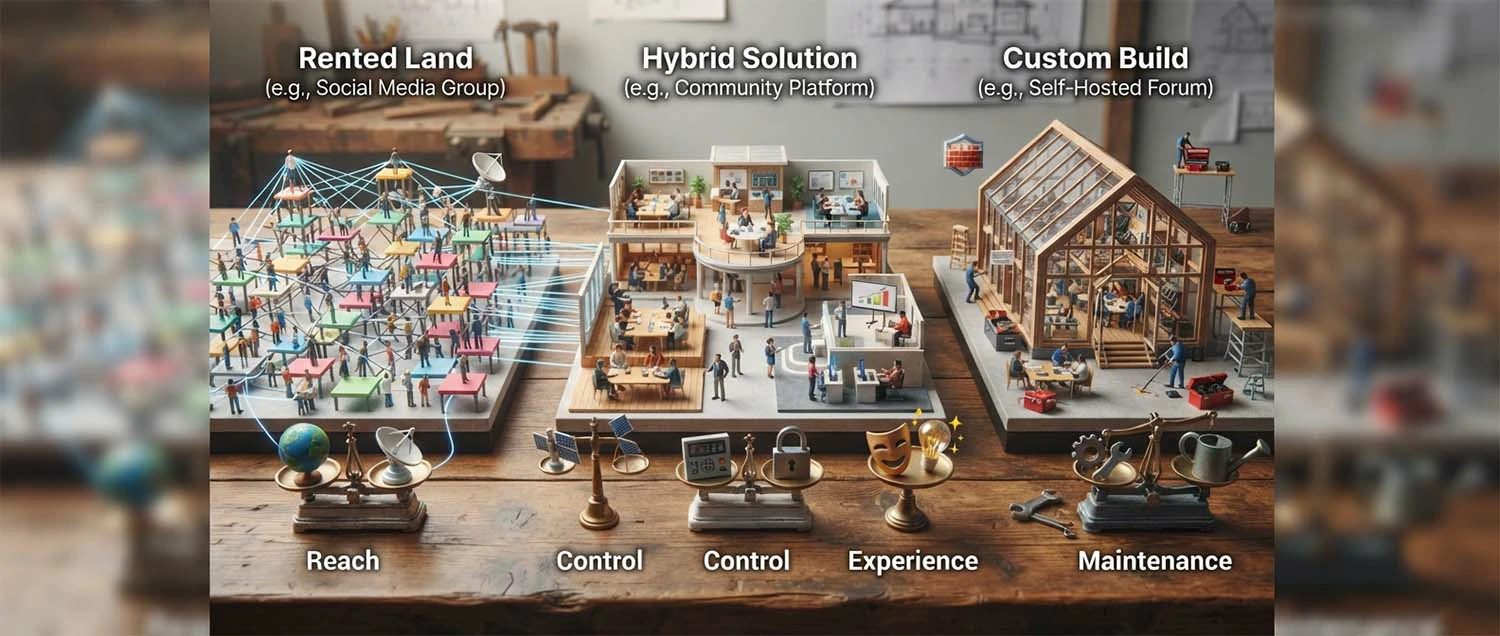
| Platform type | Strengths | Trade-offs |
|---|---|---|
| Social platform groups | Easy reach, familiar to members | Limited control, platform-dependent |
| Dedicated community software | Purpose-built features and control | Members must adopt a new space |
| Chat-style platforms | Real-time, high-energy interaction | Fast-moving, can overwhelm |
| On your own site | Full ownership and durability | More to build and maintain |
| Hybrid approach | Meet members where they are | More places to manage |
Choose based on where your members are comfortable, the experience you want, and how much control you need. Owned platforms give durability; rented ones give reach. Pick what you can sustain, not the trendiest option.
Step 3: Attract the right early members
A community's early members set its culture, so attract the right people rather than the most people. Invite those who genuinely care about the purpose—your most engaged followers, customers, or contacts who embody the spirit you want. A small group of committed, aligned early members creates a healthier foundation than a flood of indifferent joiners. These first members become the culture-carriers whose behavior newcomers will model.
Give people a clear reason to join and make the value obvious. Explain what the community is for, who it is for, and what members gain—connection, help, belonging, exclusive value. Draw members from the channels where your ideal people already are, and lean on personal invitations early, since a warm invite from a real person outperforms a broadcast. Grow deliberately, protecting culture as you scale, because a community's character is set early and hard to change later.

Step 4: Welcome new members and lower the barrier to participate
Joining a community can feel intimidating, so make the welcome warm and the first step easy. Greet new members personally, help them understand how things work and where to start, and invite a small first contribution—an introduction, a question, a simple response. The gap between joining and first participating is where many members go quiet forever, so design that moment deliberately to make speaking up feel safe and worthwhile.
Reduce the friction and fear of participating. Ask easy, inviting questions that anyone can answer, respond warmly to early contributions so people feel heard, and normalize the idea that everyone belongs and every voice matters. A newcomer who has a positive first interaction is far more likely to become an active member; one who posts and is met with silence usually drifts away. Treat the first participation as a milestone to actively support, not a step you leave to chance.

Step 5: Foster genuine engagement
A community lives on participation, and early on you must actively cultivate it. Seed conversations rather than waiting for them, ask open questions that invite many responses, share things worth reacting to, and respond generously so people feel their contributions matter. Facilitate connections between members—introduce people with shared interests, highlight good contributions, and help members see each other as the source of value, not just you.
Aim for interaction between members, not just between members and you. The healthiest sign of a community is people helping and talking to each other without your prompting. Encourage that by creating opportunities for it: discussions, shared activities, spaces for members to ask and answer, and recognition for those who help others. Over time, engagement becomes more self-sustaining, but it needs your consistent energy to reach that point. A quiet community rarely fixes itself; an actively facilitated one comes alive.

Step 6: Recognize contributions and grow leaders
People participate more when their contributions are seen and valued. Recognize members who help others, share useful things, welcome newcomers, or embody the community's spirit—through thanks, highlights, roles, or simply genuine appreciation. Recognition signals what the community values and encourages more of it, while its absence lets even generous members quietly disengage. Make it real and specific, not perfunctory.
Beyond recognition, cultivate members who help lead. In any thriving community, a portion of engaged members naturally step up to welcome others, answer questions, and steward the culture. Identify and empower these people—give them roles, support, and appreciation—so the work of nurturing the community does not rest on you alone. A community with engaged member-leaders is more resilient, more welcoming, and more self-sustaining, because its culture is carried by many hands rather than one.

Step 7: Set norms and moderate fairly
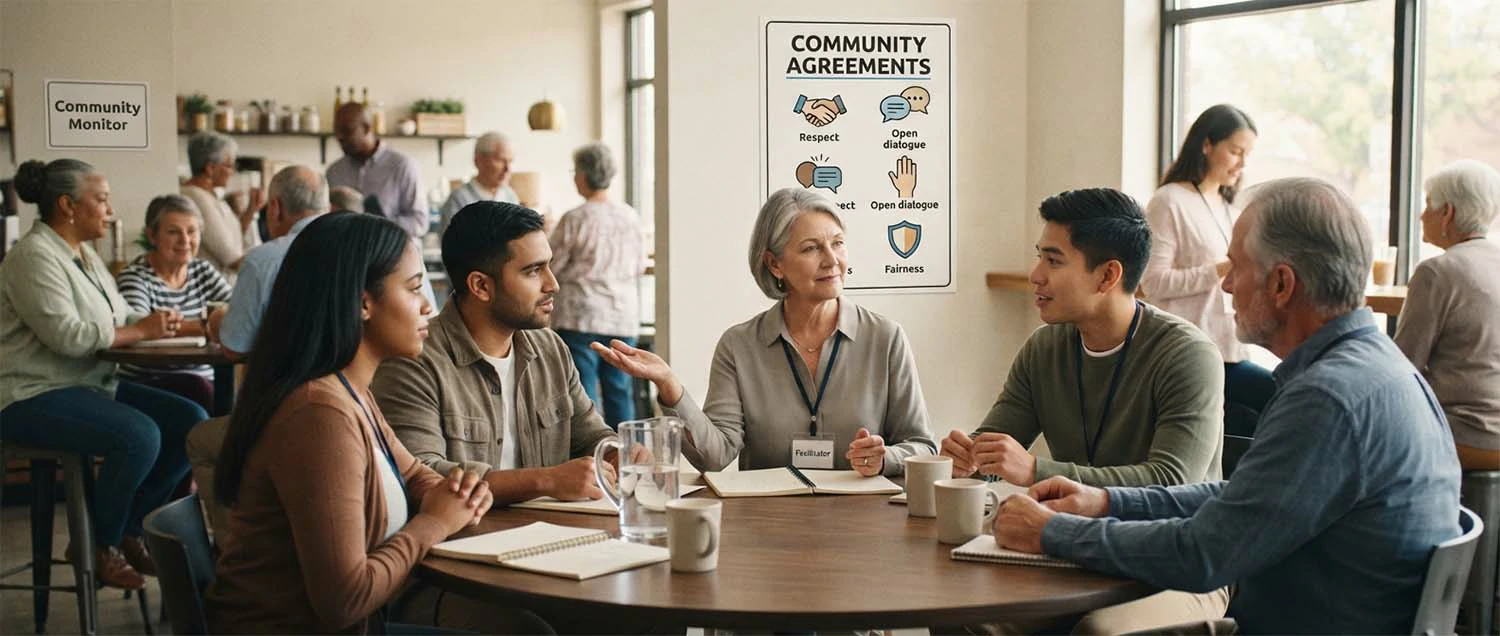
A community needs a safe, welcoming environment to thrive, and that requires clear norms and consistent moderation. Establish guidelines that reflect the community's values—how members treat each other, what belongs and what does not—and make them visible. Enforce them fairly and consistently, addressing problems early before they poison the culture. Good moderation is not heavy-handed control; it is the stewardship that keeps the space safe enough for people to participate openly.
Protect the culture as the community's most precious asset. A single tolerated bad actor, or one unresolved conflict, can drive away many good members, so act on issues promptly and transparently. Balance firmness with warmth: enforce standards while assuming good faith and helping members do better where you can. As the community grows, moderation becomes more demanding, so build the norms, tools, and trusted people to sustain it. A well-moderated community feels safe, and safety is the foundation of belonging.
Step 8: Measure what matters, beyond member count
Member count is the easiest number to track and the least meaningful. A large community where no one participates is weaker than a small one that is vibrant. Measure engagement and value instead: how active members are, what portion participate rather than lurk, the quality and helpfulness of interactions, how well the community retains members over time, and the sense of belonging people express. These signals reflect whether the community is actually working.
Also weigh the downstream value a healthy community creates—loyalty, feedback and ideas, advocacy, support that members give each other, and the business outcomes that follow. Talk to members to understand qualitatively what the community means to them, because much of its value is relational and not captured in numbers. Judge success by whether members are engaged and genuinely value being there, and let that guide how you nurture and grow the community rather than chasing a bigger headcount.

Common mistakes to avoid
No purpose
A space with no center
Without a clear reason to gather, no one stays.
Build and leave
No stewardship
Communities need ongoing energy, not a one-time launch.
Broadcasting
Audience, not community
Only talking at members prevents real connection.
Chasing size
Empty scale
A big, inactive community is weaker than a small vibrant one.
Weak moderation
Culture erosion
Tolerating bad behavior drives good members away.
Pure extraction
Taking, not serving
Using members without serving them breaks trust.
Most mistakes come from treating a community like an audience or a one-time project. Serve the members, steward the culture, and stay for the long term.

Step 9: Create rituals and shared experiences
Communities are held together not only by conversation but by shared experiences and rituals—predictable, recurring moments that members can look forward to and take part in together. A regular discussion thread, a weekly question, a recurring event, a shared challenge, or a familiar way of welcoming newcomers all give the community a rhythm and a sense of "this is how we do things here." Rituals turn a collection of individuals into a group with its own culture.
Design rituals that fit your community's purpose and that members can genuinely participate in, not just watch. The best ones invite contribution and create shared memories: members introducing themselves in a familiar format, celebrating each other's milestones, gathering for a recurring live moment, or marking the community's own traditions. These repeated experiences build familiarity and belonging over time, giving members reasons to return and something to feel part of beyond any single conversation.
Let rituals evolve with the community and let members shape them. The traditions that stick are often ones the community itself creates or adapts, because they feel owned rather than imposed. Pay attention to what members naturally repeat and enjoy, and nurture those into lasting rituals. A community with its own shared experiences and traditions has a depth of culture that makes it far more resilient and meaningful than one that is only a stream of posts.
Step 10: Grow without losing what made it special
Growth is often the goal, but it carries a real risk: the intimacy, culture, and safety that made a small community special can dilute as it scales. More members mean more voices, more moderation demand, and more chance for the original spirit to fade. The challenge of scaling a community is not just adding people but preserving belonging and culture as numbers rise, which requires deliberate effort rather than hoping it survives on its own.
Protect culture as you grow by strengthening the things that carry it. Empower more member-leaders so stewardship scales with membership. Consider sub-spaces or smaller groups within a larger community, so members can still find intimate corners where they know people. Keep reinforcing the norms and rituals that define the culture, and onboard new members into that culture deliberately rather than letting a wave of newcomers reshape it by default. Grow at a pace you can absorb without losing your center.
Remember that bigger is not automatically better. A community that grows past its ability to stay healthy, welcoming, and true to its purpose has traded its greatest strengths for a larger number. Sometimes the right choice is to grow slowly, or to stay deliberately focused rather than chasing scale. Judge growth by whether belonging and culture are holding, and let that—not headcount—set your pace.

A practical workflow to build your community
Phase 1
Define and set up
Clarify the purpose and who it serves, choose a platform you can sustain, and set norms and a welcome before inviting anyone.
Phase 2
Seed and welcome
Invite aligned early members, seed activity, welcome each person warmly, and actively facilitate the first connections.
Phase 3
Nurture and sustain
Foster engagement, recognize contributors, grow leaders, moderate fairly, and measure engagement and belonging over time.
Start small and intentional. A tight, well-cared-for early community is the seed of a thriving one; a rushed, purposeless launch rarely recovers.

Online community checklist
✅ The purpose and who it serves are clear
✅ The platform fits members and is sustainable
✅ Norms and guidelines are set and visible
✅ Early members are aligned and committed
✅ New members get a warm welcome
✅ The first participation is made easy
✅ Conversations are actively seeded
✅ Members connect with each other, not just you
✅ Contributions are recognized genuinely
✅ Member-leaders are cultivated
✅ Moderation is fair and consistent
✅ Problems are addressed early
✅ Engagement and belonging are measured
✅ Success is judged by value, not size
✅ Members are served, not just used
Work through this as you build and grow. Your community is healthy when it has a clear purpose, engaged members, a safe culture, and a real sense of belonging.
Frequently Asked Questions
Practical answers about building a community
What is an online community?
A space where people with a shared interest, goal, or identity connect with each other and with you, not just consume content. Unlike a passive audience, a community is participatory—members talk, help each other, and build relationships, creating belonging content alone cannot.
Why build an online community?
It deepens relationships and loyalty, provides support and feedback, and creates belonging that keeps people coming back. It turns an audience into invested participants and becomes a durable, defensible asset because relationships are hard for competitors to replicate.
Where should I host my community?
On a platform that fits where your members are comfortable, the experience you want, and how much control you need. Owned platforms give durability; rented ones give reach. Pick what fits your members and what you can sustain, not the trendiest option.
How do I get people to join and participate?
Give a clear reason to join and make the value obvious, then seed activity, welcome members warmly, ask inviting questions, and recognize contributions. Participation grows when people feel welcome, see value, and believe their voice matters.
How much time does it take?
Ongoing, consistent effort—especially early on—to seed activity, welcome members, and set the tone. A community is a living thing needing regular stewardship. Over time it becomes more self-sustaining, but always needs attention. Plan for a real, continuing commitment.
How do I keep it healthy?
Set clear norms and enforce them fairly, moderate consistently, foster genuine relationships, recognize positive contributions, and address problems early. Health comes from active, values-driven stewardship and a safe, welcoming space—not from size.
How do I measure success?
Look beyond member count to engagement and value: how active members are, how many participate rather than lurk, interaction quality, retention, and belonging. Also weigh loyalty, feedback, and advocacy. Success is an engaged, valued community, not merely a large one.
Build a place where people belong
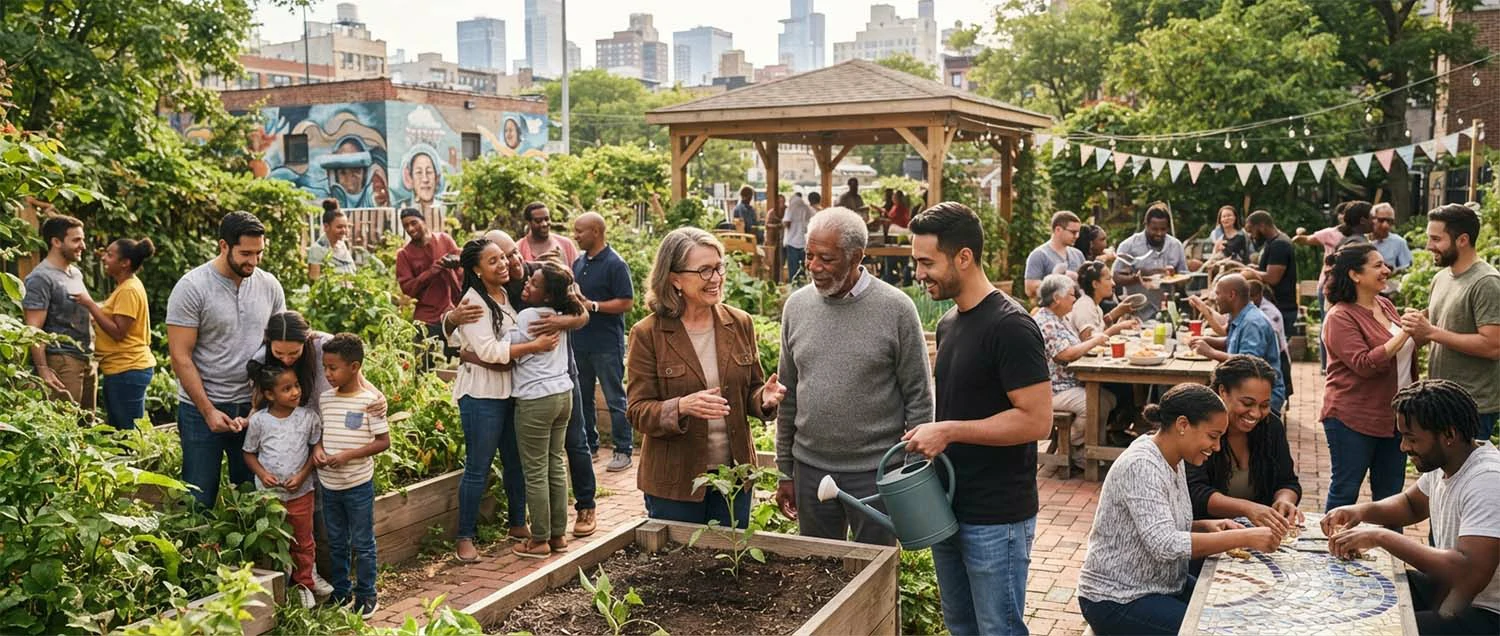
A community is not a bigger audience; it is a place where people connect, participate, and belong. Build it on a clear purpose, choose a platform you can sustain, attract aligned early members, welcome each newcomer warmly, and actively foster the connections between members that give a community its life. Recognize contributors, grow leaders, and moderate fairly to protect the culture that makes people feel safe enough to belong.
Above all, serve the members and steward the community for the long term. Its value—loyalty, feedback, support, advocacy, and durability no competitor can copy—flows from genuine relationships and belonging, which only grow with consistent, caring effort. Start small and intentional, measure engagement and belonging rather than headcount, and keep showing up. Do that, and you build something rare: a place people are glad to be part of, that grows more valuable the longer it thrives.
Learn from foundational thinking
Community building draws on well-studied ideas about belonging, participation, and safe online spaces. These references offer durable foundations as you build.

Handle conflict and difficult members with care
Wherever people gather, disagreements happen, and how a community handles conflict shapes whether it stays healthy. Some tension is natural and even productive—passionate members care. The danger is letting disputes turn personal, letting one loud voice dominate, or letting a genuinely harmful member erode the safety others depend on. A community that avoids all conflict can feel lifeless, but one that lets conflict fester loses the trust that holds it together.
Address problems early, calmly, and consistently with your stated norms. Assume good faith where you can—many conflicts come from misunderstanding, not malice—and help members find common ground or agree to differ respectfully. When someone repeatedly harms the space, act decisively; protecting the many who behave well matters more than endlessly accommodating one who does not. Handle these moments transparently enough that members trust the process, while respecting people's dignity even as you enforce boundaries.
Do the hard moderation in a way that reinforces culture rather than damaging it. Members watch how conflict is handled and learn what the community truly values from your actions, not just your rules. Fair, firm, and humane conflict resolution actually strengthens belonging, because it shows the space is genuinely safe and its values are real. Avoiding difficult decisions, by contrast, quietly tells good members that the community will not protect them.

Connect the community to real value—for members first
A thriving community can create genuine business value: loyalty, feedback and ideas, word-of-mouth, reduced support burden as members help each other, and a deeper relationship with customers. These outcomes are real and worth pursuing. But the order matters: the value to the business flows from the value to members. A community optimized to extract from people, rather than to serve them, quickly loses the engagement and trust that made it worth anything in the first place.
Design the value exchange so members always come first. Let the community be genuinely useful and enjoyable for the people in it, and let business benefits emerge as a natural byproduct rather than the constant agenda. When you do introduce products, gather feedback, or invite members to act, do it in ways that respect them and fit the community's purpose. Members can tell the difference between a space that serves them and one that mines them, and only the former sustains the belonging that makes a community a durable asset.

Resource the community and avoid burnout
Communities are sustained by people, and that human effort is easy to underestimate. Seeding conversation, welcoming members, moderating, resolving conflict, and nurturing culture is ongoing, emotionally demanding work. A common way communities fail is not dramatic collapse but quiet burnout: the person or small team carrying it runs out of energy, engagement fades, and the space slowly goes silent. Treating community as a side task no one truly owns almost guarantees this outcome.
Resource it honestly and share the load. Give the community a clear owner with real time to devote to it, and distribute responsibility—through member-leaders, moderators, and a team where possible—so it does not depend on one exhausted person. Build sustainable habits rather than heroic bursts, celebrate the wins to keep motivation up, and protect the stewards' wellbeing as carefully as the members'. A community can only stay healthy if the people running it stay healthy, so plan for a marathon, not a sprint, and build the support structure to sustain it.

Why community matters more in a noisy world
As content becomes abundant and easy to produce, and as attention grows harder to hold on crowded, algorithm-driven platforms, genuine community becomes more valuable, not less. People increasingly crave real connection and belonging amid the noise, and a space that offers those stands out precisely because they are scarce. Where content can be copied and reach can be bought, a community of people who belong together is something no competitor can simply replicate.
The tools and platforms will keep changing, but the human need the community meets does not. People will always want places where they are known, helped, and part of something. The organizations that invest in genuine community—serving members, stewarding culture, and building for the long term—create relationships and belonging that endure through every platform shift. Treat community not as a passing tactic but as a lasting way of building real connection, and it becomes one of the most durable and meaningful things you can create.
Commenting Sites and How They Can Supercharge Your Community
Read more