Real estate rendering services: types, uses and how to brief them
How developers, agents and landlords use real estate rendering services, which render types to order, what affects price, and how to brief a studio well.
 Pro Pixel Agency
Real estate rendering services create photorealistic images, animations and virtual tours of properties that are not yet built, not yet finished, or not looking their best. Developers use them to pre-sell off-plan homes, agents use them to show the potential of empty or dated spaces, and landlords use them to lease shell units faster.
The quality gap between good and average renderings is large, and buyers notice. This guide explains the main render types, where each works best, what drives cost, and how to brief a studio so you get accurate, persuasive results first time.
The short answer
Real estate rendering services turn plans, sketches or photos into lifelike exterior views, interior views, aerial images, animations and virtual tours. Order exteriors and key interiors for off-plan sales, virtual staging for empty listings, and fit-out renders for commercial leasing. Cost depends on the number of views, detail level, landscaping, revisions and how complete your drawings are, so a clear brief with plans, finishes and references saves time and money.
Types of real estate renderings
| Render type | What it shows | Best used for |
|---|---|---|
| Exterior still | Front, rear or street view with landscaping and lighting | Off-plan marketing, planning presentations, signage |
| Interior still | Furnished rooms with finishes, lighting and decor | Selling lifestyle, showing finish options |
| Aerial or bird's-eye view | The whole site, surroundings and amenities | Master-planned communities, mixed-use schemes |
| 3D floor plan | Top-down furnished layout | Listings, brochures, helping buyers understand flow |
| Animation or walkthrough | A camera moving through and around the property | Launch videos, sales suites, social media |
| 360° panorama or virtual tour | Interactive views a buyer can look around | Remote buyers, websites, sales galleries |
| Virtual staging | Furniture added to photos of real empty rooms | Vacant homes and rentals |
Where renderings in real estate pay off
Off-plan and pre-construction sales
Buyers cannot tour a building that does not exist. A set of high-quality exteriors, key interiors and amenity views becomes the core of brochures, websites, hoardings and ads. Our explainer on architectural rendering services covers how studios approach this kind of project.
Vacant and dated properties
Empty rooms look smaller and colder in photos. Virtual staging shows scale and possibility. For homes needing renovation, a rendering of the finished kitchen or bathroom helps buyers see past the current condition. See our guide to 3D interior rendering for examples of how interiors sell a lifestyle.
Commercial leasing
Retail shells, office floors and industrial units lease faster when tenants can see them fitted out as a café, clinic or open-plan office.
Approvals and community consultation
Planning boards and neighbors respond better to accurate, context-aware visuals than to technical drawings alone.
What affects the cost of real estate rendering services
- Number of views: each still is priced separately; packages for several views are often cheaper per image.
- Scale and complexity: a single home is simpler than a tower or a full master plan.
- Detail level: custom furniture, detailed landscaping, people and vehicles add modeling time.
- Input quality: complete CAD or BIM files speed things up; sketches and photos require more interpretation.
- Revisions: most quotes include a fixed number of revision rounds; changes after approval cost extra.
- Animation length and resolution: video is priced by duration and complexity.
- Turnaround: rush jobs usually carry a premium.
How to brief a rendering studio
- Drawings: plans, elevations, sections and site plans, ideally as CAD or BIM files.
- Materials and finishes: a schedule or mood board with flooring, cladding, countertops, fixtures and colors.
- Camera angles: mark the views you want on a plan, or describe the story each image should tell.
- Context: site photos, orientation, neighboring buildings and views.
- Mood and lighting: time of day, season and style references from images you like.
- Use and format: web, print, billboard or social, plus required resolutions and aspect ratios.
- Deadline and approval process: who signs off, and by when.
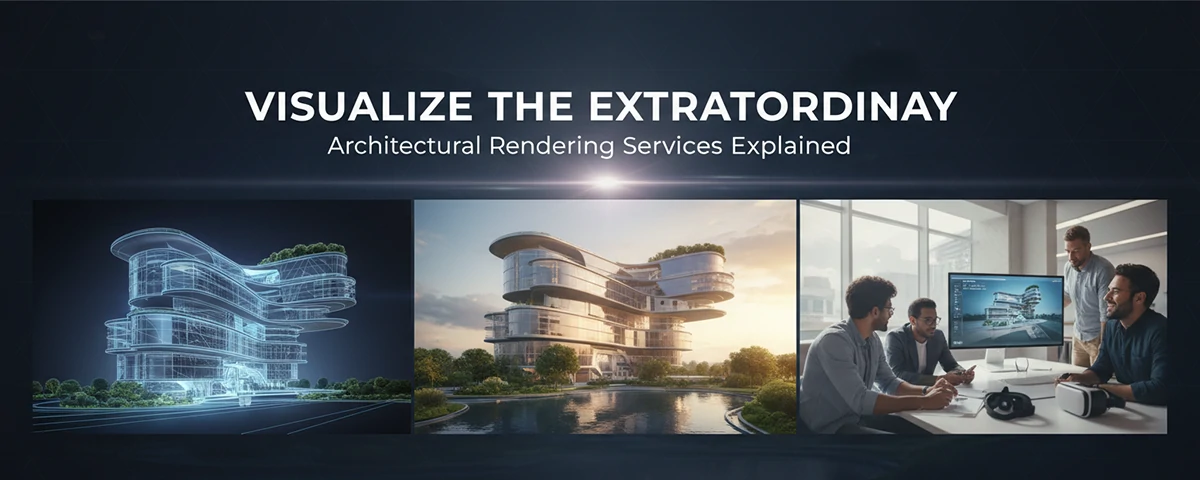
The typical rendering workflow
Knowing the stages helps you plan approvals and avoid expensive late changes.
- Brief and quote: the studio reviews drawings, confirms views and agrees a price and schedule.
- Modeling: the building, site and interiors are built in 3D from your plans.
- Clay or draft renders: untextured or low-detail images to approve camera angles and composition. This is the cheapest point to change a view.
- Materials and lighting: finishes, furniture, landscaping and lighting are applied and refined.
- Final renders and post-production: high-resolution images are rendered and retouched, with people, sky and atmosphere added.
- Delivery: files in the agreed sizes and formats for web, print and social.
Approving each stage promptly, and from a single decision-maker, is the easiest way to keep a project on schedule.
Accuracy and honesty in property visuals
Renderings are marketing, but they must not mislead. Keep views faithful to the approved design, avoid inventing views or amenities that will not exist, and make sure landscaping looks plausible at completion rather than decades later. Label virtually staged or rendered images clearly; many listing platforms and local rules require it, so check the requirements in your market. Common pitfalls, from unrealistic lighting to wrong scale, are covered in our guide to 3D rendering mistakes and how to avoid them.
Choosing a rendering partner
Look for a portfolio with property types similar to yours, consistent realism across many projects (not just a few hero images), and clear pricing that states views, revisions and file formats. Ask how they handle incomplete drawings and how they check accuracy against plans. Ask to see work-in-progress stages too, since they show how a studio checks geometry and materials before final rendering. Pro Pixel's 3D visualization and rendering service covers exteriors, interiors, floor plans and animations for residential and commercial projects.
Frequently asked questions
How long do real estate renderings take?
A small set of stills for a single property can often be delivered within days once drawings are complete, while large developments and animations take longer. Revision rounds and late design changes are the biggest causes of delay.
What files do I need to provide for a rendering?
Floor plans and elevations at a minimum, plus a finishes schedule and reference images. CAD, BIM or SketchUp files speed up modeling, but many studios can work from PDFs and sketches.
Are renderings better than photos for selling homes?
They serve different purposes. Photos show what exists; renderings show what will exist or what could be. For finished homes in good condition, professional photography is usually best, with renderings or virtual staging filling gaps.
Can renderings be reused after the project is built?
Often yes, for portfolios, awards submissions and future marketing. Confirm image rights and usage terms in your contract with the studio.
Need renderings for an upcoming listing or development? Send your plans to Pro Pixel through the 3D rendering quote form and get a scope and timeline for your views.
More useful paths
Use these paths to continue with the closest practical topic, service, or decision guide.
Spotted something wrong? Report an error on this page. We correct on the page and say what changed.