

A comprehensive guide to professional 3D product rendering from photorealistic stills to interactive experiences and real-time visualization.
Your resource for expert 3D product rendering insights and services
Table of contents
- What Are 3D Product Rendering Services
- The Importance of Professional 3D Rendering
- Types of 3D Product Renders
- Still Image Product Rendering
- 360-Degree Product Views
- Lifestyle and Contextual Rendering
- Cutaway and Exploded View Rendering
- Product Animation and Motion Rendering
- Interactive and Real-Time Rendering
- Photorealistic vs Stylized Rendering
- The Rendering Pipeline and Workflow
- Modeling Considerations for Rendering
- Materials and Surface Properties
- Lighting Techniques for Product Rendering
- Camera Composition and Framing
- Render Settings and Optimization
- Render Farms and Cloud Rendering
- Post-Processing and Compositing
- Texture Creation and Mapping
- Asset Preparation and Model Optimization
- Output Formats and Delivery Specifications
- Pricing Models for Rendering Services
- Evaluating Portfolio and Previous Work
- Turnaround Time and Production Scheduling
- Communication and Project Workflow
- Intellectual Property and Usage Rights
- Revision and Approval Process
- Common Mistakes and How to Avoid Them
- AI Integration in Product Rendering
- Industry-Specific Rendering Solutions
- Long-Term Partnerships and Retainers
- Future Trends in 3D Product Rendering
- E-Commerce and Catalog Rendering
- AR and Virtual Try-On Integration
- Quality Assurance and Render Verification
- Measuring ROI from Rendering Services
- Frequently Asked Questions
- What is the difference between 3D rendering and 3D modeling?
- How much do professional 3D product rendering services cost?
- How long does it take to produce a professional product render?
- What file formats do I need to provide for rendering?
- Can 3D rendering replace professional product photography entirely?
- How many revisions are typically included in rendering projects?
- What industries benefit most from 3D product rendering services?
- How do I choose between photorealistic and stylized rendering?
What Are 3D Product Rendering Services
3D product rendering services specialize in generating photorealistic images and animations from digital 3D models using advanced computer graphics technology. These services transform raw 3D data into stunning visual content that looks indistinguishable from photographs. Professional rendering is the final critical step in the 3D visualization pipeline that brings digital products to life with convincing lighting, materials, and environmental context.
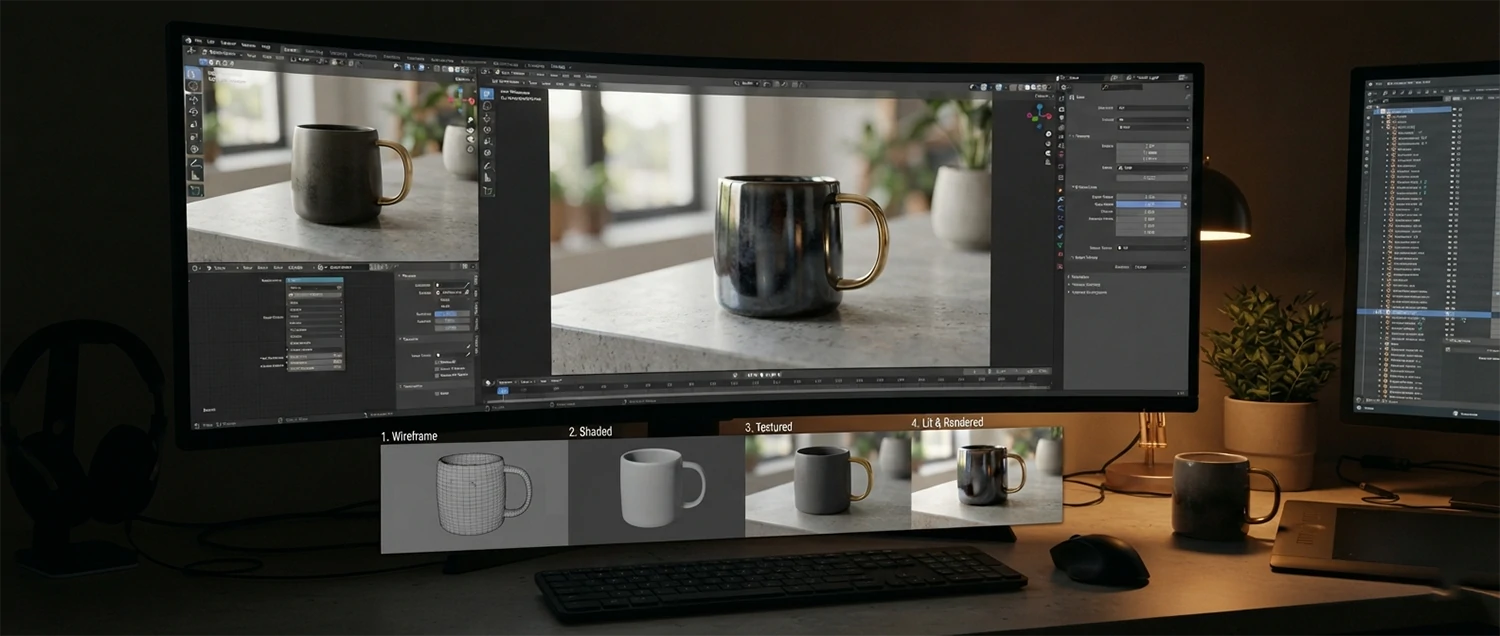
Unlike 3D modeling which creates the geometric structure of a product, rendering calculates how light interacts with that geometry to produce the final image. Rendering services use sophisticated algorithms to simulate real-world physics including light bounces, shadows, reflections, refractions, and global illumination. The result is imagery that accurately represents how a physical product would appear under specific lighting conditions and environments.
Rendering services are used across industries for product catalogs, e-commerce listings, advertising campaigns, packaging design, architectural visualization, and product development. They offer significant advantages over traditional photography including the ability to visualize products before they exist physically, instant iteration of colors and materials, and consistent quality across thousands of product variations.
The Importance of Professional 3D Rendering
Professional 3D rendering is essential for businesses that want to present their products in the best possible light across digital and print media. High-quality renders convey quality, attention to detail, and brand professionalism that builds consumer trust and drives purchasing decisions. In an increasingly visual marketplace, the quality of product imagery directly impacts business success.
Professional rendering services bring technical expertise that goes beyond what casual users or in-house generalists can achieve. Skilled rendering artists understand the complex interplay of lighting, materials, and camera settings needed to produce images that are not just technically accurate but also aesthetically compelling. They know how to make products look their absolute best while maintaining realistic representation.
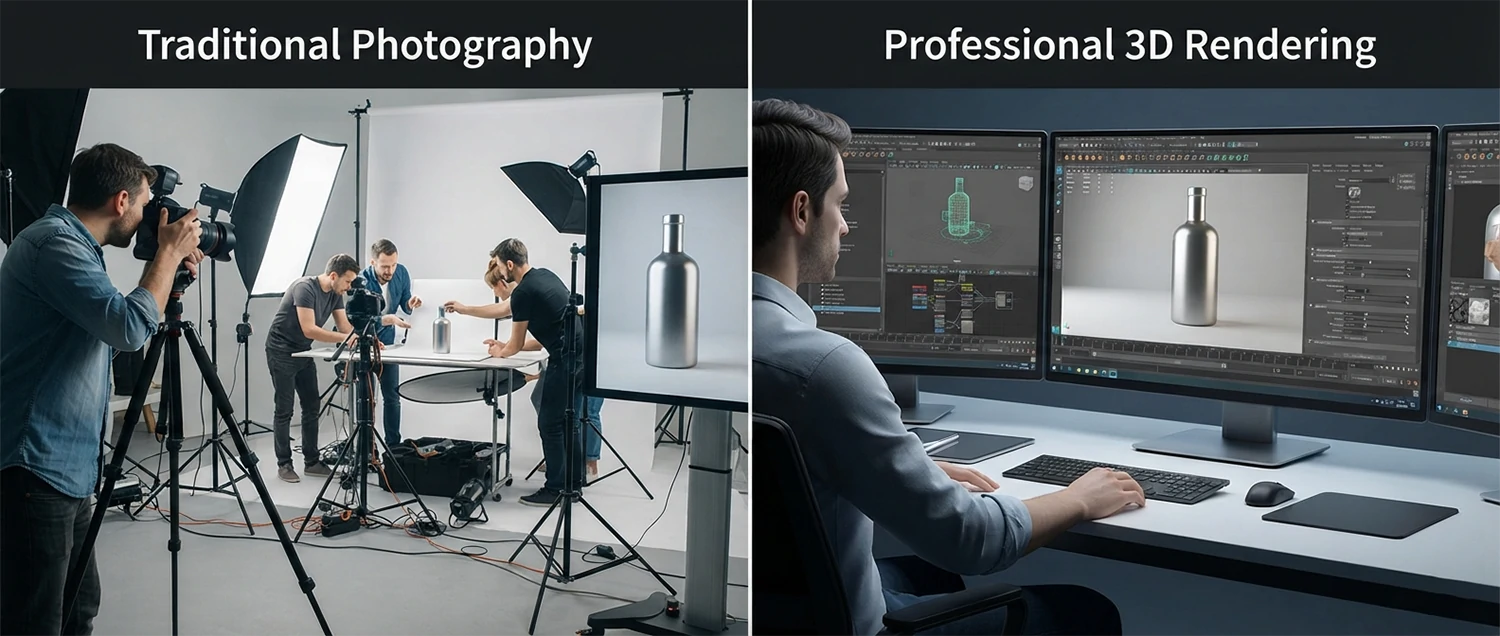
The cost and time efficiency of professional rendering versus traditional photography is substantial. Once a 3D model exists, unlimited images can be rendered from any angle, under any lighting conditions, with any material variations, without the cost of physical photoshoots. Product updates and new variations require only digital changes rather than complete reshoots, making rendering services increasingly cost-effective for businesses with evolving product lines.
Types of 3D Product Renders
3D product rendering services offer a diverse range of render types, each suited to different marketing contexts and business objectives. Understanding the options helps you select the right rendering approach for your specific project needs. Each render type requires different technical approaches, creative decisions, and production timelines.
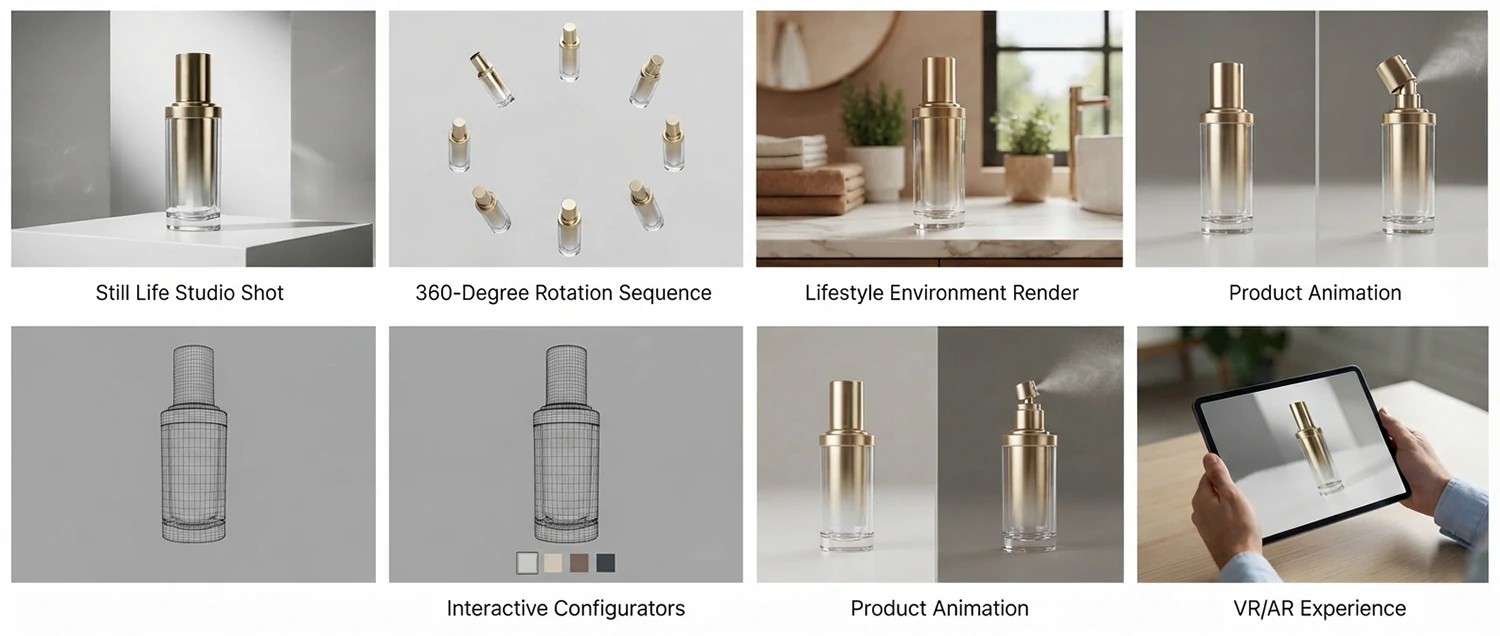
Still image rendering produces single-frame photorealistic images that serve as the foundation for most product catalogs, website imagery, and advertising. 360-degree rendering creates sequences of images showing products from every angle, enabling interactive rotation viewers. Lifestyle rendering places products in contextual environments that show them in use. Animation rendering creates moving product presentations for video marketing.
Interactive rendering generates real-time 3D experiences that respond to user input, powering product configurators and virtual try-on applications. Virtual reality rendering creates immersive environments for VR headsets. Augmented reality rendering produces lightweight 3D assets optimized for mobile AR experiences. Each render type serves specific use cases and audience engagement objectives.
Still Image Product Rendering
Still image product rendering is the most fundamental and widely used service in the 3D rendering industry. These single-frame photorealistic images serve as primary product visuals for e-commerce listings, catalogs, advertising, and packaging. Professional still renders must achieve exceptional quality because they represent products in contexts where first impressions directly influence purchasing decisions.
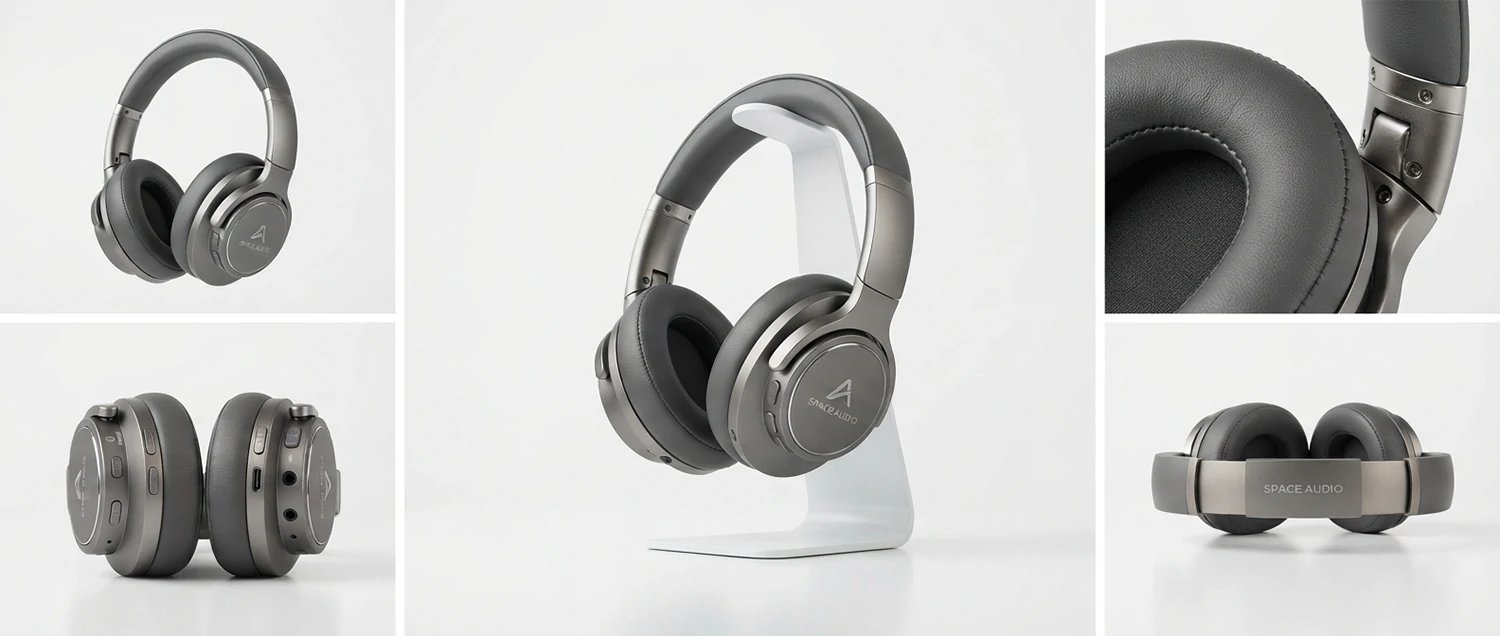
Studio still renders depict products on clean backgrounds with controlled studio lighting that highlights product features clearly. These images are essential for e-commerce platforms like Amazon, Shopify, and WooCommerce where consistent, professional product presentation is expected. White background renders ensure products are visible and appealing, with lighting carefully positioned to show form, texture, and finish.
Detail and feature callout renders focus on specific product aspects that differentiate it from competitors. These close-up views highlight craftsmanship, material quality, innovative features, and design details that might be missed in standard product shots. Multiple still renders from different angles create comprehensive product visualizations that give customers complete understanding of product appearance and design.
360-Degree Product Views
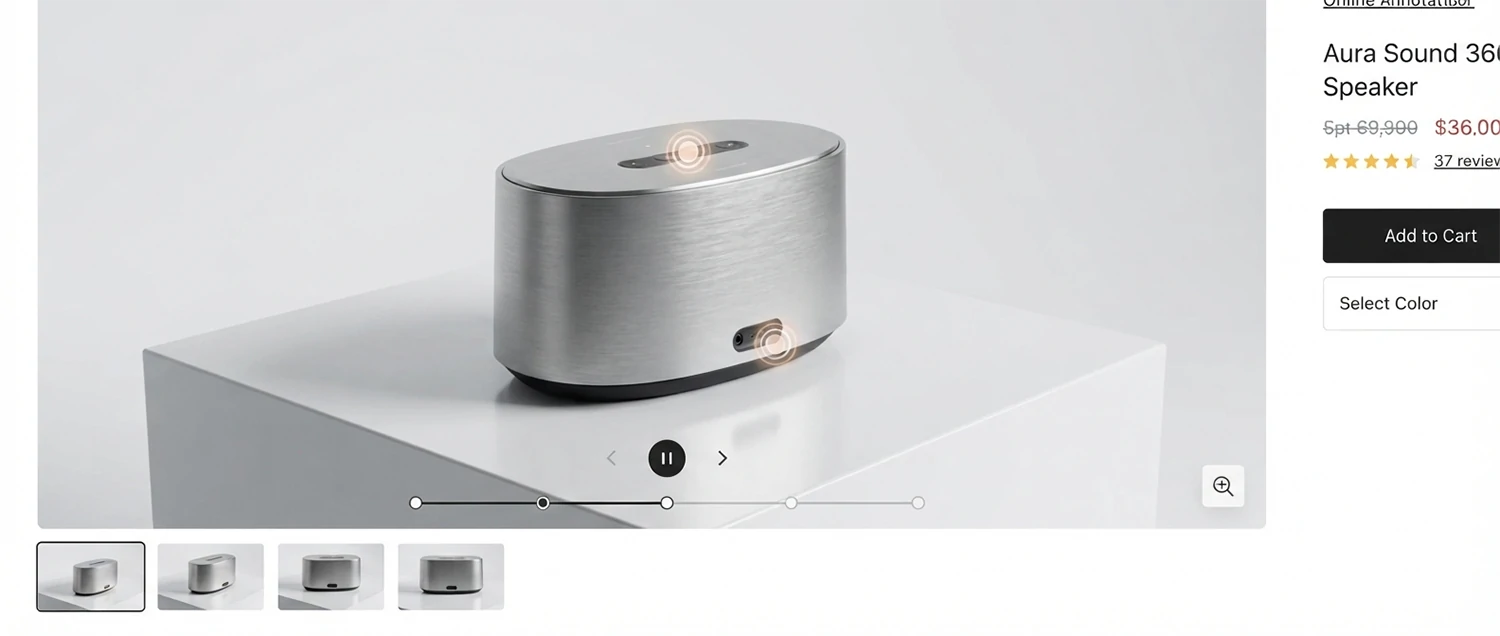
360-degree product views are interactive visualizations that allow customers to rotate products and examine them from every angle. These views are created by rendering a sequence of images from multiple camera positions around the product, then assembling them into an interactive viewer that responds to mouse drag or touch swipes. This presentation significantly improves customer understanding of product design.
Professional 360-degree rendering services ensure smooth rotation with consistent lighting and exposure across all frames. The number of frames determines rotation smoothness, with typical views using 24 to 72 frames per full rotation. Higher frame counts provide smoother motion but require more rendering time and larger file sizes. Advanced 360 views may include zoom functionality and hotspot annotations.
Interactive 360-degree views dramatically increase e-commerce engagement and conversion rates. Studies show that products presented with 360-degree views have higher conversion rates than those with static images alone. Customers feel more confident in purchase decisions when they can examine products thoroughly online, reducing return rates and increasing satisfaction with product expectations versus reality.
Lifestyle and Contextual Rendering
Lifestyle and contextual rendering places products in realistic environments that show them being used, enjoyed, or displayed in relevant settings. Unlike studio renders on clean backgrounds, lifestyle renders tell a story and help customers envision products in their own lives. These images evoke emotional responses and create aspirational connections that drive purchase desire.
Creating convincing lifestyle renders requires skilled environment modeling, realistic lighting that matches the scene setting, and careful composition that balances product prominence with contextual storytelling. Furniture might be shown in beautifully designed room settings, outdoor gear in natural landscapes, kitchen appliances in modern culinary environments, and electronics in contemporary home or office settings.
Lifestyle renders are particularly valuable for brands that sell through emotional connection and aspirational lifestyle appeal. They dominate advertising campaigns, social media marketing, and high-end catalog presentations. The flexibility of 3D rendering allows products to be placed in any conceivable environment without the logistics and expense of location photoshoots.

Cutaway and Exploded View Rendering
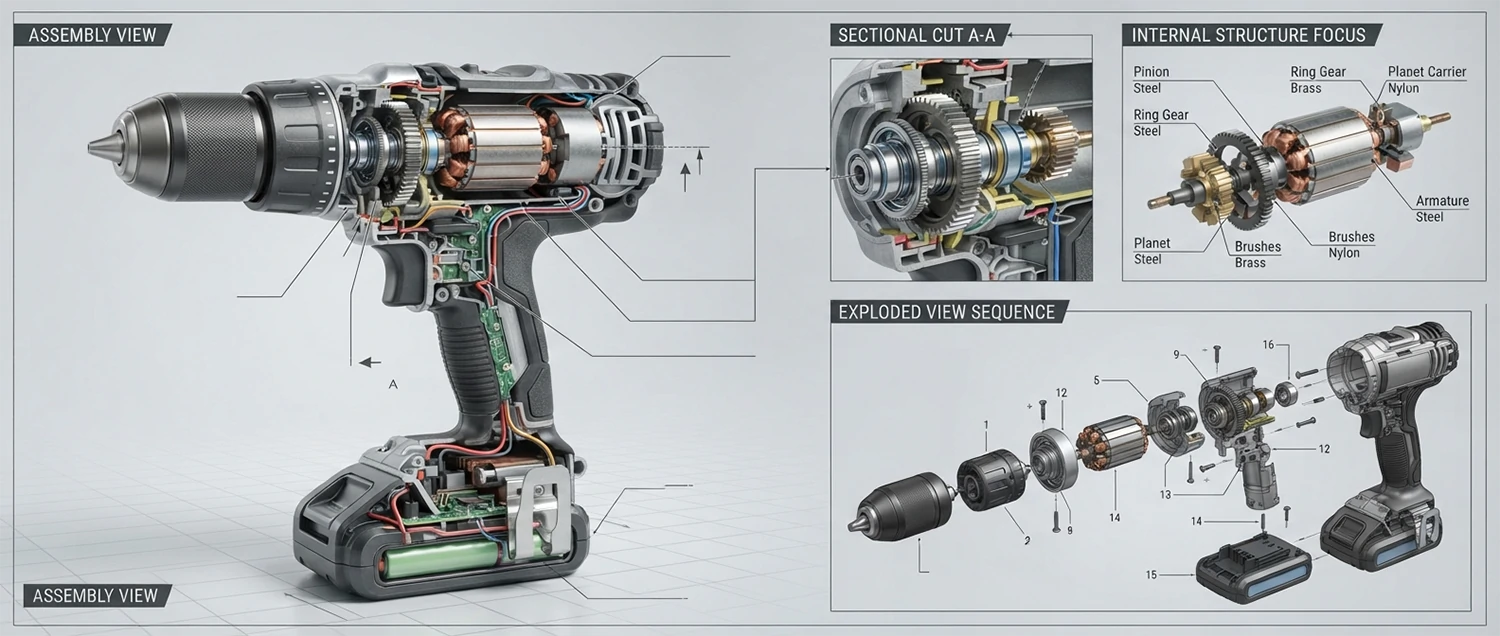
Cutaway and exploded view rendering reveals the internal structure and assembly of products in visually compelling ways. Cutaway renders show products with sections removed to reveal internal components, while exploded views display product parts separated along assembly axes to show how components fit together. These render types are invaluable for technical marketing, instructional content, and quality communication.
Cutaway renders require careful modeling of internal components that would normally be hidden from view. Skilled rendering artists create sectional cuts that reveal internal workings while maintaining visual clarity and aesthetic appeal. These images are particularly effective for showcasing engineering quality, material thickness, and internal complexity that differentiate premium products from competitors.
Exploded view renders are essential for assembly instructions, technical documentation, and product manuals. They can be presented as static images or animated sequences that show assembly processes step by step. Professional exploded view rendering requires precise alignment knowledge, accurate scaling of components, and clear visual hierarchy that guides viewers through the assembly logic.
Product Animation and Motion Rendering
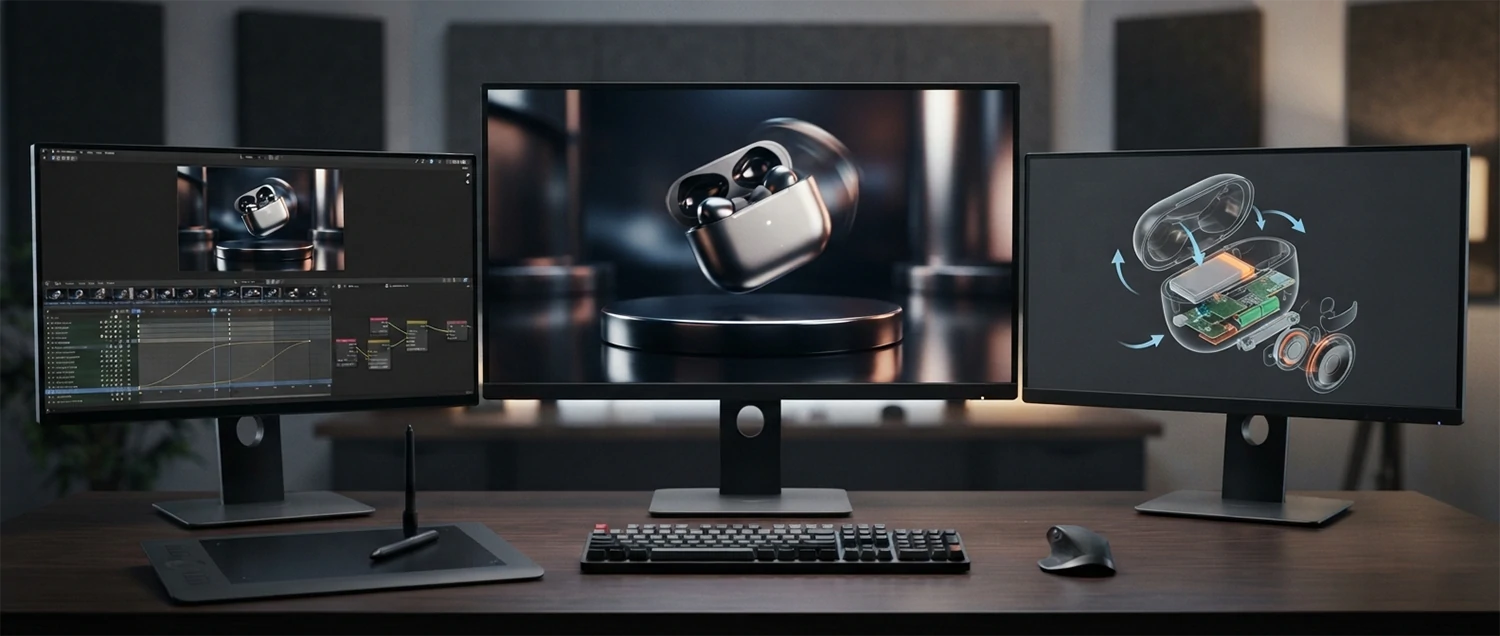
Product animation and motion rendering bring products to life through moving visual presentations that demonstrate features, functionality, and usage in ways static images cannot. Animated product renders are used in advertising, social media, website hero sections, trade show displays, and product launch videos. Motion captures attention and communicates product value more dynamically than still imagery.
Common product animation types include rotational turntable animations that showcase products from all angles, feature reveal animations that progressively highlight different product aspects, usage demonstration animations showing products in action, and cinematic product films with narrative storytelling. Each animation type requires different rendering approaches and production timelines.
Professional product animation rendering requires rendering each frame individually, then assembling frames into video sequences. Higher frame rates produce smoother motion but require more rendering time. Motion blur effects add realism to moving elements. Professional animation services handle the entire process from storyboarding and timing to final render output optimized for specific delivery platforms.
Interactive and Real-Time Rendering
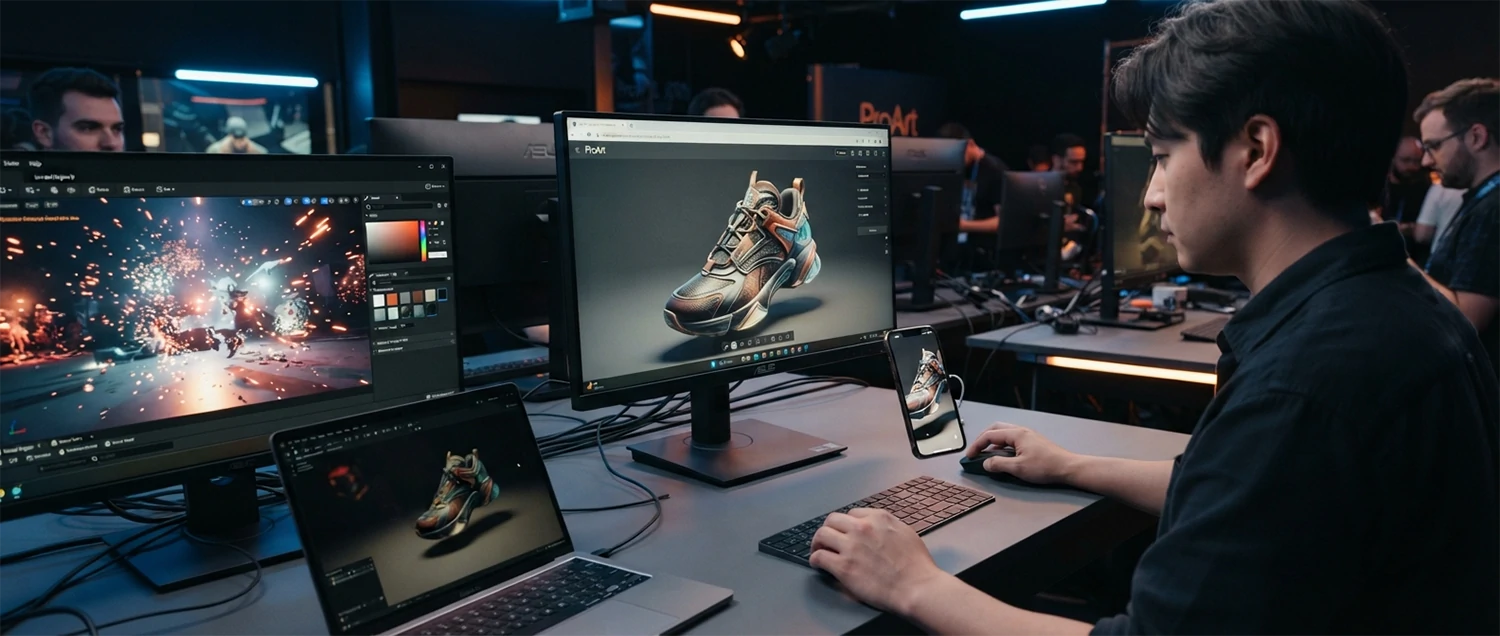
Interactive and real-time rendering enables users to explore 3D products dynamically, responding to input in real-time. Unlike pre-rendered stills or videos, real-time rendering generates images on the fly as users interact with products, allowing unlimited exploration angles, customization options, and immersive experiences. This technology is transforming e-commerce and product marketing.
Real-time rendering engines like Unreal Engine and Unity power interactive product configurators where customers customize colors, materials, and features with instant visual feedback. Web-based 3D viewers using technologies like WebGL and Three.js enable interactive product exploration directly in browsers without plugins. Mobile AR experiences overlay 3D products onto real-world environments viewed through phone cameras.
Professional interactive rendering services optimize 3D models for real-time performance while maintaining visual quality. This involves reducing polygon counts, optimizing textures, and implementing efficient lighting solutions that run smoothly on target devices. The best interactive experiences balance visual fidelity with performance to create responsive, engaging product exploration tools.
Photorealistic vs Stylized Rendering
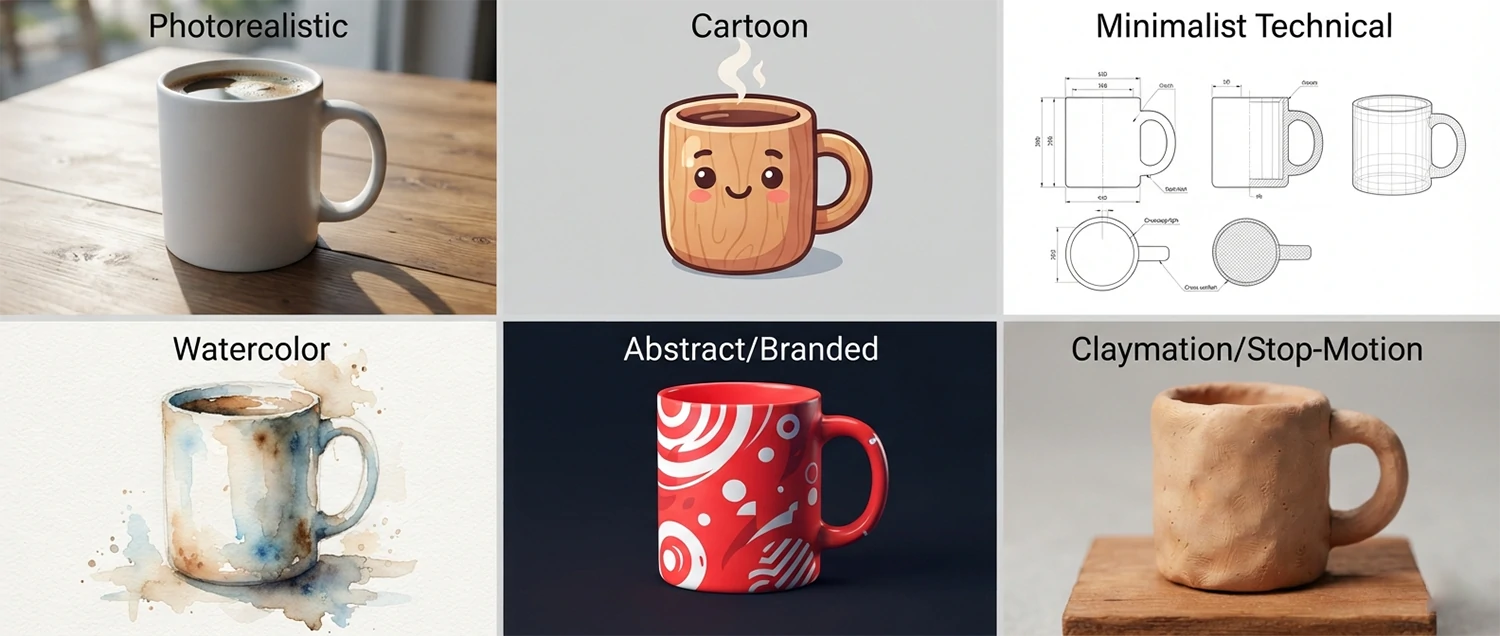
3D product rendering services offer both photorealistic and stylized rendering approaches, each serving different brand aesthetics and marketing objectives. Photorealistic rendering aims to create images indistinguishable from photographs, with accurate material properties, realistic lighting, and natural environmental integration. This approach is the standard for most commercial product visualization.
Stylized rendering offers artistic interpretations that depart from strict realism toward particular visual aesthetics. This might include cartoon-like renderings for children products, minimalist line art for technical diagrams, watercolor or sketch effects for conceptual presentations, or branded visual treatments that align with unique brand identities. Stylized renders can help products stand out in visually saturated markets.
The choice between photorealistic and stylized rendering depends on brand positioning, audience expectations, and marketing context. Photorealism builds trust and accurately represents product appearance, essential for e-commerce. Stylized approaches create distinctive brand identities and can be more memorable in advertising. Many brands use both approaches for different contexts within their marketing mix.
The Rendering Pipeline and Workflow
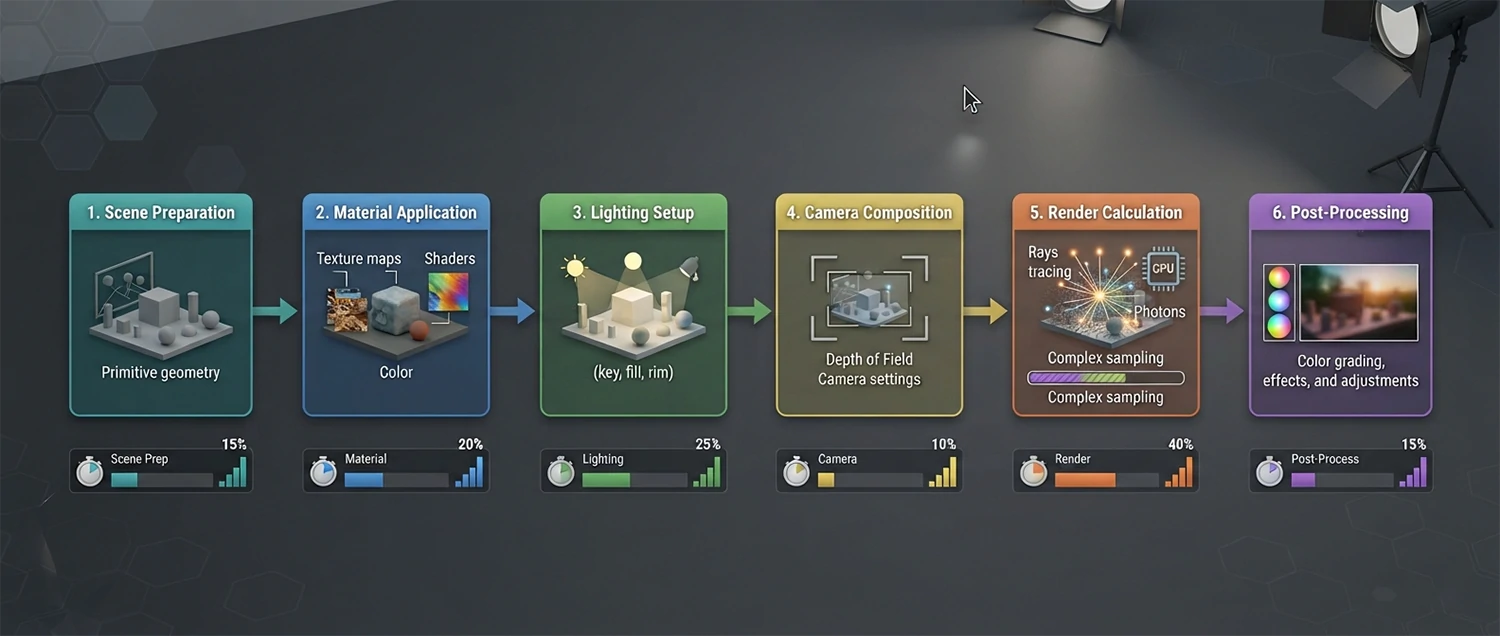
Understanding the rendering pipeline helps clients appreciate the complexity and skill involved in producing professional product renders. The rendering process follows a structured workflow that transforms raw 3D data into final polished images, with multiple stages requiring different expertise and technical decisions at each step.
The pipeline begins with scene preparation where the 3D model is imported, scaled correctly, and positioned. Materials and textures are applied or refined. Lighting is designed and placed to create the desired mood and product emphasis. Camera angles are chosen to present products most effectively. Render settings including resolution, sampling rates, and output format are configured based on quality requirements.
The actual rendering process calculates how light interacts with the scene, which can take from minutes to hours depending on complexity and quality settings. Post-processing then refines the raw render output through color correction, compositing, and final adjustments. Professional rendering services manage this entire pipeline efficiently, making technical decisions that balance quality with production timelines.
Modeling Considerations for Rendering
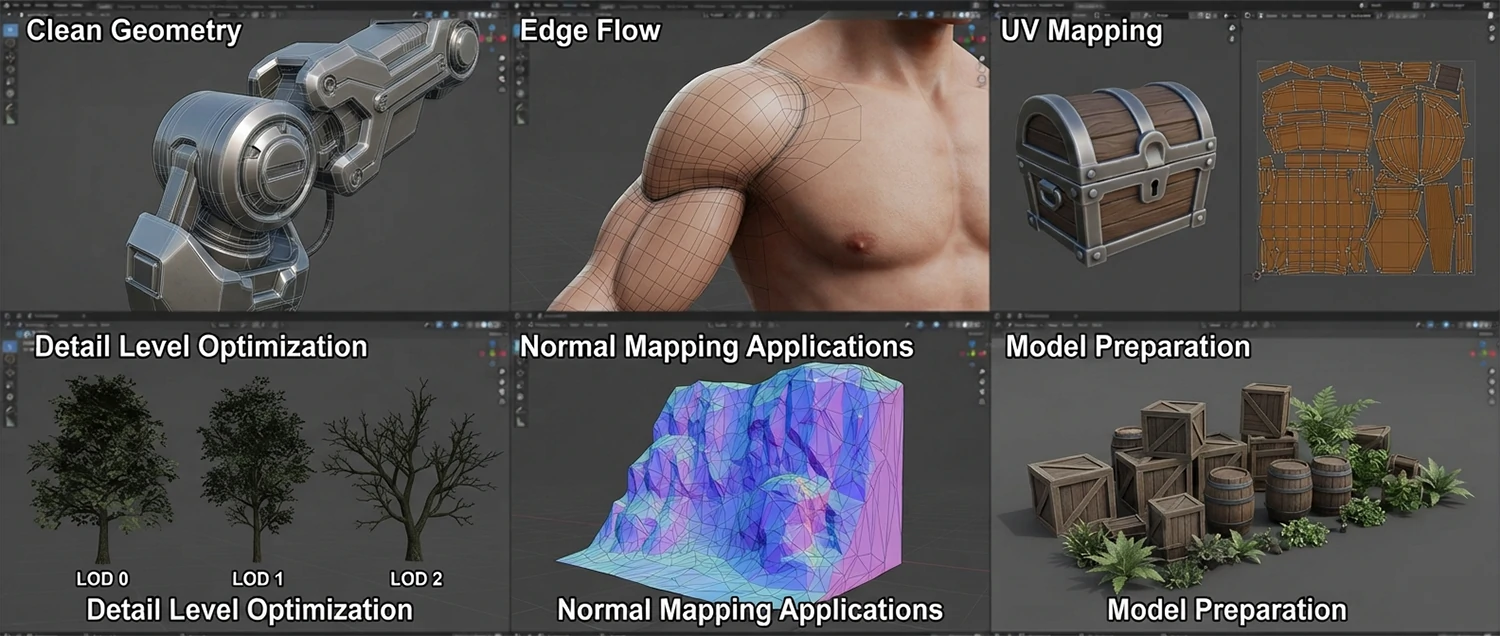
The quality of a 3D render depends fundamentally on the quality of the 3D model it starts from. Models intended for rendering require specific considerations that differ from models created for other purposes like 3D printing or real-time applications. Understanding these requirements helps clients evaluate modeling quality and its impact on final render results.
Models for photorealistic rendering need clean geometry with proper edge flow that allows smooth surface rendering and accurate light interaction. Triangles or quads should be evenly distributed, with additional density where curvature requires more detail. Models must be watertight without gaps or overlapping geometry that could cause rendering artifacts. Proper UV mapping ensures textures apply correctly to surfaces.
Detail level is a critical consideration. Models need sufficient detail to appear realistic at the intended viewing distance and resolution, but excessive detail unnecessarily increases rendering time. Professional rendering artists balance detail with efficiency, using techniques like normal mapping to add surface detail without increasing geometry complexity. Proper modeling sets the foundation for efficient, high-quality rendering.
Materials and Surface Properties
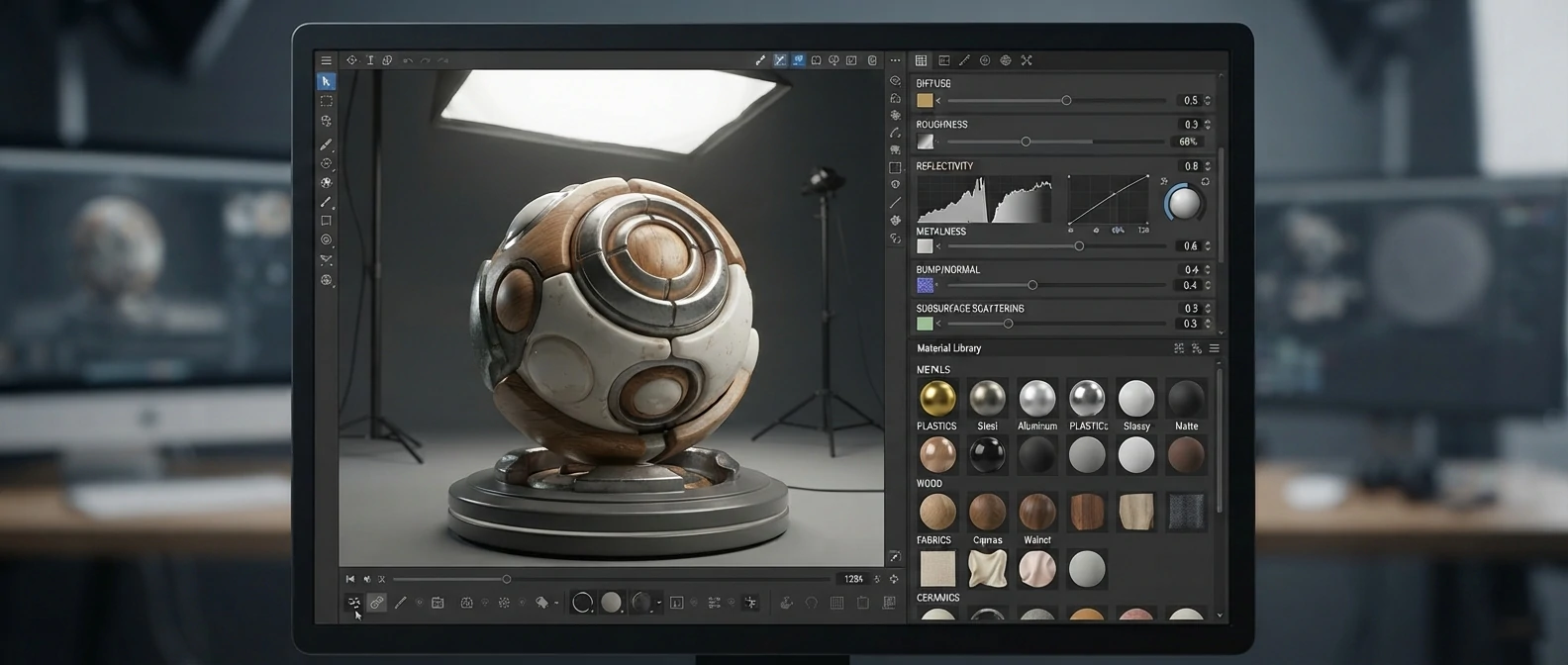
Material creation and surface property definition are where much of the realism in 3D product rendering is achieved. Skilled rendering artists create digital materials that accurately simulate how real-world surfaces interact with light. The complexity and accuracy of material definitions directly determines whether renders appear photorealistic or obviously computer-generated.
Key material properties include diffuse color which defines the base surface color, roughness controlling how light scatters across surfaces, reflectivity determining mirror-like qualities, metalness indicating whether surfaces are metallic or dielectric, and bump or displacement mapping that adds geometric surface detail. Advanced materials incorporate subsurface scattering for translucent materials like skin, wax, and plastics.
Professional material creation involves layering multiple texture maps that control different surface properties independently. A realistic wood material might combine color maps, roughness maps, normal maps for grain detail, and ambient occlusion maps for crevice shadowing. Fabric materials require specialized shader networks that simulate thread-level detail and fiber interaction with light.
Lighting Techniques for Product Rendering
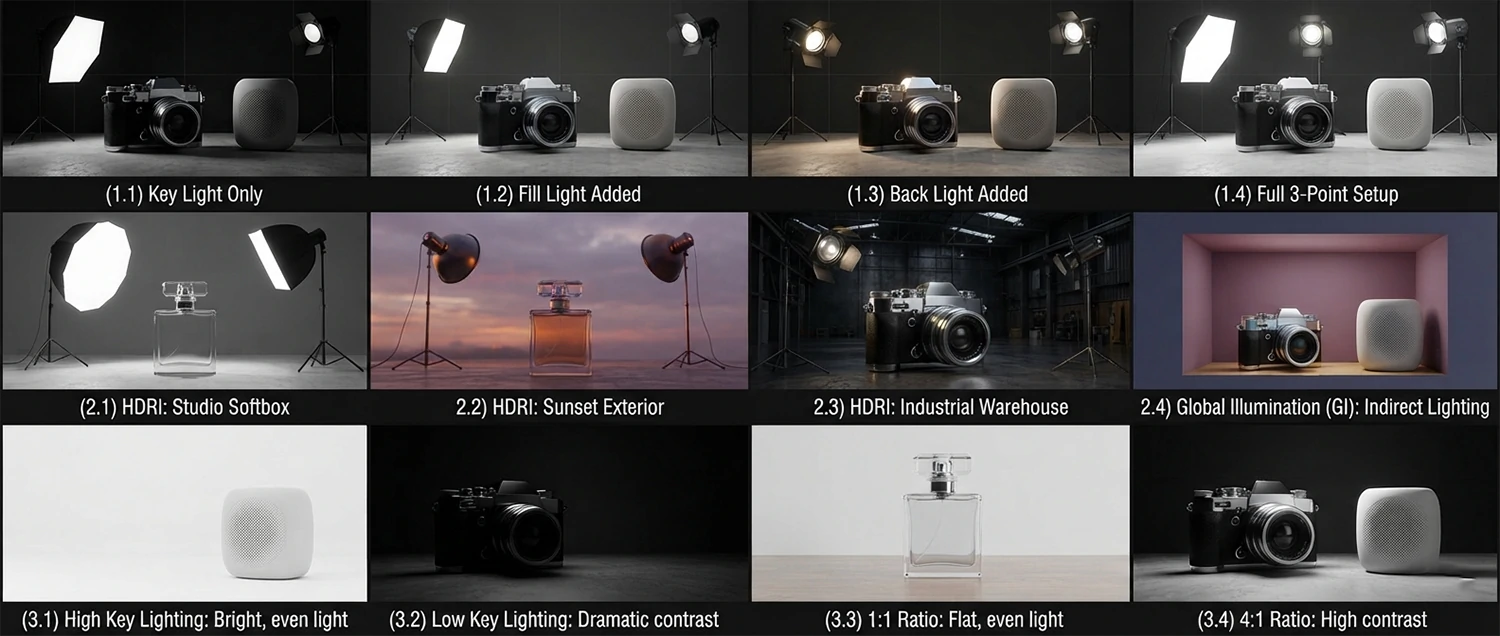
Lighting is the single most important element in creating compelling product renders. Professional rendering artists understand how to design lighting that reveals product form, highlights desirable features, minimizes unflattering aspects, and creates mood that aligns with brand identity. The same product model can look dramatically different under different lighting conditions.
Studio lighting setups use multiple virtual lights positioned to control shadows, highlights, and reflections. Three-point lighting with key, fill, and rim lights creates dimensional depth while maintaining product visibility. Softboxes and diffusers create soft, flattering light, while direct lighting produces dramatic, high-contrast looks. Lighting ratios control the balance between illuminated and shadow areas.
HDRI environment lighting uses high dynamic range images to illuminate scenes with natural, realistic light from all directions. This technique excels at creating convincing reflections on glossy products and integrating products naturally into contextual environments. Advanced global illumination algorithms simulate how light bounces between surfaces, creating subtle color bleeding and ambient occlusion that adds realism.
Camera Composition and Framing
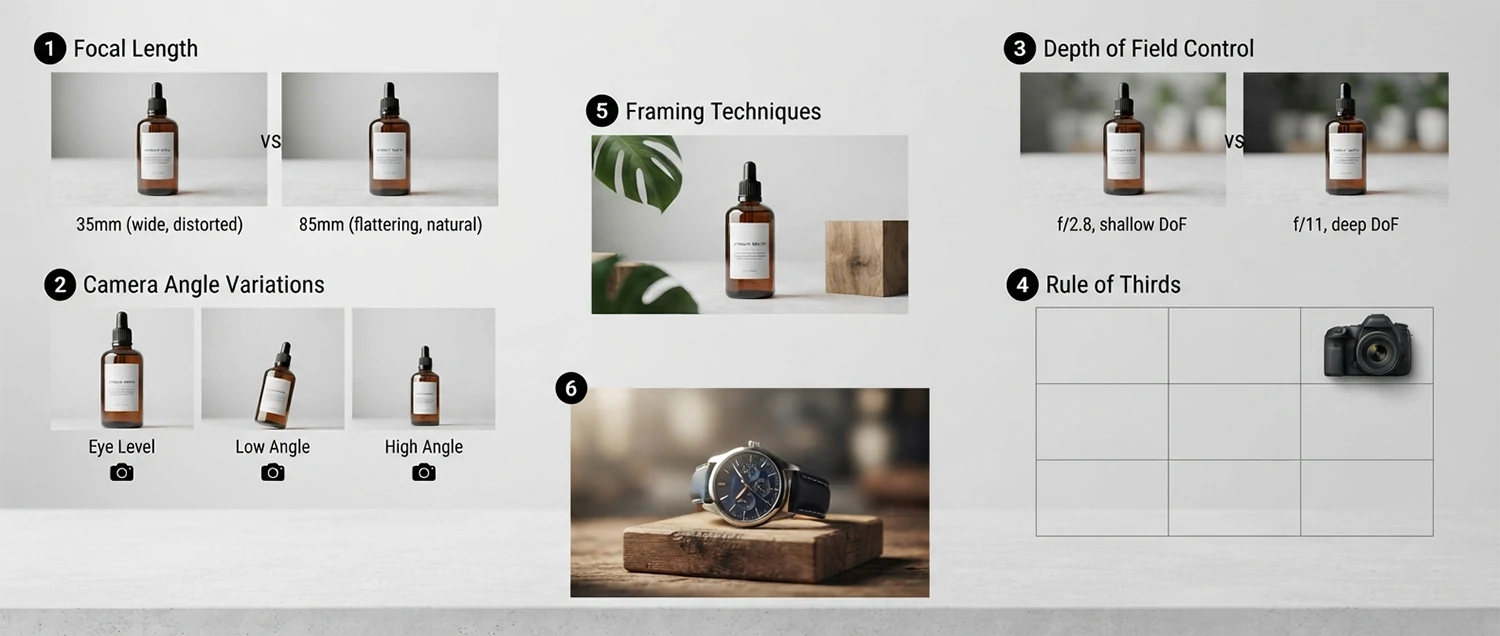
Camera composition and framing decisions significantly impact how products are perceived in rendered images. Professional rendering artists apply cinematography principles to create compelling product presentations that guide viewer attention, communicate product scale, and create visual interest. The virtual camera in 3D rendering offers flexibility impossible in physical photography.
Key compositional considerations include focal length selection which affects perspective and perceived product proportions. Wide-angle lenses create dramatic perspective with exaggerated depth, while longer focal lengths compress space and present more natural product proportions. Camera height and angle relative to the product influence whether products appear imposing, approachable, or functional. Eye-level shots create connection with viewers.
Depth of field control selectively blurs foreground or background elements to focus attention on the product. Virtual cameras can achieve focus effects impossible in real photography with perfect sharpness exactly where desired. Rule of thirds, leading lines, and negative space principles guide composition for aesthetically pleasing results. Professional rendering services apply these principles to create images that are both informative and visually captivating.
Render Settings and Optimization
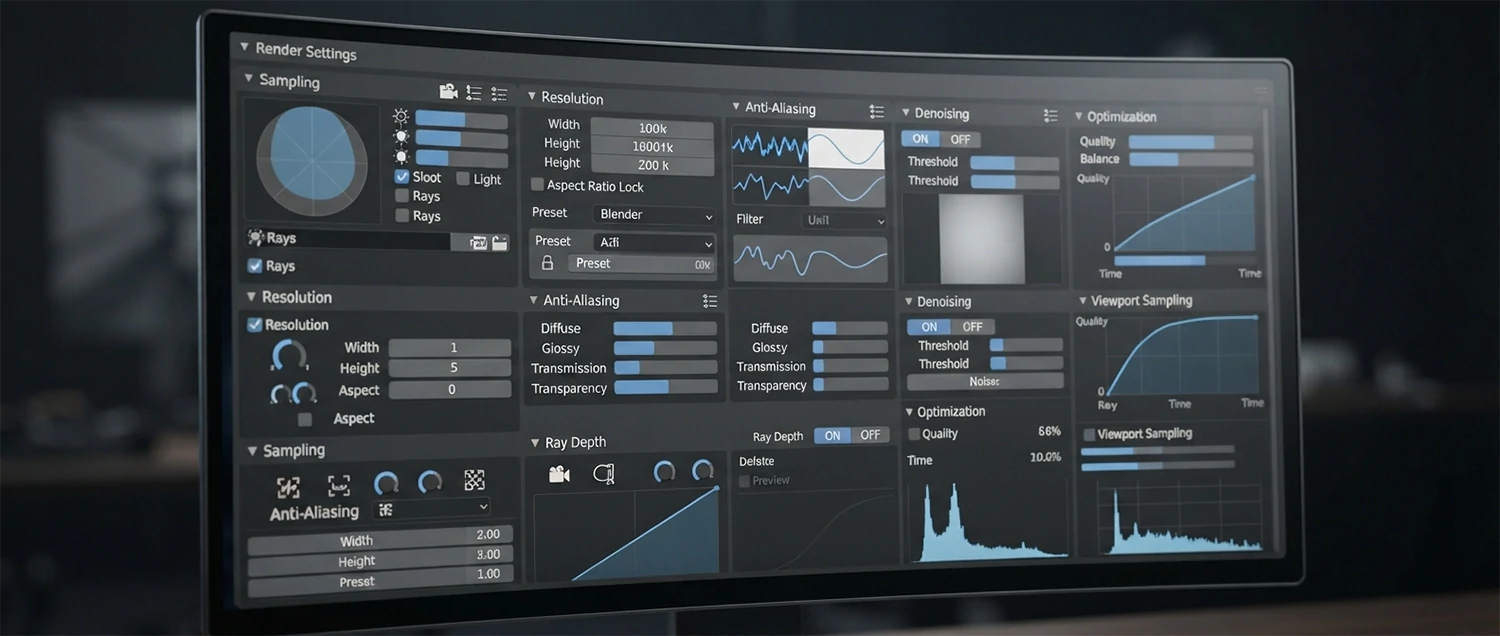
Render settings and optimization determine the balance between image quality and rendering time. Professional rendering services understand how to configure these settings to achieve the required quality level within project timelines and budgets. Proper optimization ensures renders are completed efficiently without unnecessary computational expense.
Key render settings include sampling rate which controls quality by determining how many light samples are calculated per pixel. Higher sampling produces cleaner images but increases render time. Resolution determines output dimensions and pixel density reflected in final file sizes. Anti-aliasing settings smooth jagged edges. Ray depth controls how many light bounces are calculated, affecting realism of reflections and refractions.
Optimization techniques include render region rendering that tests settings on small image areas before committing to full renders, render passes that separate different visual elements for efficient post-processing, and denoising algorithms that clean up noisy renders so lower sampling rates can be used. Experienced rendering artists optimize these settings to achieve maximum quality per render hour spent.
Render Farms and Cloud Rendering
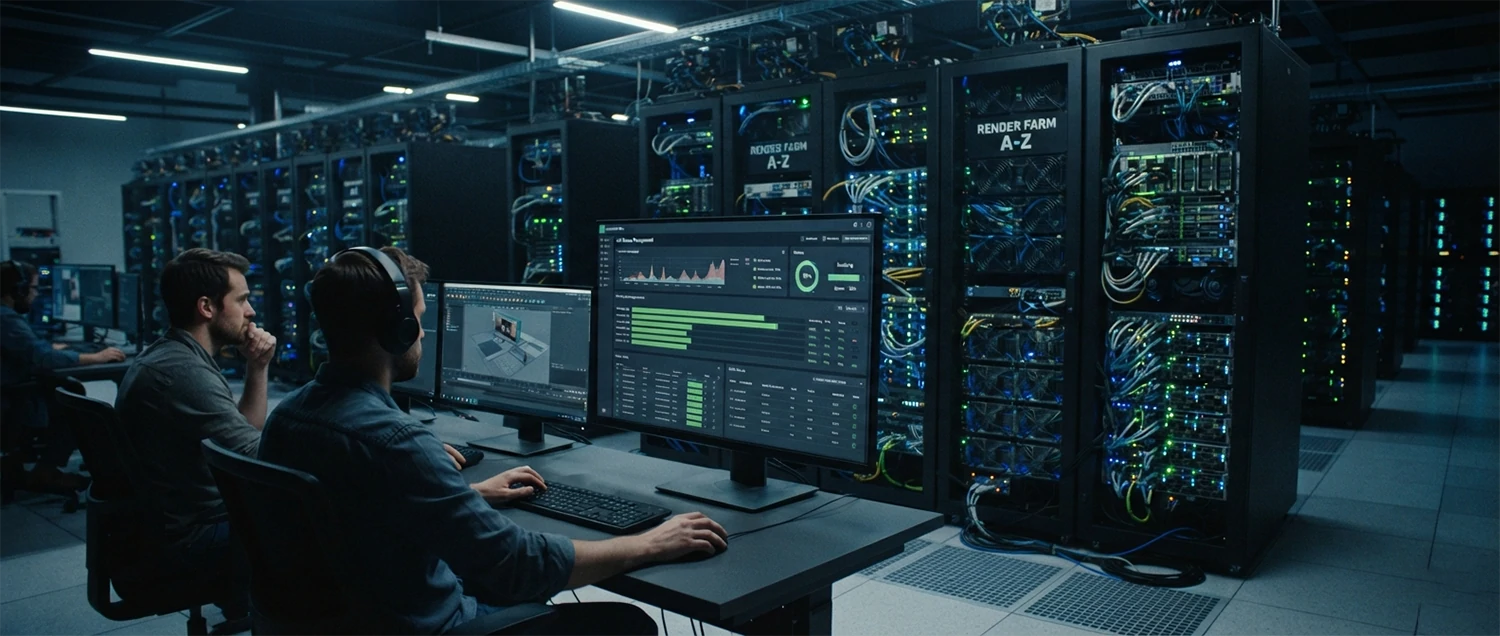
Render farms and cloud rendering services provide access to massive computational resources that dramatically reduce rendering time for complex product scenes. Instead of relying on local workstation processing power, rendering services can distribute render calculations across hundreds or thousands of networked computers, completing in minutes what might require days on a single machine.
Professional rendering companies maintain their own render farms or partner with cloud rendering providers. These facilities house powerful server-grade GPUs and CPUs optimized for rendering workloads. Clients benefit from faster turnaround times, the ability to render multiple variations simultaneously, and the capacity to handle extremely complex scenes with billions of light calculations.
Cloud rendering platforms offer pay-per-use pricing models that make high-performance rendering accessible for projects of any size. Files are uploaded securely, rendering jobs are queued and processed, and finished frames are downloaded back to the rendering studio. Professional services manage this process seamlessly, handling file formats, compatibility, and quality control across distributed rendering environments.
Post-Processing and Compositing
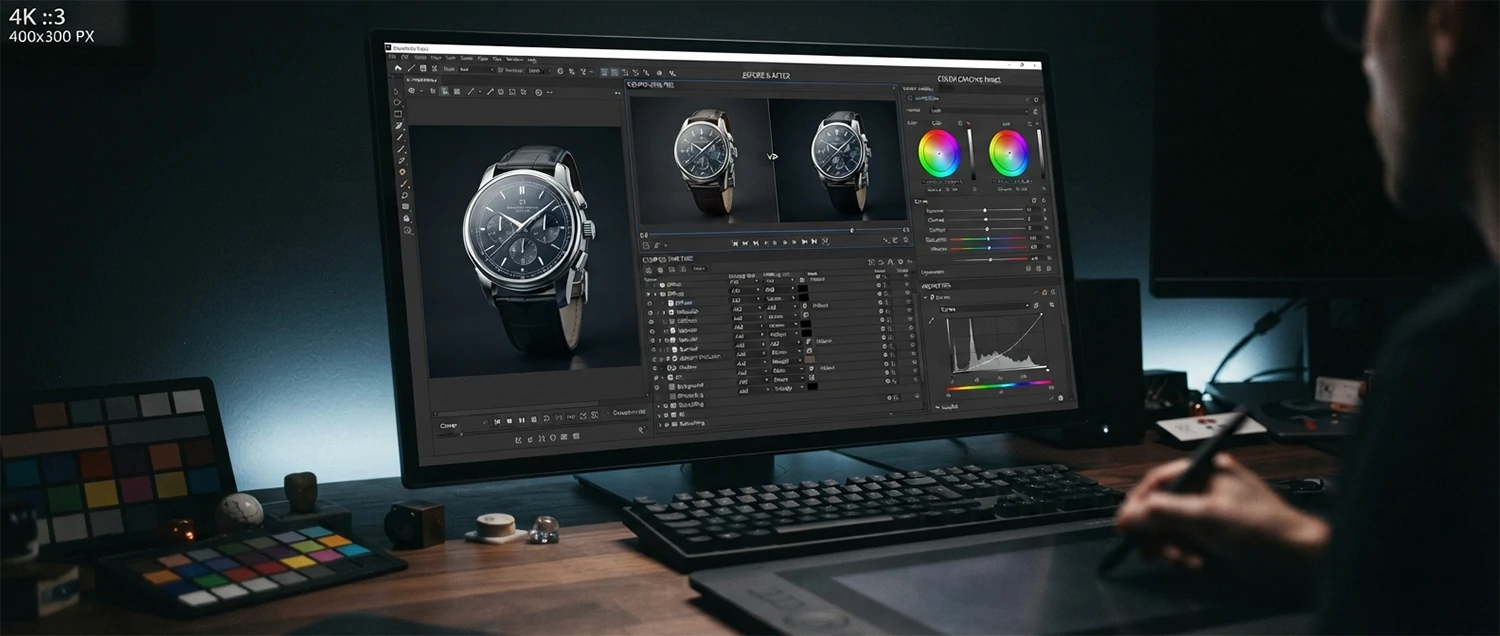
Post-processing and compositing transform raw render output into final polished images ready for publication. While rendering produces the foundation, post-processing adds the refinements that elevate images from good to exceptional. Professional post-processing services bring years of experience in color science, retouching, and compositing techniques that enhance rendered imagery.
Common post-processing steps include color grading to establish consistent visual tone and brand alignment, contrast and exposure adjustments that refine image presence, sharpening that enhances perceived detail, dust and artifact removal, and background integration that seamlessly composites products into contextual settings. Professional colorists ensure renders match brand color specifications exactly.
Compositing combines multiple render passes or elements into final images. A single product render might combine separate passes for diffuse lighting, reflections, shadows, ambient occlusion, and depth information. Compositing gives post-production artists control to adjust each element independently, creating final images with perfect balance across all visual properties.
Texture Creation and Mapping
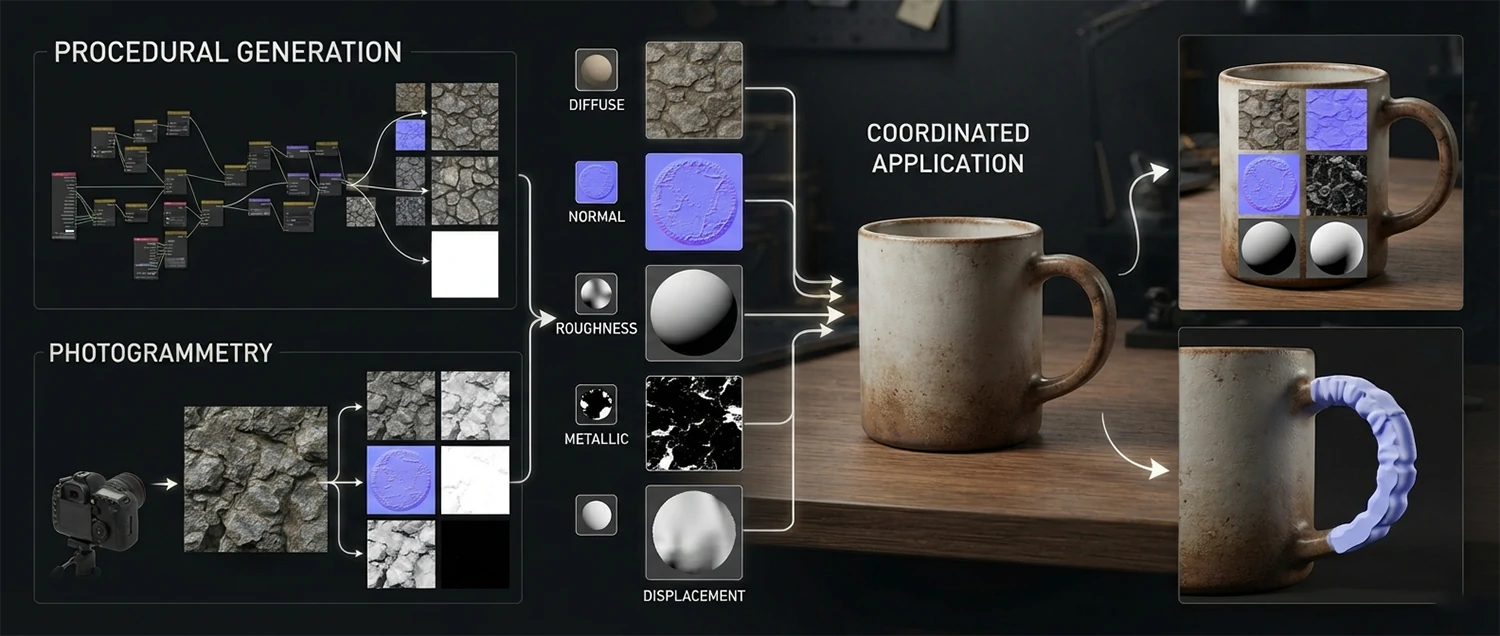
Texture creation and mapping form the visual surface layer of 3D rendered products, determining colors, patterns, details, and surface variations that make rendered objects appear real. Professional texture artists create custom textures from scratch or modify existing texture libraries to match specific product requirements, ensuring every surface detail is accurately represented.
Texture types include diffuse maps defining base color and pattern, normal maps encoding surface bump detail without geometric complexity, roughness maps controlling surface micro-texture light interaction, metallic maps defining conductive properties, and displacement maps physically altering geometry for deep surface features. Each texture type requires specific creation techniques and careful coordination with other maps.
Procedural texture generation creates textures mathematically rather than from photographs, offering infinite resolution and seamless tiling. This approach excels for natural materials like wood grain, stone patterns, and fabric weaves where organic variation is important. Photogrammetry techniques capture real-world surface detail for reproduction in digital renders, achieving unprecedented realism for authentic product representations.
Asset Preparation and Model Optimization
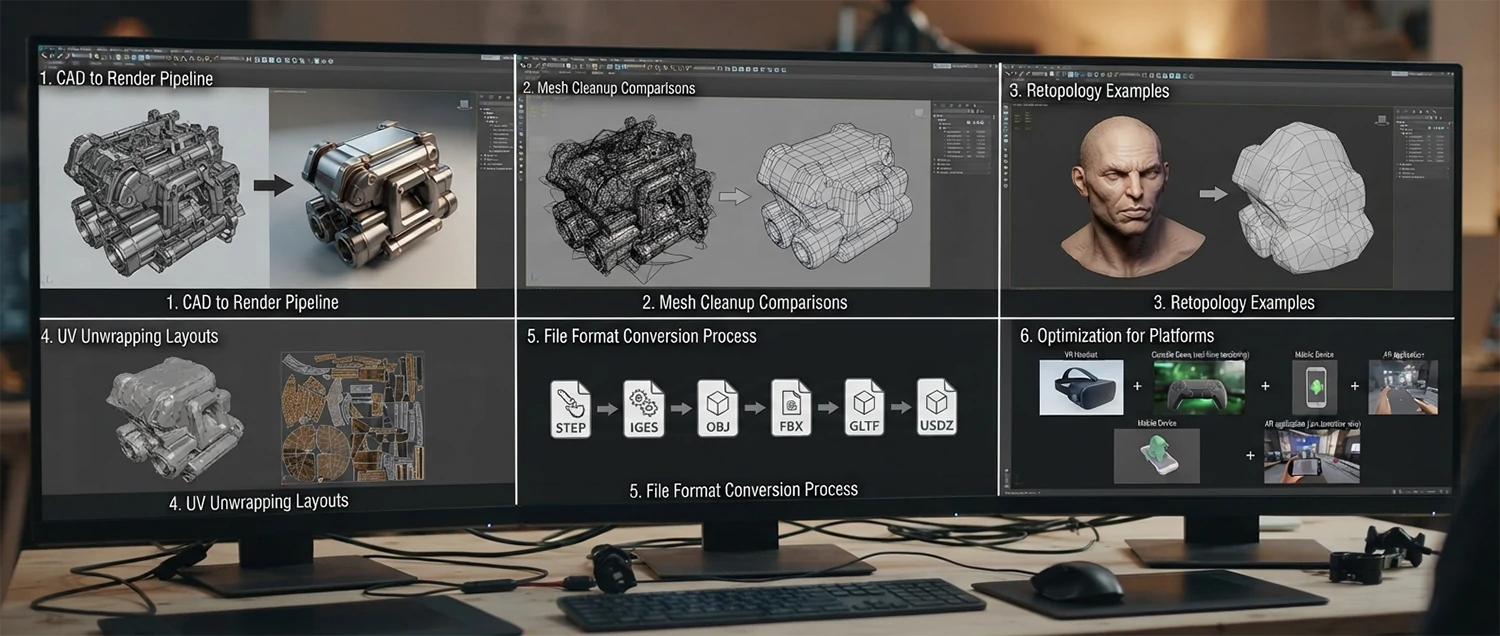
Asset preparation and model optimization ensure that 3D files are ready for efficient, high-quality rendering. Raw CAD or design files often require significant preparation before they can be rendered effectively. Professional rendering services have established workflows for converting engineering data into render-ready assets while maintaining design intent and dimensional accuracy.
Common preparation steps include mesh cleanup removing duplicate geometry and non-manifold edges, retopology reorganizing geometry for optimal rendering performance, UV unwrapping creating efficient texture coordinate layouts, naming conventions organizing scene elements logically, and file format conversion between CAD and rendering software. Each step requires specialized tools and expertise.
Optimization for different delivery formats is another critical service. Models intended for high-resolution print renders require different optimization than models for web-based interactive viewers or mobile AR applications. Professional services understand all these requirements and prepare assets appropriately for their intended use, saving clients time and ensuring consistent quality across all outputs.
Output Formats and Delivery Specifications
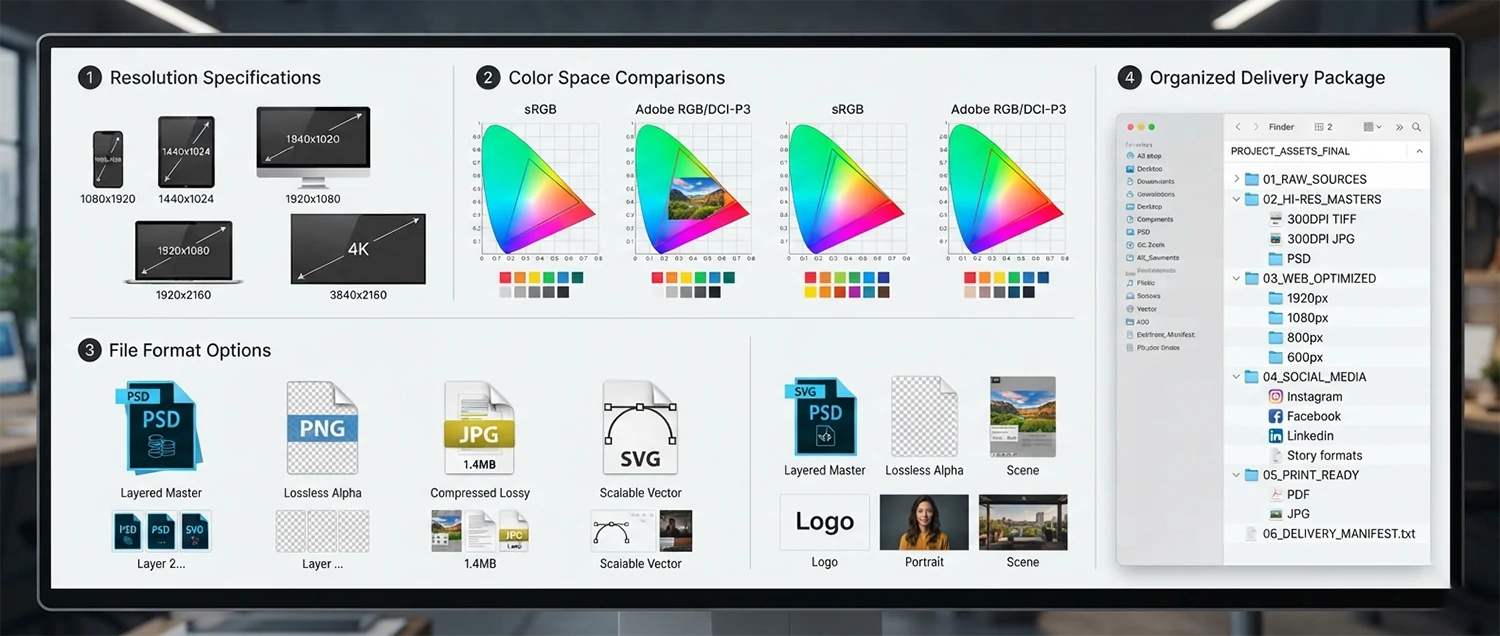
Professional 3D product rendering services deliver final assets in formats and specifications matched to client requirements and intended use cases. Understanding output options helps clients specify exactly what they need for their particular applications, ensuring rendered assets integrate seamlessly into existing workflows and platforms.
Common output specifications include resolution and aspect ratio for specific platforms like social media, e-commerce listings, print catalogs, or trade show displays. Color space selection between sRGB, Adobe RGB, or CMYK ensures accurate color reproduction across different media. File formats such as PNG for e-commerce, TIFF for print production, JPEG for web use, and layered PSD or EXR files for post-production flexibility each serve different purposes.
Delivery specifications extend beyond file formats to include naming conventions, folder structures, metadata embedding, and version control documentation. Professional services provide organized delivery packages that make it easy for client teams to find, use, and manage rendered assets. Batch delivery of multiple product variations, color options, and camera angles is coordinated efficiently.
Pricing Models for Rendering Services
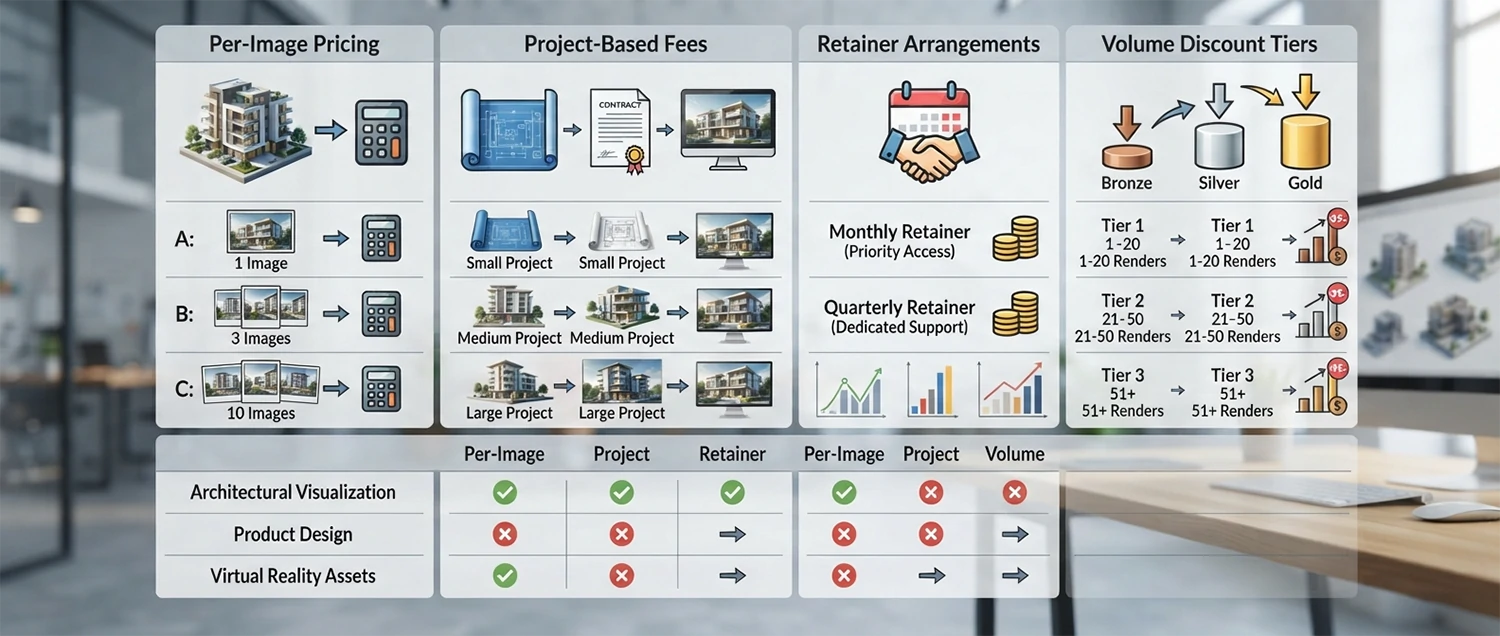
Pricing models for 3D product rendering services vary based on project complexity, quality requirements, turnaround time, and usage rights. Understanding common pricing approaches helps clients evaluate proposals and budget appropriately for their rendering needs. Transparent pricing discussions ensure both parties have aligned expectations from project inception.
Per-image pricing is the most straightforward model where each finished render is quoted individually based on complexity. Simple product-on-white renders typically cost less than complex lifestyle scenes with multiple elements, custom environments, and extensive post-processing. Volume discounts are commonly offered for projects requiring multiple product views or large product catalogs.
Project-based pricing provides a fixed fee for complete rendering projects including all deliverables, revisions, and project management. Retainer arrangements offer reduced per-unit rates for ongoing rendering needs with guaranteed capacity. Hourly billing is less common but appropriate for exploratory work, conceptual rendering, or projects with undefined scopes. Each model has advantages depending on project requirements and volume.
Evaluating Portfolio and Previous Work
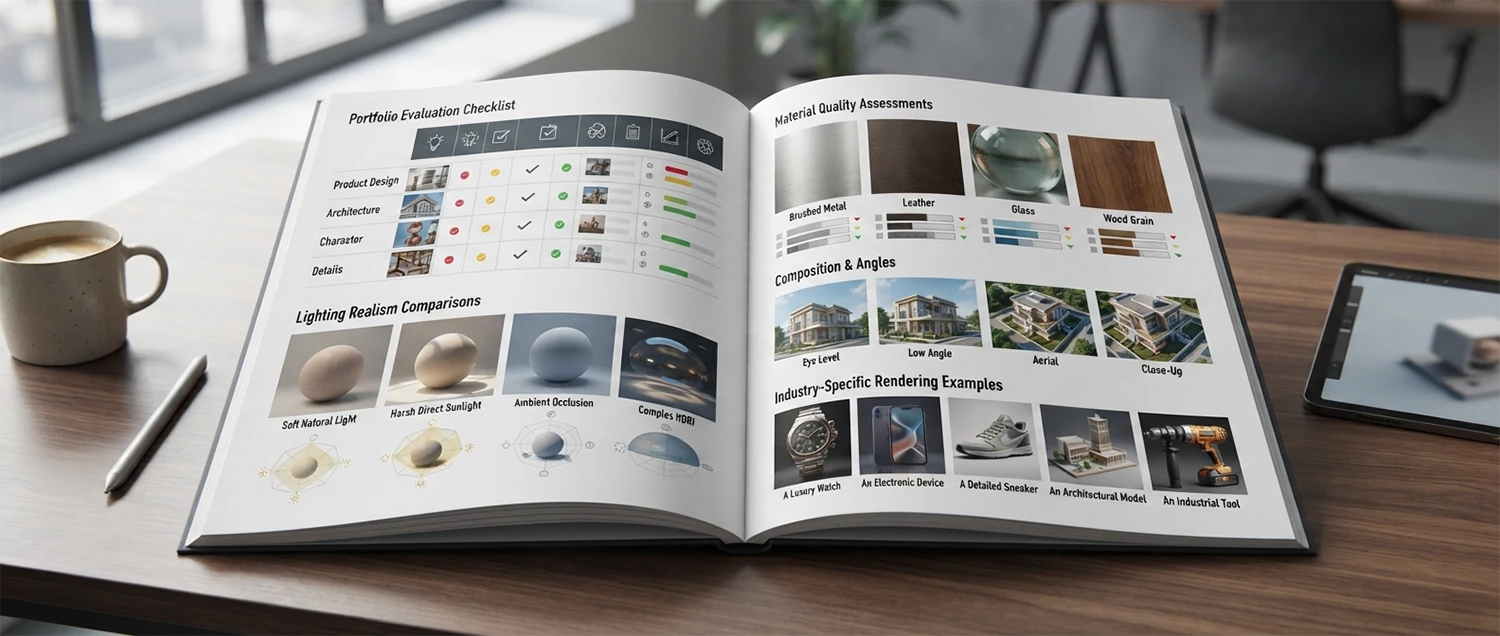
Evaluating a rendering service portfolio is essential for selecting the right partner for your product visualization needs. A portfolio reveals technical capability, artistic sensibility, industry experience, and quality consistency across different project types. Savvy clients know what to look for when assessing rendering portfolios to make informed hiring decisions.
Key quality indicators include lighting realism where shadows, reflections, and illumination appear natural and physically accurate. Material quality shows surfaces with convincing properties including proper roughness, reflectivity, and texture detail. Composition demonstrates thoughtful framing, camera angles, and visual hierarchy. Attention to small details like surface imperfections, environmental reflections, and realistic wear adds authenticity.
Relevant experience in your product category is important but not essential. Strong rendering skills transfer across categories. Look for versatility in style, consistent output quality, evidence of handling complex projects, and client testimonials. Request full-resolution samples rather than web-compressed versions to truly evaluate render quality. Professional services readily provide relevant work samples.
Turnaround Time and Production Scheduling
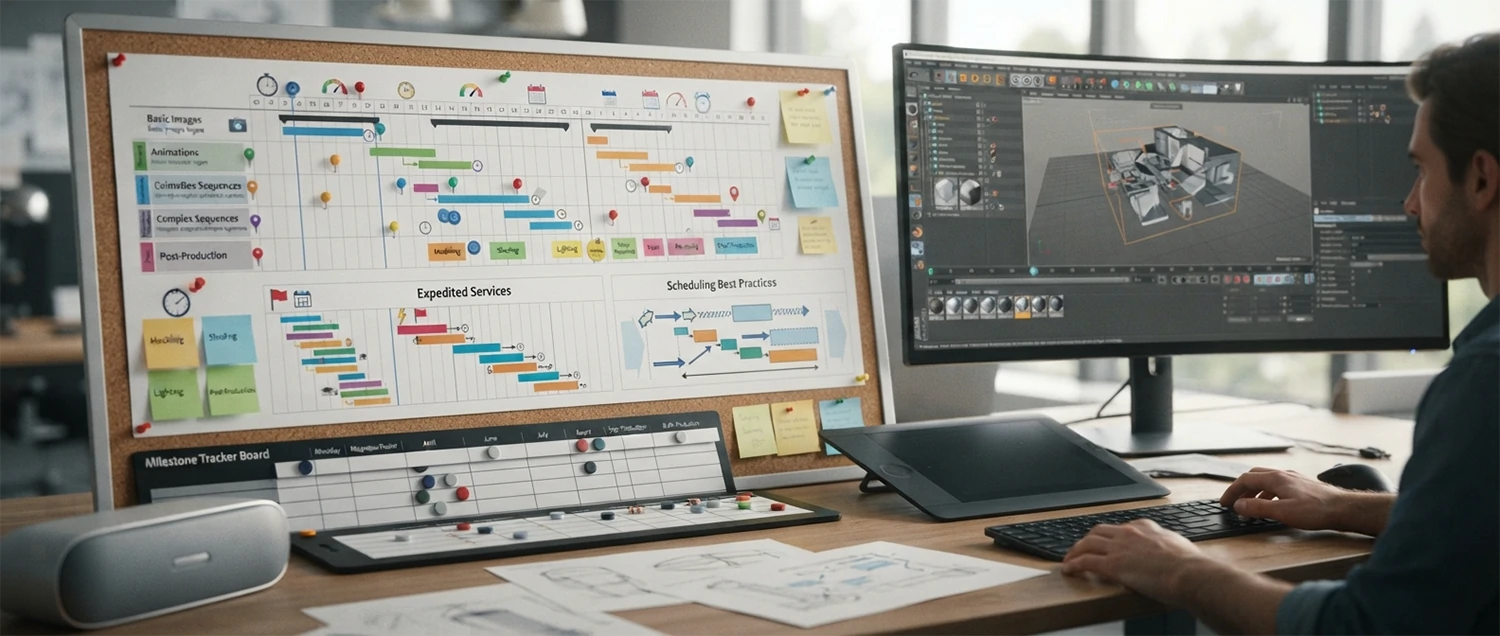
Turnaround time for 3D product rendering projects depends on complexity, quantity, quality requirements, and current workload of the rendering service. Understanding typical production timelines helps clients plan marketing campaigns, product launches, and content creation schedules effectively. Professional services provide realistic timelines and communicate progress throughout production.
Simple product renders on white backgrounds with standard lighting might be completed in a few days to a week per image. Complex lifestyle scenes with custom environments, multiple products, detailed materials, and extensive post-processing can require one to three weeks per image. Animation projects require additional time proportional to length and frame count.
Expedited services are available for rush projects requiring faster turnaround, typically at premium pricing. Planning ahead and providing complete, well-organized source materials significantly reduces production time. Professional rendering services manage multiple projects simultaneously and schedule work to meet client deadlines consistently. Regular communication on timeline expectations maintains project momentum.
Communication and Project Workflow
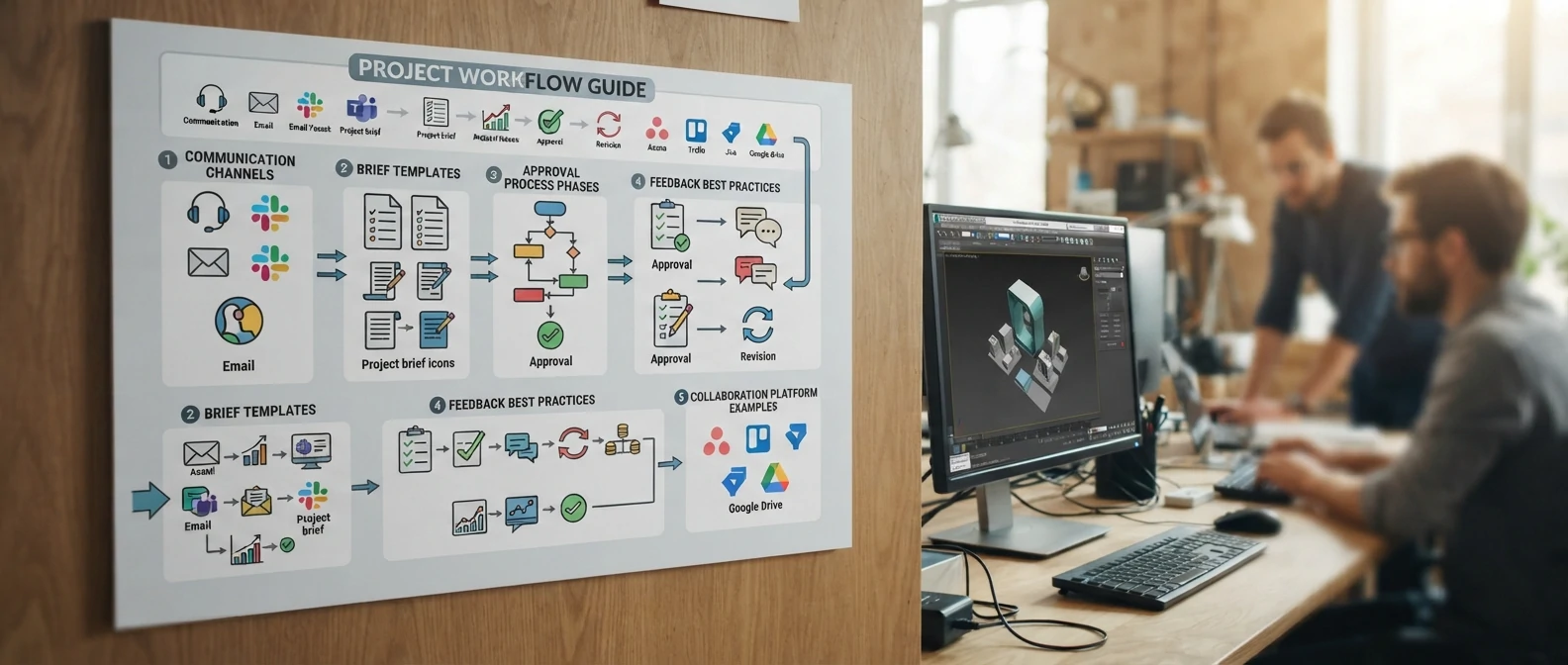
Effective communication and structured project workflow ensure successful rendering project outcomes. Professional rendering services establish clear communication channels, defined approval processes, and efficient feedback mechanisms that keep projects moving forward smoothly. Clients who understand how to work effectively with rendering services achieve better results faster.
Initial project briefs should clearly communicate product specifications, intended use of renders, brand guidelines, visual references, and quality expectations. Providing reference images, competitor examples, and mood boards helps rendering artists understand desired aesthetic direction. Well-prepared briefs reduce the number of revision rounds and accelerate production.
Workflow typically progresses through concept phase with initial direction exploration, review phase where draft renders are evaluated, revision phase where feedback is incorporated, and final delivery where approved assets are provided in required formats. Online collaboration platforms enable real-time feedback and version tracking. Professional services manage this workflow efficiently with clear milestone expectations.
Intellectual Property and Usage Rights
Intellectual property rights and usage licensing are important legal considerations in 3D product rendering services. Clear agreements on ownership, usage scope, and limitations protect both clients and rendering providers. Understanding standard IP arrangements helps clients negotiate fair terms that align with their business needs.
Standard arrangements typically transfer full copyright ownership of rendered images to clients upon final payment, granting unlimited usage rights for marketing, advertising, e-commerce, and any other business purposes. Some rendering services retain rights to display work in portfolios, which benefits both parties through marketing exposure. Exclusive arrangements can be negotiated for competitive advantage.
Usage scope considerations include media channels where renders can be used, geographic territories, duration of use, and exclusivity periods. Additional fees may apply for extended use beyond standard terms such as worldwide advertising campaigns, broadcast media, or licensed merchandising. Professional services clearly document these terms in service agreements to prevent future disputes.

Revision and Approval Process
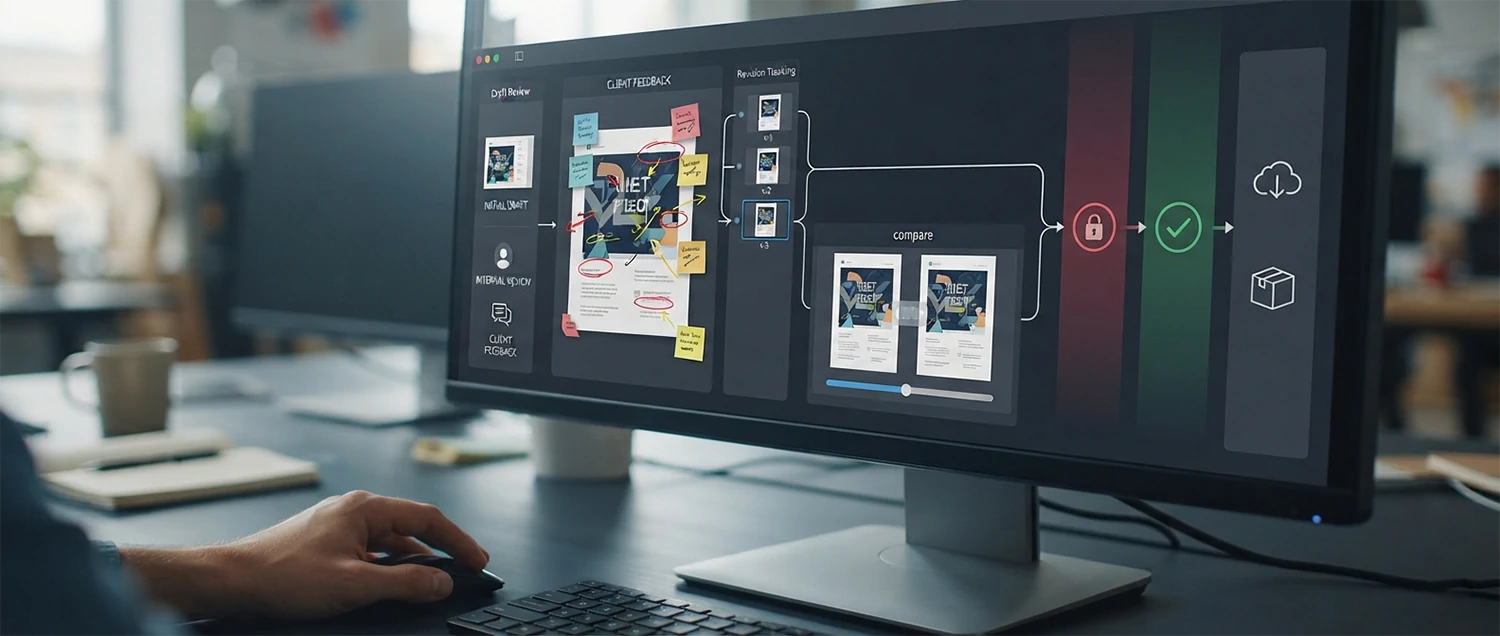
The revision and approval process is a critical phase in 3D product rendering projects where client feedback is incorporated to refine renders toward final quality. Professional rendering services structure this process efficiently to balance quality refinement with production timelines. Understanding how to provide effective feedback accelerates the revision process.
Typical revision cycles begin with draft renders at lower resolution for initial review, allowing clients to evaluate composition, lighting, and materials before full-resolution rendering. Feedback should be specific and actionable, referencing particular elements that need adjustment. Annotated screenshots, reference images, and written descriptions help communicate desired changes clearly.
Most rendering services include a specified number of revision rounds in their standard pricing, with additional revisions charged at agreed rates. Approved renders move to final high-resolution output and format delivery. Professional services maintain revision history and provide comparison tools that help clients evaluate progress between versions.
Common Mistakes and How to Avoid Them
Understanding common mistakes in 3D product rendering helps clients avoid pitfalls that compromise quality, increase costs, and delay projects. Knowledgeable clients who recognize these issues can set better expectations, provide better source materials, and select rendering services that consistently deliver high-quality results.
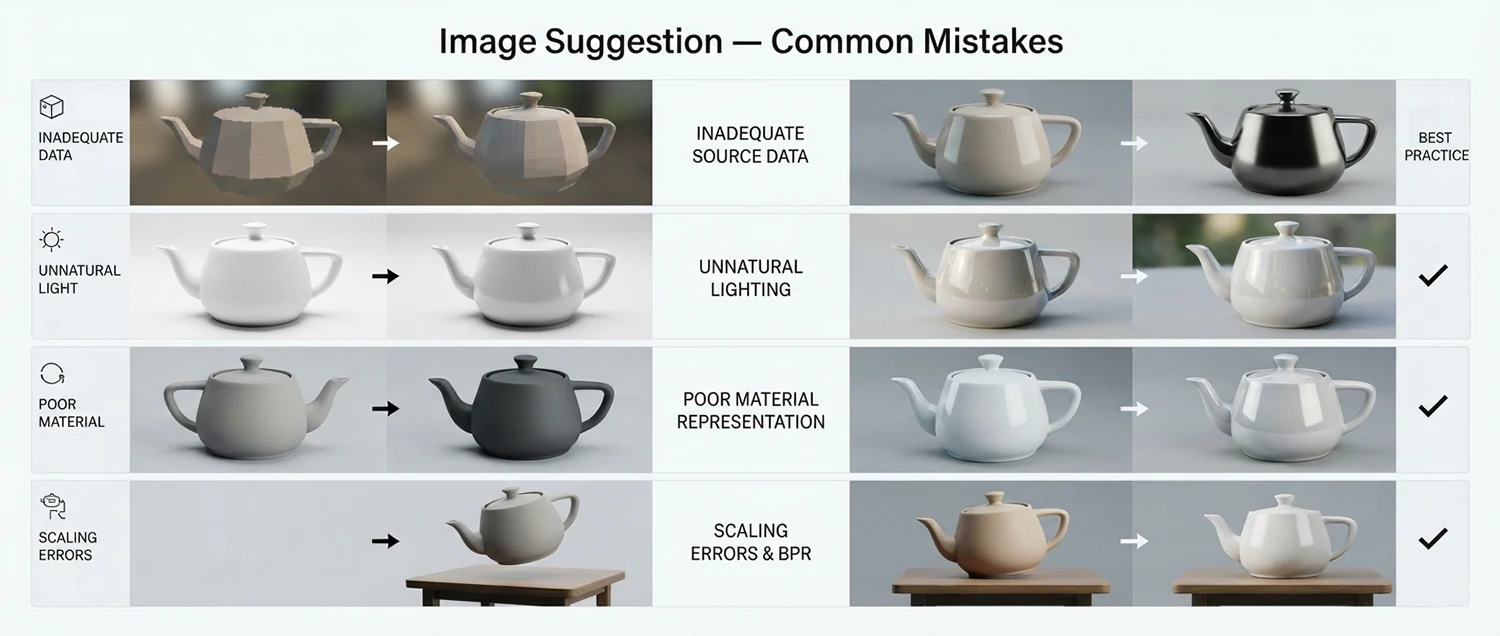
Frequent mistakes include inadequate source data where CAD files are incomplete or unorganized causing modeling delays, unrealistic timelines that force compromises on quality or completeness, unclear creative direction resulting in multiple revision rounds, and insufficient budget allocation that limits render complexity. Clients should invest time in project preparation to avoid these issues.
Technical missteps on the service side include poor material definitions that produce plastic-looking results, unnatural lighting setups that create unconvincing shadows and reflections, improper scaling that distorts product proportions, and over-reliance on default settings without custom optimization. Professional services have quality control processes that catch these issues before client delivery.
AI Integration in Product Rendering
Artificial intelligence is transforming 3D product rendering, introducing new capabilities that accelerate workflows, enhance quality, and enable creative possibilities previously impractical. Professional rendering services increasingly integrate AI tools alongside traditional rendering techniques to deliver superior results more efficiently. Understanding AI applications helps clients leverage these advances.
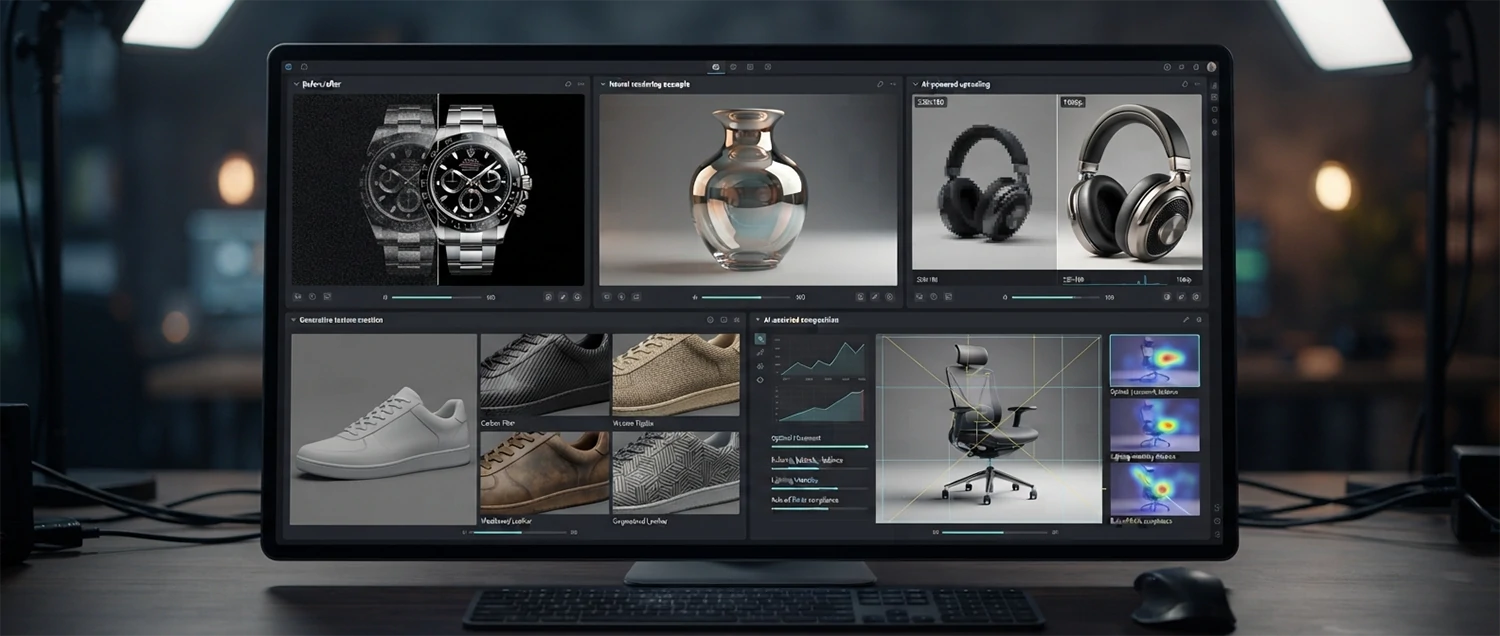
AI denoising has become standard in rendering pipelines, using machine learning algorithms to clean up noisy renders in seconds rather than requiring extended render times for perfect results. Neural rendering techniques generate photorealistic images from simpler 3D inputs. AI-powered upscaling creates high-resolution renders from lower-resolution outputs, dramatically reducing render time requirements.
Generative AI assists with texture creation, background generation, and material ideation where artists can describe desired results in natural language and receive suitable options. AI-driven composition analysis suggests optimal camera angles and framing. While AI significantly enhances rendering workflows, professional oversight remains essential for quality control, creative direction, and brand alignment.
Industry-Specific Rendering Solutions
Different industries have unique 3D product rendering requirements based on their products, target audiences, and marketing channels. Professional rendering services develop specialized expertise across multiple industry sectors, adapting their techniques to meet specific needs. Understanding industry-specific considerations helps clients find rendering partners with relevant experience.
Consumer electronics rendering demands precise material representation for glass, metal, and plastic surfaces with accurate screen displays and interface elements. Automotive rendering requires high-quality paint finishes, chrome reflections, interior materials, and contextual environments. Furniture rendering focuses on fabric textures, wood grains, scale accuracy, and room setting integration.
Packaging rendering requires accurate color reproduction, label details, structural integrity representation, and shelf-ready presentation. Medical device rendering needs precise dimensional accuracy, clean sterile environments, and clear feature callouts. Fashion and apparel rendering demands realistic fabric draping, accurate color representation, and appealing presentation on or off virtual models.

Long-Term Partnerships and Retainers
Establishing long-term partnerships or retainer arrangements with 3D product rendering services offers significant advantages for businesses with ongoing visualization needs. These relationships develop over time into efficient, collaborative partnerships that deliver consistent quality with minimal onboarding overhead for each new project.
Retainer arrangements guarantee dedicated rendering capacity, priority scheduling, and reduced per-project rates. Long-term partners develop deep understanding of client brand guidelines, product lines, quality standards, and preferred visual styles. This accumulated knowledge reduces project setup time and improves consistency across all rendered assets produced over time.
Partnership benefits include streamlined communication where teams work together efficiently without repeated introductions, faster turnaround through established workflows and templates, volume pricing advantages, and collaborative innovation where rendering partners contribute creative ideas and technical improvements. Many successful brands maintain decade-long relationships with trusted rendering partners.

Future Trends in 3D Product Rendering
The 3D product rendering industry continues to evolve rapidly, driven by technological advances, changing consumer expectations, and new marketing channels. Staying informed about emerging trends helps businesses make strategic decisions about their visualization investments and maintain competitive advantage in their markets.
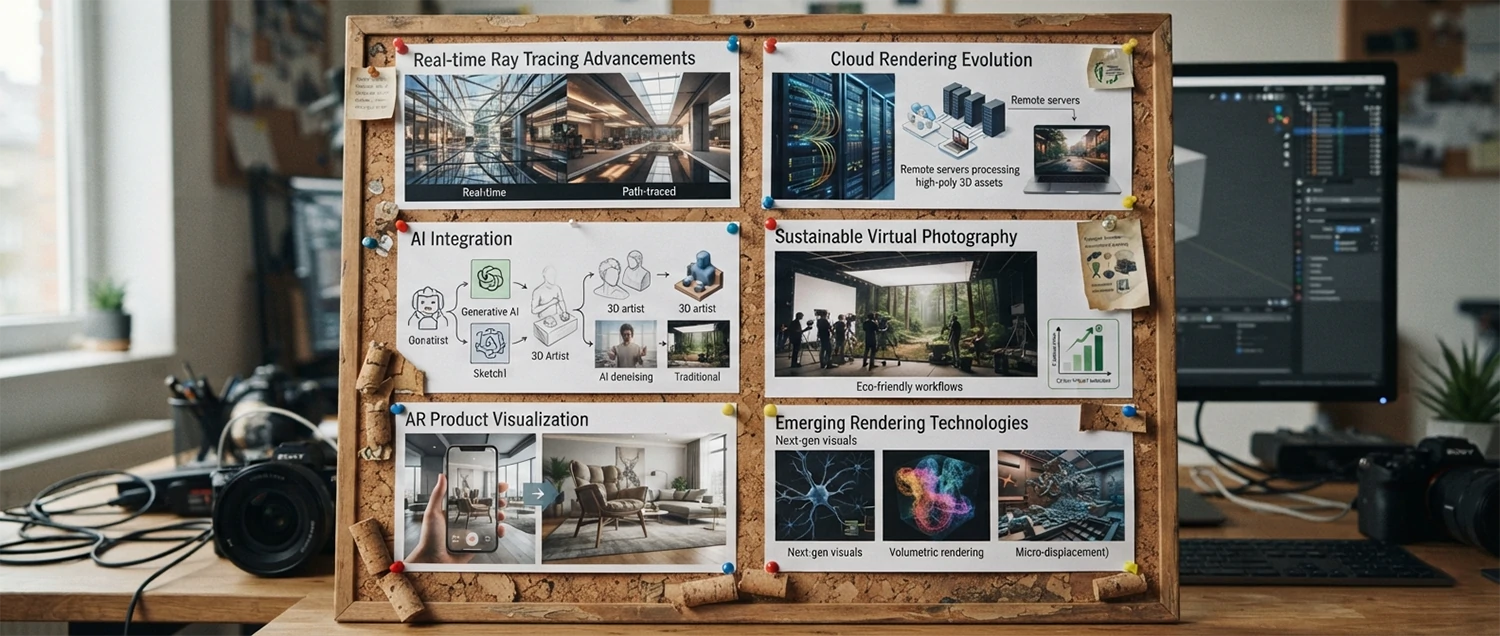
Real-time ray tracing technology increasingly bridges the gap between real-time and offline rendering quality, enabling interactive product experiences with cinematic visual quality. Cloud-based rendering services make high-performance computing accessible to businesses of all sizes without capital investment. AI integration continues to automate routine tasks and enhance creative possibilities.
Sustainability considerations are driving interest in virtual photography that eliminates the environmental impact of physical product photography. Augmented reality product visualization becomes standard in e-commerce. As these trends converge, 3D product rendering becomes more accessible, more capable, and more integral to commercial success across industries.
E-Commerce and Catalog Rendering
E-commerce and product catalog rendering is one of the most significant applications of 3D product visualization services. Online retailers require consistent, high-quality product imagery across thousands of SKUs, and 3D rendering delivers this at scale while maintaining visual uniformity impossible with traditional photography. Professional rendering services specialize in e-commerce workflows that handle high-volume product visualization requirements efficiently.
Catalog rendering demands consistent lighting, camera angles, and styling across all products in a collection so customers can compare items fairly. White-background product shots for e-commerce listings require precise exposure and color accuracy. Multi-angle product views give customers comprehensive visual information that reduces return rates and increases purchase confidence. Color variant renders show every available option without additional photography costs.
Scalability is a key advantage of 3D rendering for e-commerce. Once a product is modeled, unlimited views, angles, and configurations can be rendered without additional setup costs. Seasonal catalog updates, new color introductions, and promotional variations are generated quickly from existing models. Professional rendering services offer batch processing capabilities that deliver hundreds of consistent product images within tight production timelines.

AR and Virtual Try-On Integration
Augmented reality and virtual try-on experiences represent the cutting edge of 3D product rendering applications, enabling customers to visualize products in their own environments or on themselves before purchasing. Professional rendering services prepare and optimize 3D assets specifically for AR platforms, ensuring seamless performance across mobile devices and web browsers while maintaining visual quality.
AR product visualization allows customers to place true-to-scale 3D products in their real-world spaces using smartphone cameras. Furniture retailers use this to show how sofas fit in living rooms, home decor brands display artwork on actual walls, and electronics companies demonstrate device sizes on real desks. These immersive experiences significantly increase purchase confidence and reduce return rates.
Virtual try-on extends AR capabilities to wearable products including apparel, accessories, and cosmetics. Customers see how products look on themselves through their device cameras, using facial tracking and body mapping technology. Professional rendering services optimize 3D models for real-time AR performance, balancing polygon counts and texture resolutions for smooth mobile experiences while retaining product detail and brand fidelity.

Quality Assurance and Render Verification
Quality assurance and render verification processes ensure that final 3D product renders meet client specifications, brand standards, and technical requirements before delivery. Professional rendering services implement systematic QA workflows that catch errors, inconsistencies, and quality issues early in the production pipeline, saving time and ensuring client satisfaction with every deliverable.
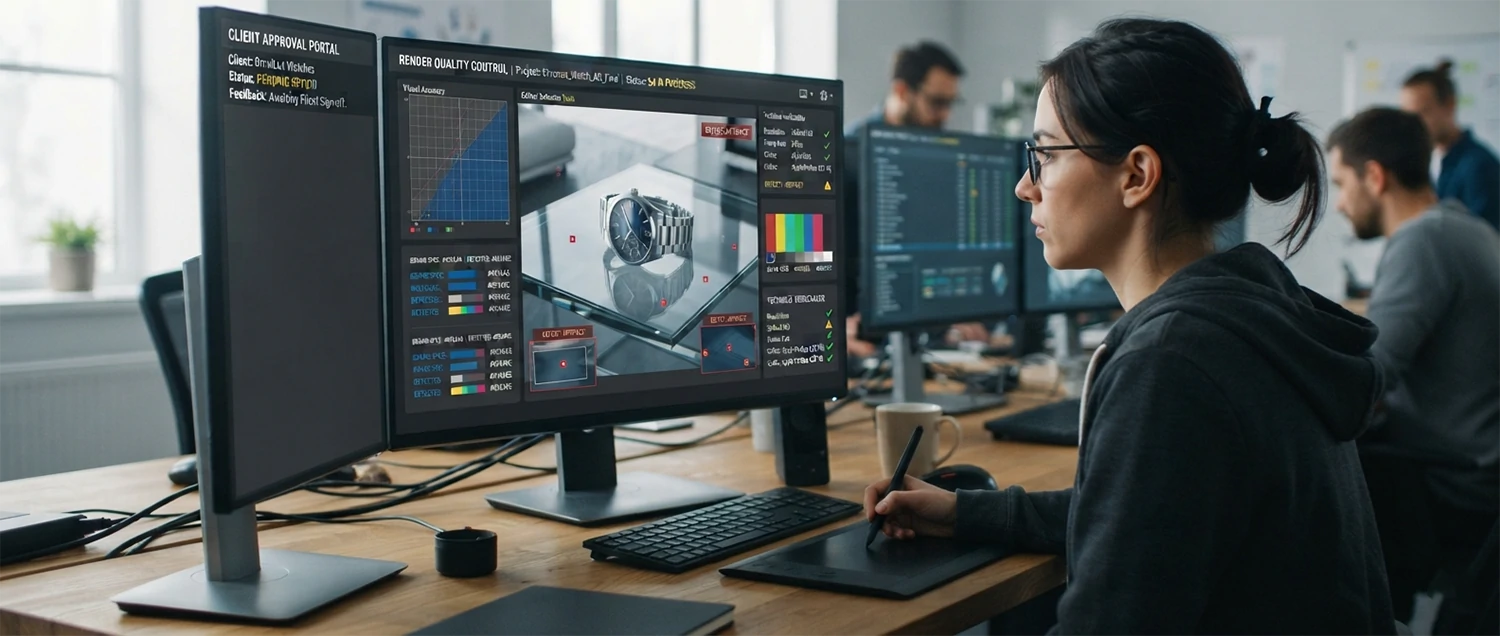
Visual quality checks verify color accuracy against brand color specifications, proper material representation, consistent lighting across product views, and absence of rendering artifacts like noise, fireflies, or geometry errors. Technical checks confirm correct resolution, color space, file format, and naming conventions according to project specifications. Comparison tools check renders against reference images for dimensional and visual accuracy.
Systematic QA documentation tracks each render through the verification process with status updates, approval records, and revision history. Automated scripts perform initial technical validation, while experienced artists conduct visual reviews. Client approval portals provide streamlined review and sign-off interfaces. Professional rendering services treat QA as an integral part of their production workflow, not an afterthought.
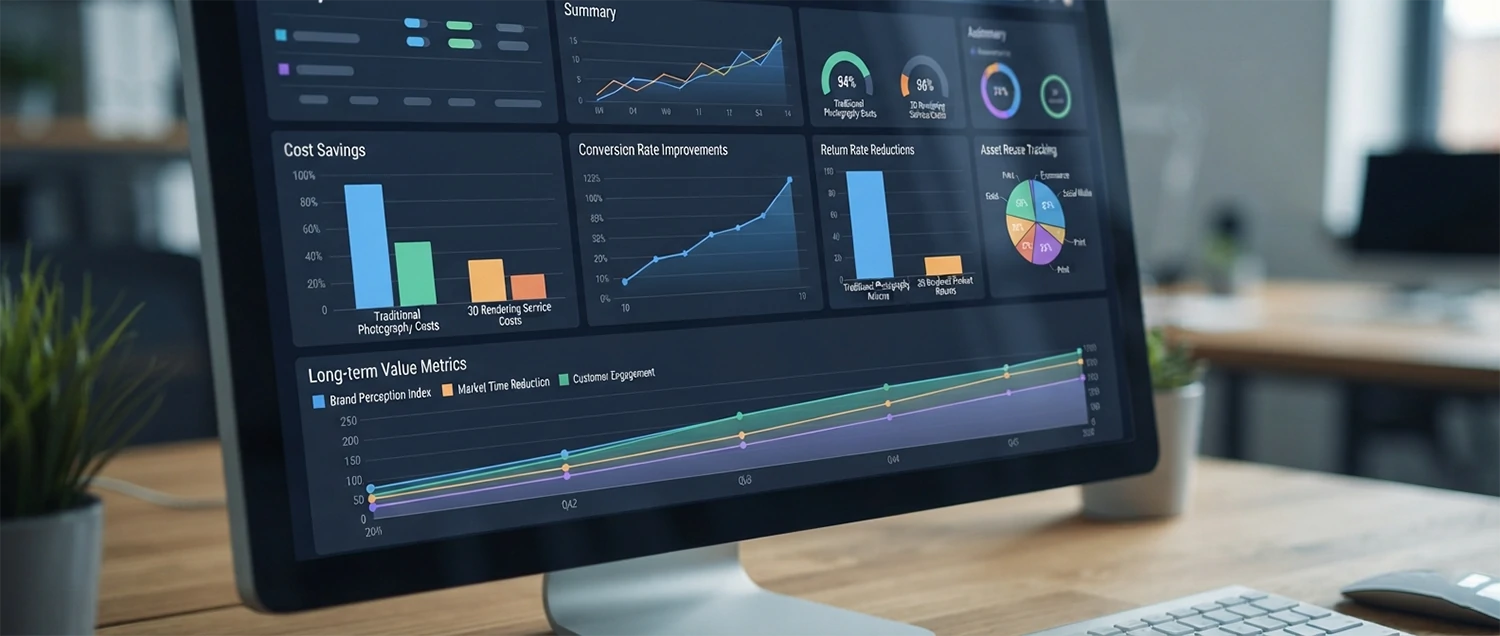
Measuring ROI from Rendering Services
Measuring return on investment from 3D product rendering services helps businesses justify visualization expenditures and optimize their rendering strategies over time. While the benefits of professional product rendering are substantial, quantifying them provides concrete evidence for budget decisions and helps identify which rendering applications deliver the greatest value for specific business contexts.
Direct cost savings come from reduced photography expenses, elimination of physical sample production for photoshoots, faster time-to-market for new products, and lower retouching costs. E-commerce businesses measure ROI through improved conversion rates, reduced return rates from better product visualization, increased average order value from configurator engagement, and higher customer satisfaction scores from immersive product experiences.
Long-term ROI includes marketing efficiencies from reusing rendered assets across multiple channels, brand consistency improvements from standardized visualization, and competitive advantages from faster product launches with complete visual content. Professional rendering services help clients track these metrics and optimize their rendering investments. Many clients find that rendering pays for itself within the first major product campaign through reduced photography and retouching costs alone.
Frequently Asked Questions
What is the difference between 3D rendering and 3D modeling?
3D modeling creates the digital wireframe geometry of an object, while 3D rendering generates the final realistic image by calculating how light interacts with that geometry, materials, and textures. Modeling is the construction phase; rendering is the visualization phase that produces the finished image.
How much do professional 3D product rendering services cost?
Costs vary widely based on complexity, quality level, and usage rights. Simple product-on-white renders typically range from $100 to $500 per image. Complex lifestyle scenes with custom environments and extensive post-processing range from $500 to $2,500 or more per image. Volume discounts apply for larger projects. Complex animation and interactive projects are quoted individually based on scope.
How long does it take to produce a professional product render?
Timelines depend on complexity. Simple renders can be completed in 2-5 business days. Complex lifestyle or multi-product scenes typically require 1-3 weeks. Animation projects require additional time based on length and frame count. Rush services with premium pricing can accelerate timelines when needed.
What file formats do I need to provide for rendering?
Most rendering services accept common 3D file formats including STEP, IGES, STL, OBJ, FBX, and native CAD formats like SolidWorks, Rhino, or Blender files. The best format depends on your design software and the complexity of your models. Professional services can advise on optimal file preparation for your specific project.
Can 3D rendering replace professional product photography entirely?
For many applications, yes. 3D rendering offers advantages including cost-effectiveness for multiple variations, the ability to visualize products before manufacturing, unlimited angle and lighting options, and easy color or configuration changes. However, some brands value the authenticity of photography for certain contexts. Many businesses use both approaches strategically.
How many revisions are typically included in rendering projects?
Most professional rendering services include 2-3 revision rounds in their standard pricing. Additional revisions beyond the agreed scope are charged at hourly or per-round rates. The number of included revisions should be clearly stated in your service agreement. Providing clear, detailed feedback helps maximize the value of each revision round.
What industries benefit most from 3D product rendering services?
Consumer electronics, furniture, automotive, packaging, medical devices, fashion, jewelry, home goods, sporting equipment, industrial equipment, and food and beverage all benefit significantly. Virtually any industry that sells physical products can leverage 3D rendering for marketing, e-commerce, catalogs, and advertising.
How do I choose between photorealistic and stylized rendering?
The choice depends on your brand identity, target audience, and marketing objectives. Photorealistic rendering builds trust and accurately represents product appearance, ideal for e-commerce and catalogs. Stylized rendering creates distinctive brand identities and stands out in advertising. Many brands use both approaches for different contexts within their marketing mix.