
This knowledge-based, visitor-centric guide explains what separates a strong custom WordPress development company from the rest—from strategic thinking and technical excellence to team composition, delivery discipline, and long-term partnership—so you can choose wisely and build solutions that last.
Table of contents
- What Defines a Custom WordPress Development Company
- Development Company vs Design Agency: Key Differences
- Core Expertise Areas
- Team Composition: Who Builds Custom Solutions
- Delivery Models and Engagement Structures
- Development Process: Discipline and Rigor
- Quality Assurance: Confidence in Production
- Security and Compliance: Built In, Not Bolted On
- Scalability and Performance: Built for Growth
- Support and Maintenance: The Long Game
- Pricing Models and ROI
- How to Choose a Custom WordPress Development Company
- Delivery Playbooks: Proven Patterns
- KPIs and Governance: Measure Success
- Mini Case Studies (Hypothetical)
- FAQ
- Downloadable Checklist: Custom Development Readiness
- Conclusion: Partnership Over Transactions
SECTION 01
What Defines a Custom WordPress Development Company
A custom WordPress development company is a team of specialists who build bespoke solutions tailored to your exact business needs. They don’t sell templates or plugins; they architect systems, write proprietary code, and operate sites reliably in production. They treat WordPress as a platform for innovation, not a constraint.
The best companies combine deep WordPress expertise with software engineering discipline: architecture, testing, security, DevOps, and long-term partnership. They own outcomes, not just deliverables.

SECTION 02
Development Company vs Design Agency: Key Differences
Both build WordPress sites, but with different strengths and philosophies. Understanding the difference helps you choose the right partner.
Design Agency
Focus: Visual design, UX, branding. Typical work: Brochures, portfolios, lead gen. Timeline: 6–12 weeks.
Dev Company
Focus: Architecture, scale, ops. Typical work: Platforms, stores, integrations. Timeline: 3–12+ months.
SECTION 03
Core Expertise Areas
A mature custom WordPress development company brings expertise across the full stack:
- WordPress core: Deep knowledge of hooks, filters, and architecture
- Custom development: Themes, plugins, and proprietary code
- APIs and integrations: REST, GraphQL, webhooks, third-party systems
- Database design: Custom post types, taxonomies, relationships
- Performance optimization: Caching, CDN, database tuning
- Security: Hardening, compliance, penetration testing
- DevOps: Infrastructure, CI/CD, monitoring, incident response
- Testing: Unit, integration, E2E, performance, security
SECTION 04
Team Composition: Who Builds Custom Solutions
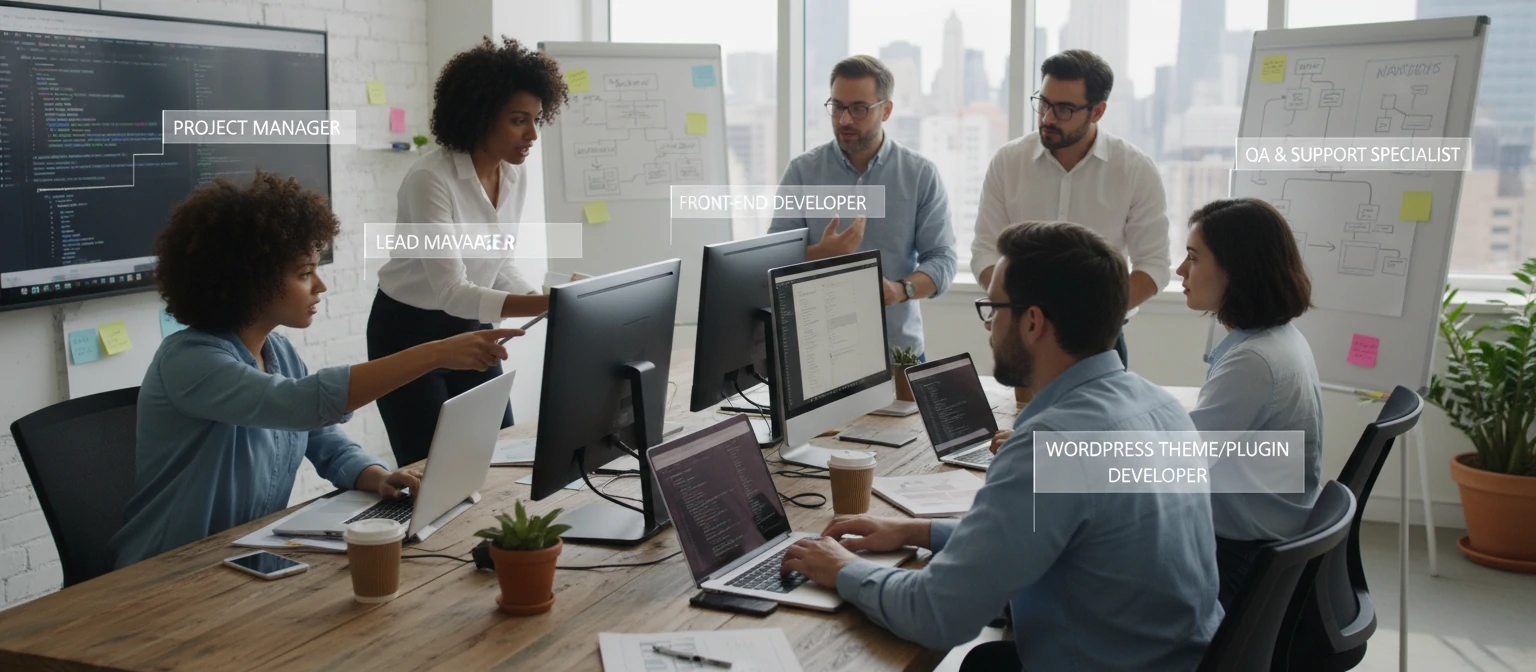
A strong custom development company has specialists across disciplines. Expect to see:
- Technical architects: System design, scalability, technical strategy
- Backend engineers: PHP, WordPress core, custom plugins, APIs
- Frontend engineers: JavaScript, React/Vue, block development
- DevOps/SRE: Infrastructure, CI/CD, monitoring, incident response
- QA engineers: Test automation, performance testing, security scanning
- Product managers: Roadmap, stakeholder alignment, delivery
- Security specialists: Threat modeling, compliance, pen testing
SECTION 05
Delivery Models and Engagement Structures
Choose a model that aligns with your risk tolerance and internal capacity.
- Project-based (fixed scope): Well-defined requirements, fixed timeline and budget. Best for clear, bounded work.
- Time & materials (T&M): Flexible scope, hourly billing. Best for discovery or evolving needs.
- Dedicated team: Embedded squad for ongoing roadmap. Best for long-term partnerships.
- Retainer + project: Base retainer for support + project work for new features.
SECTION 06
Development Process: Discipline and Rigor
A mature company follows a disciplined process. This isn’t bureaucracy; it’s how quality gets built.
- Discovery and requirements gathering
- Architecture and design review
- Iterative development with code reviews
- Continuous testing and integration
- Staging and UAT environments
- Deployment and monitoring
- Post-launch support and optimization
SECTION 07
Quality Assurance: Confidence in Production
Quality separates professional development from hobbyist work. A strong company has rigorous testing practices and clear quality gates.
- Unit tests for business logic
- Integration tests for API contracts
- End-to-end tests for critical user flows
- Performance testing and load testing
- Security scanning (SAST, dependency checks)
- Accessibility audits and testing
- Manual QA and exploratory testing
SECTION 08
Security and Compliance: Built In, Not Bolted On
Security is not an afterthought. A mature company bakes it into every layer: code, infrastructure, and operations.
- Secure coding practices (OWASP Top 10)
- Input validation and output escaping
- Authentication and authorization (OAuth, JWT, 2FA)
- Encryption in transit and at rest
- WAF, DDoS protection, and rate limiting
- Regular security audits and penetration testing
- Compliance: SOC 2, ISO 27001, GDPR, HIPAA
SECTION 09
Scalability and Performance: Built for Growth
A site that works for 1,000 users may crumble at 100,000. A strong company designs for scale from day one.
- Multi-layer caching: object cache, page cache, CDN
- Database optimization: indexing, query profiling, read replicas
- Async processing: queues for heavy tasks
- Load balancing and auto-scaling infrastructure
- Performance monitoring and alerting
- Load testing and capacity planning
SECTION 10
Support and Maintenance: The Long Game
A site doesn’t end at launch. A strong company provides ongoing support: updates, security patches, performance tuning, and incident response.
- Automated updates and security patches
- Performance monitoring and optimization
- Backup verification and disaster recovery
- 24/7 monitoring with SLA-backed incident response
- Code reviews and technical debt management
- Quarterly architecture reviews and planning
SECTION 11
Pricing Models and ROI
Custom development costs more upfront but delivers long-term value. Calculate ROI based on flexibility, performance, and reduced maintenance burden.
- Small projects: $25K–$75K
- Medium projects: $75K–$250K
- Large projects: $250K–$1M+
- Retainers: $3K–$15K/month for ongoing support

SECTION 12
How to Choose a Custom WordPress Development Company
Look for depth, not just breadth. You want a partner who has shipped complex systems and can speak to architecture, testing, and operations.
Signals of strength
- Referenceable projects with similar scale and complexity
- Published architecture decisions and case studies
- Evidence of testing, CI/CD, and monitoring practices
- Security certifications and compliance readiness
- Leadership access: meet the architect and delivery lead
Red flags
- Heavy page builders without performance controls
- Plugin sprawl (20+ plugins) for basic features
- No evidence of testing or QA practices
- Vague on architecture, security, or maintenance
SECTION 13
Delivery Playbooks: Proven Patterns
1) Enterprise Platform (6–12 months)
- Months 1–2: Discovery, architecture, infrastructure setup
- Months 3–4: Core features, API development, testing framework
- Months 5–6: Integrations, performance tuning, security hardening
- Months 7–8: Staging, UAT, documentation
- Months 9–12: Pilot, production launch, monitoring, support
2) Rapid MVP (8–12 weeks)
- Weeks 1–2: Scope, architecture, tech stack
- Weeks 3–6: Core features, basic testing
- Weeks 7–10: Polish, performance, security baseline
- Weeks 11–12: Launch, monitoring, handoff
3) Migration & Modernization (3–6 months)
- Data audit, mapping, and validation
- Parallel run and cutover planning
- Rollback procedures and testing
SECTION 14
KPIs and Governance: Measure Success
Define success metrics upfront and review monthly. Tie incentives to quality and reliability, not just velocity.
- Delivery: on-time, on-budget, scope adherence
- Quality: test coverage, escaped defects, code review metrics
- Performance: page load time, Core Web Vitals, uptime
- Security: vulnerability MTTR, compliance audit results
- Business: traffic, conversions, revenue impact
SECTION 15
Mini Case Studies (Hypothetical)
1) SaaS Platform Rebuild
A company rebuilt their WordPress site with a custom REST API, React frontend, and microservices architecture. Handled 100K concurrent users. Reduced infrastructure costs 45% while improving feature velocity by 60%.
2) Enterprise E‑commerce
Custom WooCommerce platform with proprietary inventory sync, multi-warehouse fulfillment, and real-time pricing. Handled Black Friday traffic (500K concurrent) without downtime. Revenue increased 52% post-launch.
3) Publishing Network
Custom multisite WordPress for a media company with 100+ publications. Shared infrastructure, isolated databases, federated search. Reduced operational overhead by 60% while enabling editorial independence.
SECTION 16
FAQ
How long does custom development take?
Simple projects: 8–12 weeks. Complex platforms: 6–12+ months. Depends on scope, team size, and complexity.
What about ongoing costs?
Budget 20–30% of development cost annually for maintenance, updates, and support. It’s cheaper than technical debt.
Can I switch vendors later?
Yes, if the code is well-documented and follows WordPress standards. Insist on clean code, tests, and documentation from day one.
SECTION 17
Downloadable Checklist: Custom Development Readiness
- Clear requirements and success metrics
- Architecture and scalability plan
- Data model and API design
- Testing and QA framework
- Security and compliance baseline
- Infrastructure and DevOps strategy
- Monitoring and alerting setup
- Maintenance and support plan
- Team composition and roles
Conclusion: Partnership Over Transactions
Custom WordPress development is not for everyone. It requires investment, discipline, and a skilled team. But for businesses with complex needs, high traffic, or unique workflows, it’s the right choice. You get flexibility, performance, and ownership. Start with a clear RFP, define success metrics, and build a long-term partnership. The best custom WordPress projects are collaborations between your team and a vendor who understands your business and commits to your success.