
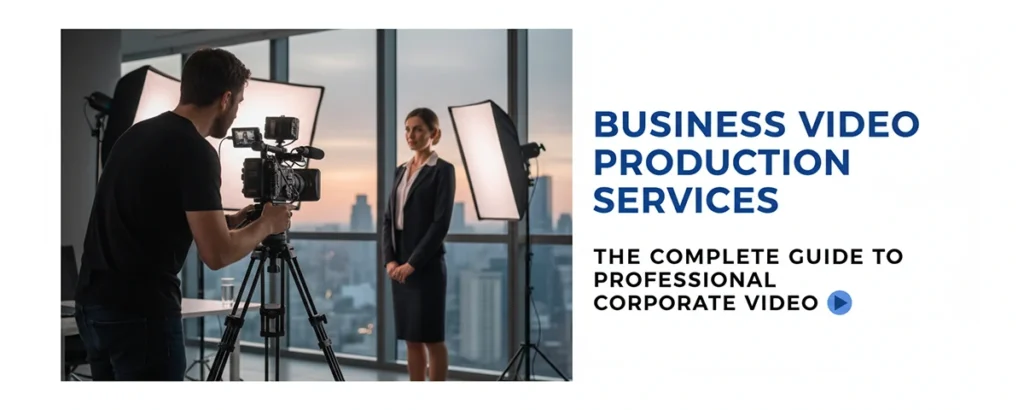
Transform your business communications with professional video. From marketing campaigns to training programs, learn how video production services drive measurable results and accelerate your brand’s growth.
Table of contents
- 💡 Key Takeaways
- What Are Business Video Production Services?
- Types of Business Video Content
- Benefits for Your Organization
- Core Services Explained
- The Production Process
- Understanding Pricing
- Choosing the Right Provider
- Preparing for Your Project
- Measuring ROI
- Future Trends in 2026
- Common Mistakes to Avoid
- Frequently Asked Questions
- Conclusion: Transform Your Business Communications
💡 Key Takeaways
- Business video production services generate 66% more qualified leads than other marketing channels and boost conversion rates by up to 80%
- Professional video content covers marketing videos, training programs, corporate communications, event coverage, and animated explainers
- Investment ranges from $2,000 for basic productions to $150,000+ for comprehensive brand campaigns with cinematic quality
- The production process spans six phases: discovery, creative development, pre-production, filming, post-production, and delivery
- AI-enhanced production, interactive video, and personalization at scale are reshaping the industry landscape in 2026
- ROI measurement should be established before production begins through clear KPIs, baseline metrics, and analytics tracking
In today’s digital-first business environment, video has become the most powerful medium for communication. Whether you’re trying to attract new customers, train employees, communicate with stakeholders, or build brand awareness, professional video content delivers messages more effectively than any other format. Studies consistently show that viewers retain 95% of a message when watching video compared to just 10% when reading text—making video an indispensable tool for modern business strategy.
The business video production landscape has evolved dramatically in recent years. What once required massive budgets and months of planning can now be achieved more efficiently—but the need for strategic, professional-quality content has only grown. With over 82% of all internet traffic projected to be video content by 2026, businesses that fail to invest in professional video production risk falling behind competitors who understand the medium’s unmatched ability to engage, persuade, and convert audiences.
Business video production services provide companies with the expertise, equipment, and creative vision needed to produce professional video content that achieves specific business objectives. Unlike DIY approaches, professional production companies bring strategic thinking, technical excellence, and storytelling craft that transforms ordinary messaging into compelling visual narratives. This comprehensive guide explores everything you need to know about these services—from understanding what’s available to selecting the right provider and maximizing your return on investment.
Industry Insight: According to Wyzowl’s annual State of Video Marketing report, 91% of businesses now use video as a marketing tool—up from just 61% five years ago. More importantly, 87% of marketers say video has directly increased sales for their organization.
What Are Business Video Production Services?
Business video production services encompass the full range of professional capabilities required to create video content for commercial and organizational purposes. These services are provided by specialized agencies, production companies, and creative studios that work with businesses to conceptualize, produce, and deliver video assets aligned with specific business goals. Unlike amateur or DIY video creation, professional business video production involves strategic planning, creative direction, technical expertise, and polished execution that elevates your brand and delivers measurable results.
The scope of these services extends far beyond simply pointing a camera and pressing record. Professional providers bring together multidisciplinary teams—strategists, writers, directors, cinematographers, editors, motion designers, and sound engineers—who collaborate to create content that resonates with your target audience and achieves your business objectives. This holistic approach ensures that every element of your video, from the opening frame to the final call-to-action, is crafted with purpose and precision.
Business video production requires a strategic approach that considers brand consistency, target audience psychology, distribution channels, and measurable outcomes. Professional providers bring together creative direction, technical expertise, industry experience, and post-production capabilities under one coordinated service offering. They understand that a video is not just a piece of content—it’s a business asset that should generate returns through increased engagement, leads, conversions, and brand equity.
Types of Business Video Content
Business video production services create diverse content types, each designed to serve specific organizational needs. Understanding these categories helps you identify which types of video will best support your business objectives and deliver the highest return on your investment. Most organizations benefit from a mix of several video types that work together to support different stages of the customer journey and internal operations.
Marketing & Promotional Videos
Content designed to attract, engage, and convert potential customers. These videos serve as the backbone of digital marketing strategies, driving awareness and consideration across multiple channels. Effective marketing videos tell stories that resonate emotionally while clearly communicating your unique value proposition. They range from polished brand films that build emotional connections to direct-response product demonstrations that drive immediate action.
Corporate Communications
Internal and external communications that represent your organization professionally to stakeholders, investors, employees, and the broader market. These videos build trust, convey authority, and humanize your leadership team. Company overviews, executive messages, investor relations presentations, and stakeholder updates all benefit from professional production that reflects the caliber of your organization. Well-produced corporate communications videos demonstrate commitment to quality and transparency.
Training & Educational Content
Videos that educate employees, customers, or partners while maximizing knowledge retention and engagement. Professional training videos dramatically outperform text-based materials, with studies showing 83% better retention rates. Employee onboarding, compliance training, product tutorials, safety procedures, and skill development programs all deliver better outcomes when presented through well-crafted video content that combines visual demonstrations with clear narration.
Event & Conference Coverage
Capturing and extending the value of business events through professional video documentation. Live streaming, highlight reels, keynote recordings, and post-event promotional content maximize the reach of your events far beyond the physical attendees. Event video extends the shelf life of expensive conferences and summits, providing content that continues generating engagement for months or even years after the event concludes.
Explainer & Animation
Animated content that simplifies complex concepts and makes abstract ideas tangible and memorable. Explainer videos, infographic animations, motion graphics, and 2D/3D animations transform complicated products, services, or processes into engaging visual narratives that audiences actually enjoy watching. Animation is particularly effective for SaaS products, financial services, healthcare, and technology companies whose offerings may be difficult to demonstrate through live-action footage alone.
Benefits for Your Organization
Professional business video production delivers measurable benefits across multiple dimensions of organizational performance. The investment in quality video content compounds over time, as each asset continues generating value long after production costs are recouped. Understanding these advantages helps build the business case for investment and ensures you capture the full range of benefits available.
Increased Conversions
Landing pages with video see up to 80% higher conversion rates. Video content keeps visitors engaged longer and communicates value propositions more effectively than text alone. Viewers who watch product videos are 1.81x more likely to make a purchase than non-viewers.
Better Lead Quality
Video-generated leads are 66% more qualified than those from other channels. Viewers who watch your video understand your offering better before making contact, reducing unqualified inquiries and accelerating the sales cycle significantly.
Enhanced Brand Perception
Professional video signals credibility and investment in quality. It positions your brand alongside industry leaders while differentiating you from competitors who rely on amateur content. High-quality video builds trust before any conversation begins.
Improved Training Outcomes
Video-based training improves knowledge retention by 83% compared to text. Employees learn faster and remember more, reducing time-to-competency and repeat training costs. Consistent video training also ensures uniform quality across locations.
SEO & Visibility
Websites with video are 53x more likely to appear on Google’s first page. Video increases time on site, reduces bounce rates, and signals content quality to search engines. YouTube is the world’s second-largest search engine, offering massive organic reach.
Social Media Performance
Video posts generate 48% more views and 1,200% more shares than text and image content combined. Social algorithms on LinkedIn, Instagram, TikTok, and Facebook actively favor video content in feeds, amplifying your organic reach.
Business Impact: Companies using video grow revenue 49% faster than non-video users. The investment in professional video production typically pays for itself through increased conversions, reduced support costs, improved training efficiency, and stronger brand equity that compounds over time.
Core Services Explained
Business video production services are typically organized into three distinct phases, each with specialized capabilities. Understanding what each service involves helps you evaluate providers effectively, plan your project timeline, and allocate budget appropriately across the production lifecycle.
Pre-Production Services
Pre-production is where the strategic foundation of your video is established. This phase typically represents 15–25% of your total budget but has an outsized impact on the final product’s effectiveness. Rushing through pre-production is the single biggest mistake organizations make—resulting in costly changes during filming or editing that could have been avoided with thorough planning.
Defining objectives, identifying target audiences, developing key messages, researching competitor approaches, and creating creative concepts that align with business goals. This phase includes competitive analysis, audience persona development, and messaging frameworks.
Professional writers craft scripts that communicate your message clearly while maintaining viewer engagement and achieving desired emotional responses. Scripts go through multiple drafts to refine tone, pacing, and call-to-action effectiveness before moving forward.
Visual representation of each scene showing camera angles, compositions, transitions, and on-screen graphics. Storyboards ensure alignment before costly production begins and serve as a shared visual reference for all team members.
Location scouting, scheduling, talent casting, equipment planning, permits, insurance, and all logistical coordination required for smooth shoot days. Detailed planning minimizes expensive on-set delays and ensures maximum productivity.
Production Services
The production phase is where your vision comes to life through professional filming. This is often the most exciting phase for clients, but it’s important to understand that production quality depends heavily on the pre-production planning that precedes it and the post-production polish that follows.
Post-Production Services
Post-production is where raw footage transforms into a polished, professional video asset. This phase typically takes two to three times longer than the actual filming and represents a significant portion of the overall budget. It’s where the magic truly happens—skilled editors, colorists, and motion designers shape your footage into a compelling narrative.
Assembling footage, cutting for pacing, creating narrative flow, and polishing the final product through multiple revision rounds.
Adjusting color, contrast, and visual tone to create consistent, cinematic-looking footage that reinforces brand identity.
Animated titles, lower thirds, data visualizations, transitions, and visual effects that enhance storytelling and reinforce key points.
Balancing dialogue, music, and sound effects for professional audio quality that enhances the viewing experience and emotional impact.
The Production Process
Understanding the typical workflow of business video production helps set expectations and ensures effective collaboration between your organization and the production team. While specific processes vary by provider and project type, most professional productions follow a structured six-phase approach that ensures quality, efficiency, and alignment with your objectives throughout the project lifecycle.
Initial meetings to understand objectives, audience, distribution channels, and requirements. The production team reviews brand guidelines, existing assets, competitor content, and success benchmarks. This phase establishes the foundation for everything that follows.
Concept presentation, script drafts, and storyboard development. Multiple revision rounds until final approval ensures creative alignment before production investment begins. Expect two to three rounds of feedback at this stage.
Logistics coordination, location scouting, talent casting, equipment preparation, permit acquisition, and schedule finalization. All details are locked down to ensure smooth, efficient shoot days.
Shoot days where footage is captured with professional crew and equipment. Duration depends on project complexity, number of locations, and interview requirements. Clients are typically invited to observe filming in person.
Editing, color grading, motion graphics, sound design, and music integration. This phase includes two to three revision rounds with client feedback to refine the final product until it meets your standards.
Final files delivered in all required formats optimized for each distribution channel. May include platform-specific versions, thumbnail creation, caption files, publishing support, and analytics setup for performance tracking.
Understanding Pricing
Business video production costs vary significantly based on complexity, quality level, scope, and geographic market. Understanding the factors that influence pricing helps you budget appropriately, evaluate proposals from different providers, and ensure you’re getting fair value for your investment. Remember that video is a long-term asset—a well-produced video can serve your business for years, making the per-impression cost remarkably low compared to other marketing investments.
Typical Investment Ranges
Key Cost Factors
Several variables significantly influence the final cost of your video production project. Understanding these factors helps you make informed trade-offs and communicate realistic expectations to both your internal stakeholders and production partners.
Choosing the Right Provider
Selecting the right business video production partner significantly impacts your project’s success and your overall experience. The best provider isn’t always the biggest or cheapest—it’s the one whose capabilities, experience, creative sensibility, and working style align with your specific needs. Taking time to properly evaluate potential partners prevents costly mismatches and ensures a productive, enjoyable collaboration.
Evaluation Criteria
Portfolio Relevance
Review their work for projects similar to yours—same industry, video type, or production style. A company that excels at corporate documentaries may not be ideal for social media content, and vice versa. Look for demonstrated expertise in your specific needs, and pay attention to the quality of storytelling, not just technical polish.
Client References & Reviews
Ask for references from clients with similar project types and budgets. Inquire about communication quality, ability to meet deadlines, handling of challenges and revisions, and overall satisfaction. Past performance is the most reliable predictor of future results.
Strategic Thinking
The best providers don’t just execute—they think strategically about your business objectives and audience psychology. Do they ask smart questions about your goals? Can they recommend approaches you hadn’t considered? Strategic partners add value beyond technical execution.
Communication Style
Video production requires close, ongoing collaboration over weeks or months. Evaluate responsiveness, clarity, and professionalism during initial conversations. A provider who is slow to respond or unclear in early interactions will likely cause frustration during production.
Pricing Transparency
Reputable providers give clear, detailed estimates that explain exactly what’s included and what falls outside scope. Vague pricing, hidden fees, or reluctance to discuss budgets openly signals potential problems. You should understand every line item in the proposal.
Pro Tip: Schedule a chemistry meeting before signing contracts. Video production involves weeks of close collaboration—you need to genuinely enjoy working with these people. A slightly more expensive provider who communicates well and understands your vision often delivers dramatically better results than a cheaper option that causes constant friction.
Preparing for Your Project
Proper preparation accelerates production, reduces costs, and dramatically improves outcomes. The work you do before engaging a production company significantly impacts project success. Organizations that invest time in thorough preparation consistently achieve better results and spend less overall than those who rush into production without clear direction.
Pre-Project Checklist
What specific business outcome should this video achieve? Define measurable KPIs such as lead generation targets, conversion rate improvements, or training completion benchmarks.
Who will watch this video? What do they care about? What action should they take after watching? Create audience personas with demographics, pain points, and motivations.
Have a realistic budget range in mind. Sharing your budget helps production companies propose the most appropriate solution rather than guessing at your expectations.
When do you need the final video? Work backwards to determine when to start, including buffer time for internal approvals and revision rounds.
Collect logos, brand guidelines, font files, color codes, existing footage, photography, and any templates that the production team will need for consistency.
Who needs to approve the video at each stage? Involve all stakeholders early to prevent costly late-stage surprises and ensure efficient feedback rounds.
Gather videos you admire and articulate specifically what you like about each—the tone, pacing, visual style, or storytelling approach. This gives producers concrete creative direction.
Measuring ROI
Demonstrating return on investment is essential for justifying video production budgets and informing future content decisions. The most successful video programs establish clear measurement frameworks before production begins, ensuring that every dollar spent can be traced to business outcomes. Without proper measurement, video becomes an expense rather than an investment.
Metrics by Video Type
Measurement Tip: Establish baseline metrics before launching video content. How do your current landing pages convert? What’s your average training completion time? What’s your current cost per lead? Improvement over baseline demonstrates video ROI more convincingly than absolute numbers and makes the case for continued investment.
Future Trends in 2026
The business video production landscape continues to evolve rapidly, driven by technological advances, changing viewer behaviors, and new platform capabilities. Understanding these emerging trends helps you make forward-looking decisions about video content strategy and ensures your investments remain relevant as the industry transforms.
AI-Enhanced Production
Artificial intelligence is revolutionizing every phase of video production—from automated rough cuts and intelligent captioning to AI-generated B-roll, script assistance, and dynamic personalization. Forward-thinking providers integrate AI tools to increase efficiency while maintaining human creative oversight.
Vertical & Short-Form
Mobile-first viewing habits have made vertical video and sub-60-second content essential for business marketing. Production services now routinely deliver social-optimized versions alongside traditional horizontal formats, maximizing distribution reach.
Interactive Video
Clickable hotspots, branching narratives, shoppable video elements, and embedded forms create immersive experiences with significantly higher engagement rates and conversion potential than passive linear content.
Personalization at Scale
Dynamic video platforms enable personalized content based on viewer data—customized with names, company logos, relevant product recommendations, or industry-specific messaging that dramatically improves engagement.
Remote & Hybrid Production
Cloud-based workflows, remote interview recording, and distributed production teams have expanded possibilities for collaborating with talent and experts worldwide without the expense and logistics of travel.
Authenticity Focus
Audiences increasingly prefer authentic, relatable content over highly polished productions. The “perfectly imperfect” aesthetic builds trust and human connection, especially with younger demographics who value transparency.
Common Mistakes to Avoid
Even experienced organizations make avoidable mistakes when investing in video production. Learning from others’ missteps helps you maximize your investment and avoid common pitfalls that can derail otherwise promising video projects.
Rushing into filming without proper strategy, scripting, and planning is the most expensive mistake. Changes during production or post-production cost significantly more than thorough upfront planning. Always invest adequate time in the creative brief and script development phase.
The cheapest quote rarely delivers the best results. Low-budget productions often require expensive reshoots or fail to generate the business outcomes that justify the investment. Focus on value and demonstrated quality rather than the lowest bid.
Committee-driven feedback creates conflicting directions and dilutes the creative vision. Designate one or two people as primary decision-makers who consolidate feedback from all stakeholders into clear, unified direction for the production team.
Creating excellent video content without a clear distribution and promotion plan is like printing brochures and leaving them in a warehouse. Plan how, where, and when your video will reach its intended audience before you start producing it.
Attention spans are shorter than ever, and every second of your video must earn the viewer’s continued attention. Most marketing videos should be under two minutes, and even corporate overviews rarely need to exceed four minutes. Trust your production team’s advice on optimal length for each platform.
Frequently Asked Questions
How long does a typical business video project take?
Simple projects like interview videos can be completed in 3–4 weeks. Standard corporate videos typically take 6–8 weeks from initial briefing to final delivery. Complex productions like brand films or multi-video campaigns may require 10–16 weeks. Always include buffer time for internal approvals and revision rounds.
Should we hire locally or work with remote providers?
Both approaches have merit. Local providers simplify logistics for projects requiring significant on-site filming at your facilities. Remote providers may offer specialized expertise, different creative perspectives, or better value. For animation-heavy or post-production-focused work, geographic proximity matters less. Consider your specific project requirements.
How many revisions should we expect?
Most proposals include 2–3 revision rounds at each stage (script, rough cut, fine cut). Additional rounds typically incur extra charges. The key to efficient revisions is consolidating feedback from all stakeholders before each round and providing clear, specific, actionable notes.
What should our creative brief include?
A strong creative brief covers: project objectives and KPIs, target audience description with demographics and psychographics, key messages prioritized by importance, brand guidelines, competitive examples, reference videos you admire (and why), required deliverables and formats, timeline constraints, and budget range.
Who owns the final video content?
Ownership should be clearly defined in your contract before work begins. Most business agreements transfer full ownership rights to the client upon final payment. Raw footage ownership, music licensing terms, talent usage rights, and portfolio usage permissions all need explicit written agreement.
Can we repurpose video content across multiple platforms?
Absolutely—and you should. A single professional video shoot can yield multiple content pieces: a full-length version for your website, shorter cuts for social media, vertical clips for Instagram Reels and TikTok, audio for podcasts, and still frames for email marketing. Discuss repurposing strategy with your production partner during the planning phase.
What’s the difference between a production company and a freelancer?
Production companies offer full-service capabilities with dedicated project managers, established workflows, and teams of specialists. Freelancers may offer lower costs for simpler projects but typically handle fewer aspects of production themselves. For complex, multi-day projects, a production company provides better reliability and quality consistency.
How do we ensure our video stays on brand?
Share comprehensive brand guidelines during the discovery phase, including visual identity, tone of voice, messaging frameworks, and examples of content you consider on-brand. Establish brand checkpoints at the script, storyboard, and rough cut stages to catch any misalignment before it becomes expensive to correct.
Conclusion: Transform Your Business Communications
Business video production services offer a powerful, proven way to communicate your message, train your workforce, engage your audience, and build your brand in ways that text and static images simply cannot match. In a world where video dominates digital communication across every platform and demographic, professional video content is no longer a luxury reserved for enterprise brands—it’s a competitive necessity for organizations of every size.
The key to success lies in finding the right production partner, establishing clear objectives from the start, preparing thoroughly, and measuring results to demonstrate ROI and inform future investments. Whether you’re creating your first company video or scaling a comprehensive video content program across multiple departments and channels, the principles in this guide will help you make informed decisions that maximize the impact of every dollar invested.
Start by defining what you want your video to achieve, research providers with relevant experience and strong portfolios, prepare thoroughly for the project with a detailed creative brief, and commit to measuring results against clear benchmarks. With the right partner, strategic approach, and proper execution, business video production delivers measurable results that justify the investment many times over—building a library of brand assets that continues working for your organization year after year.
Ready to Elevate Your Business Video?
Define your objectives, gather your brand assets, identify your audience, and start conversations with production partners who understand your vision. The best time to start your video journey is now.
Lauren Walker
Corporate Communications Director
Lauren has led corporate communications for Fortune 500 companies for over 15 years, overseeing video production programs that have won multiple industry awards including Webby Awards and Telly Awards. She now consults with organizations on video strategy and vendor selection, helping businesses maximize the impact of their video investments across marketing, training, and internal communications.