


Unveiling the complex, multifaceted world of architecture—where art meets engineering, and vision transforms into reality. A deep dive into the profession shaping our built environment.
When you look at the skyline of a city, or the cozy layout of a home, you are looking at the culmination of thousands of decisions. But who makes those decisions? The common answer is "an architect." Yet, the popular image of an architect—someone hunched over a drafting table, sketching beautiful lines—captures only a tiny fraction of reality.
In today's complex world, the question "What do architects do?" yields an answer that is as vast as it is surprising. Architects are not just designers; they are conductors of an orchestra involving engineers, city planners, contractors, and clients. They are legal experts navigating zoning laws. They are environmentalists calculating carbon footprints. They are psychologists understanding how space affects human behavior.
This comprehensive guide explores the depths of the architectural profession. We will strip away the mystique to reveal the practical, technical, and creative rigor required to bring a building from a mere thought into a concrete reality. Whether you are a student considering this career path, a client looking to hire one, or simply a curious mind, this article will change the way you look at the buildings around you.
1. The Core Responsibilities: It’s More Than Just Drawing
Design & Aesthetics
This is the most visible part of the job. Architects determine the look and feel of a structure. They decide on the geometry, the materials, the light, and the shadow. But "good design" isn't just about beauty; it's about context. A glass tower might look stunning in Dubai but out of place in a historic Parisian neighborhood. Architects must balance their artistic vision with the cultural and physical environment.
Safety & Code Compliance
Perhaps the most critical responsibility is ensuring the safety of occupants. An architect must know fire codes, accessibility laws (like the ADA in the US), and structural limitations inside out. If a building looks beautiful but collapses in a minor earthquake or traps people during a fire, the architect has failed. They are legally liable for the health, safety, and welfare of the public.
Functionality & Programming
"Form follows function" is a famous modernist adage. Architects engage in "programming," which involves interviewing the client to understand their needs. How many people will live here? How does the traffic flow in this hospital? Where should the kitchen be relative to the dining room? Architects solve the puzzle of spatial organization to make daily life efficient and comfortable.
Budget & Project Management
Architects are often the stewards of the client's budget. They must design within financial constraints, selecting materials and construction methods that are affordable yet durable. They also manage the timeline, ensuring that the project moves through the various phases of approval and construction without costly delays.
Deep Dive: The "Architect of Record" vs. "Design Architect"
On large projects, you might hear these terms. The Design Architect is responsible for the overall concept and look—the "big idea." The Architect of Record signs the drawings and takes legal responsibility, ensuring the design actually works and meets all laws. Sometimes they are the same firm; other times, they are two different entities collaborating.
2. The Architectural Process: From Napkin to Key Handover
Architecture isn't a linear process of drawing and building. It is a cyclical, iterative process defined by standard phases. In the United States, the American Institute of Architects (AIA) defines these phases clearly. Here is what happens in each.
Pre-Design & Programming (5-10% of effort)
Before a single line is drawn, the architect must understand the problem. This involves site analysis (sun paths, wind directions, soil conditions), zoning checks (what is legally allowed to be built?), and budget verification.
Key Activity: Creating a "Program of Requirements"—a document listing every room, its desired size, and its function.
Schematic Design (SD) (15% of effort)
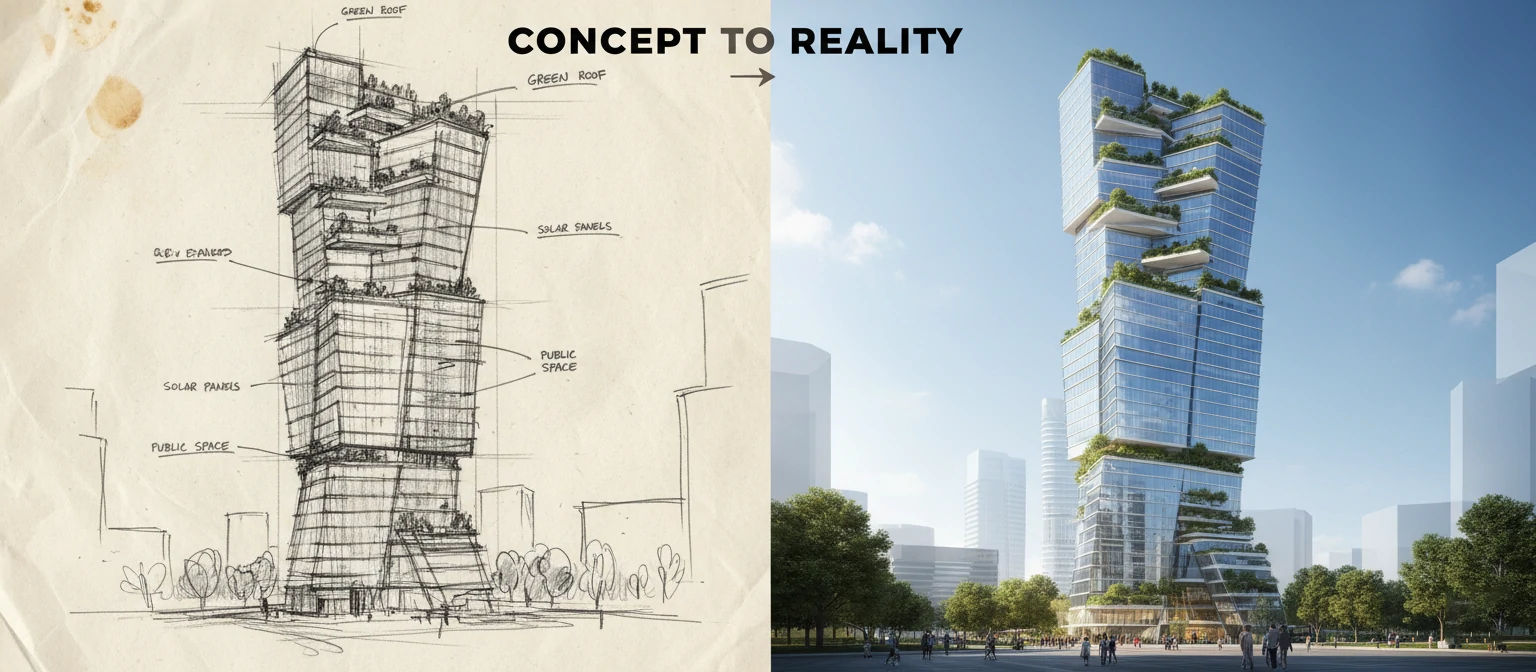
This is the brainstorming phase. Architects produce rough sketches, massing models (blocks showing the building's shape), and initial floor plans. The goal is to agree on a general look and layout.
"This phase is about exploring options. We might present the client with three completely different concepts—one conservative, one modern, one radical—to see what resonates."
Design Development (DD) (20% of effort)
The design is refined. Materials are selected (wood vs. steel, tile vs. carpet). Structural engineers join to decide where columns and beams go. Mechanical engineers figure out ductwork. The building stops being a sketch and starts becoming a buildable reality. Dimensions are finalized.
Construction Documents (CD) (40% of effort)
This is the heaviest workload. Architects create the "blueprints"—hundreds of sheets of technical drawings detailing every joint, window, and outlet. These drawings are the legal contract between the client and the builder. If it's not in the drawings, it doesn't get built.
The Spec Book: Alongside drawings, architects write a "Specification Manual"—a book as thick as a novel describing the quality of materials to be used, from the grade of concrete to the brand of door handle.
Bidding & Negotiation (5% of effort)
The architect helps the client find a contractor. They answer questions from builders, clarify details in the drawings, and help evaluate the price bids to ensure the client is getting a fair deal.
Construction Administration (CA) (Varies)
The architect does not build the building, but they watch over it. They visit the site regularly (e.g., once a week) to ensure the builder is following the plans. They solve problems that arise on-site (e.g., "We dug for the foundation and found a pipe that wasn't on the map, what do we do?"). They approve the contractor's requests for payment.
3. The Tools of the Trade
Gone are the days when architecture was solely about T-squares and pencils. Today's architect is a technologist.
-
BIM (Building Information Modeling)
Software like Revit or ArchiCAD creates a "digital twin" of the building. It's not just lines; it's a database. If you change a window in the floor plan, it automatically updates in the 3D view, the elevation, and the window schedule. -
3D Rendering & VR
Tools like Lumion, V-Ray, and Twinmotion allow architects to create photo-realistic images to sell their ideas. VR (Virtual Reality) lets clients "walk through" the building before ground is even broken. -
Computational Design
Using scripts (like Grasshopper for Rhino), architects can generate complex, mathematical forms that would be impossible to draw by hand, essentially coding the geometry of the building.
The Hybrid Workflow
Even with high-tech tools, the humble sketchbook remains king during the early stages. The speed of a hand gesture cannot be matched by a mouse click.
4. It's Not One Size Fits All: Types of Architects
Just as doctors specialize in cardiology or neurology, architects often find a niche. The complexity of modern building codes makes it difficult to be a generalist.
Residential Architects
Focus on private homes, renovations, and extensions. Highly personal, working directly with homeowners.
Commercial Architects
Office towers, shopping centers, hotels. Focus on efficiency, branding, and maximizing floor area for profit.
Institutional Architects
Schools, hospitals, museums, airports. These are complex, long-term projects serving the public good.
Urban Designers
They don't just design buildings; they design districts. They look at the space between buildings, streetscapes, and city grids.
Preservation Architects
Experts in history and old materials. They restore historic landmarks, ensuring they last for another century.
Sustainability Consultants
Architects who focus solely on energy efficiency, LEED certification, and net-zero building strategies.
5. Becoming an Architect: A Long Road
The title "Architect" is protected by law, much like "Doctor" or "Lawyer." You cannot call yourself one unless you are licensed.
- 1. Education (5-7 years)
A professional degree accredited by the NAAB (in the US) is required. This is usually a 5-year Bachelor of Architecture (B.Arch) or a Master of Architecture (M.Arch).
- 2. Experience (AXP) (~3,740 hours)
Graduates must work under a licensed architect as an intern to gain documented experience in specific areas like site planning, project management, and construction observation.
- 3. Examination (ARE 5.0)
Candidates must pass the Architect Registration Examination. It currently consists of 6 rigorous divisions covering practice management, project planning, and construction evaluation.
Frequently Asked Questions
What is the difference between an Architect and a Civil Engineer?
While they overlap, the architect focuses on the spatial design, aesthetics, human experience, and function. The civil engineer focuses on the physics: making sure the skeleton of the building stands up, dealing with soil mechanics, and infrastructure. Architects design the body; engineers design the bones.
Do architects build the buildings?
No. Contractors and builders construct the building. Architects provide the instructions (drawings and specs) and observe the process to ensure it matches the design.
Why are architects so expensive?
Architect fees typically range from 8% to 15% of construction costs. This fee covers thousands of hours of highly skilled labor, immense liability insurance costs, and overhead. A good architect often saves the client money in the long run by designing energy-efficient buildings and avoiding costly construction errors.
The Architect's Legacy
Architects do more than create shelter. They shape the way we live, work, and interact. They preserve our history and design our future. In a world facing climate change and rapid urbanization, the role of the architect is more vital than ever—solving the world's biggest problems, one building at a time.