
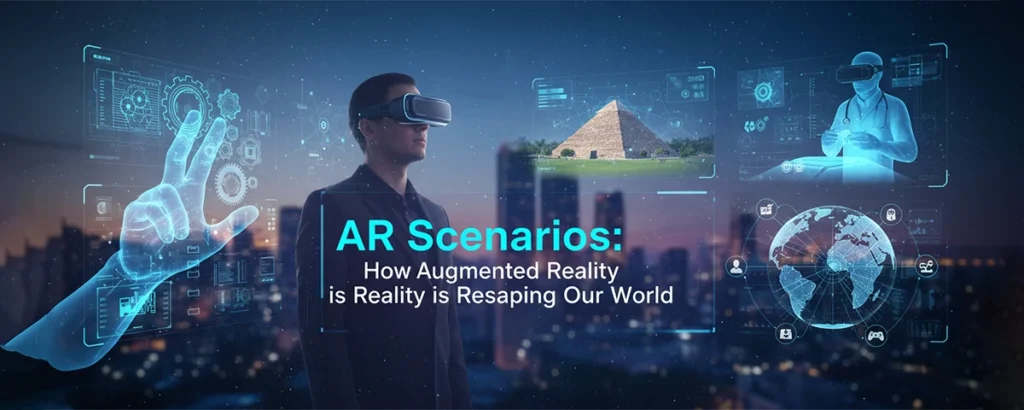
From trying on virtual sneakers to performing complex surgeries with digital overlays, augmented reality is transforming how we interact with information, products, and each other.
Table of contents
- Key Takeaways
- Understanding Augmented Reality Technology
- Retail and E-Commerce AR Scenarios
- Healthcare and Medical Applications
- Education and Training Transformation
- Manufacturing and Industrial AR
- Navigation and Wayfinding Solutions
- Entertainment and Gaming Experiences
- Real Estate and Architecture Visualization
- Social Interaction and Remote Collaboration
- Emerging AR Scenarios and Future Possibilities
- Frequently Asked Questions
- Embracing the Augmented Future

Picture this: A surgeon peers through specialized glasses, seeing a patient's vital organs overlaid with real-time diagnostic data. Across town, a teenager points their phone at a movie poster, watching characters come alive and interact. Meanwhile, a factory technician follows floating arrows and instructions only they can see, guiding them through a complex repair. These aren't scenes from science fiction—they're AR scenarios happening right now.
Augmented reality has evolved far beyond the novelty filters that first captured public attention. Today, AR represents a fundamental shift in how humans process information and interact with their environment. Unlike virtual reality, which replaces your surroundings entirely, augmented reality enhances what you already see, adding layers of digital information to the physical world in real-time.
This guide explores the diverse scenarios where AR is making meaningful impact—not as a futuristic promise but as present-day reality. Whether you're a business leader evaluating AR investment, a developer seeking inspiration, or simply curious about how this technology is reshaping daily life, understanding these scenarios will illuminate where augmented reality truly shines and where its potential remains untapped.
Key Takeaways
- ✓ AR scenarios span from consumer entertainment to mission-critical industrial applications
- ✓ Retail AR experiences increase purchase confidence by up to 94% according to recent studies
- ✓ Healthcare AR applications are reducing procedure times and improving surgical precision
- ✓ Education AR transforms abstract concepts into tangible, interactive experiences
- ✓ Successful AR implementation requires understanding specific user contexts and pain points
Understanding Augmented Reality Technology
Before exploring specific scenarios, it helps to understand what makes AR work. At its core, augmented reality combines three essential elements: environmental understanding (knowing where things are in physical space), digital content rendering (creating visual elements), and precise alignment (placing digital objects accurately within the real world).
AR Technology Components
Sensors & Cameras
Capture real-world environment data
Processing Power
Compute spatial mapping in real-time
Display Technology
Render digital overlays seamlessly
Tracking Systems
Maintain precise spatial alignment
AR experiences are delivered through various devices, each suited to different scenarios. Smartphones remain the most accessible AR platform, with billions of devices already AR-capable. Tablets offer larger screens for detailed visualization. Smart glasses provide hands-free experiences essential for industrial applications. Head-mounted displays deliver the most immersive AR but currently sacrifice portability.
"The best AR experiences feel invisible—the technology fades into the background while the enhanced information feels naturally present in your world."
What distinguishes effective AR scenarios from gimmicks is purpose. Successful implementations solve genuine problems or create value that couldn't exist without the spatial, contextual nature of augmented reality. A floating 3D logo is a novelty; a floating 3D repair guide that adjusts based on which part you're looking at is a solution.
Retail and E-Commerce AR Scenarios
Retail represents one of AR's most mature application areas, addressing the fundamental challenge of online shopping: customers can't physically interact with products before purchasing. AR bridges this gap by bringing products into customers' spaces virtually, dramatically reducing purchase uncertainty and return rates.
Virtual Try-On Experiences
The fashion and beauty industries have embraced AR try-on technology enthusiastically. Cosmetics brands now allow customers to test lipstick shades, eyeshadow colors, and foundation matches through their phone cameras. The experience goes beyond simple color overlay—advanced systems account for skin texture, lighting conditions, and facial features to provide realistic previews.
👓 Eyewear
Try frames virtually with accurate facial mapping, see how different styles complement face shapes, and compare multiple options side by side.
👟 Footwear
View sneakers and shoes on your feet in real-time, rotate to see different angles, and visualize how colors match with your outfit.
💍 Jewelry
See how rings, watches, and bracelets look on your hand with realistic reflections and sizing visualization.
👕 Apparel
Virtual fitting rooms show how clothing drapes and fits, helping customers choose sizes and styles confidently.
Product Visualization in Space
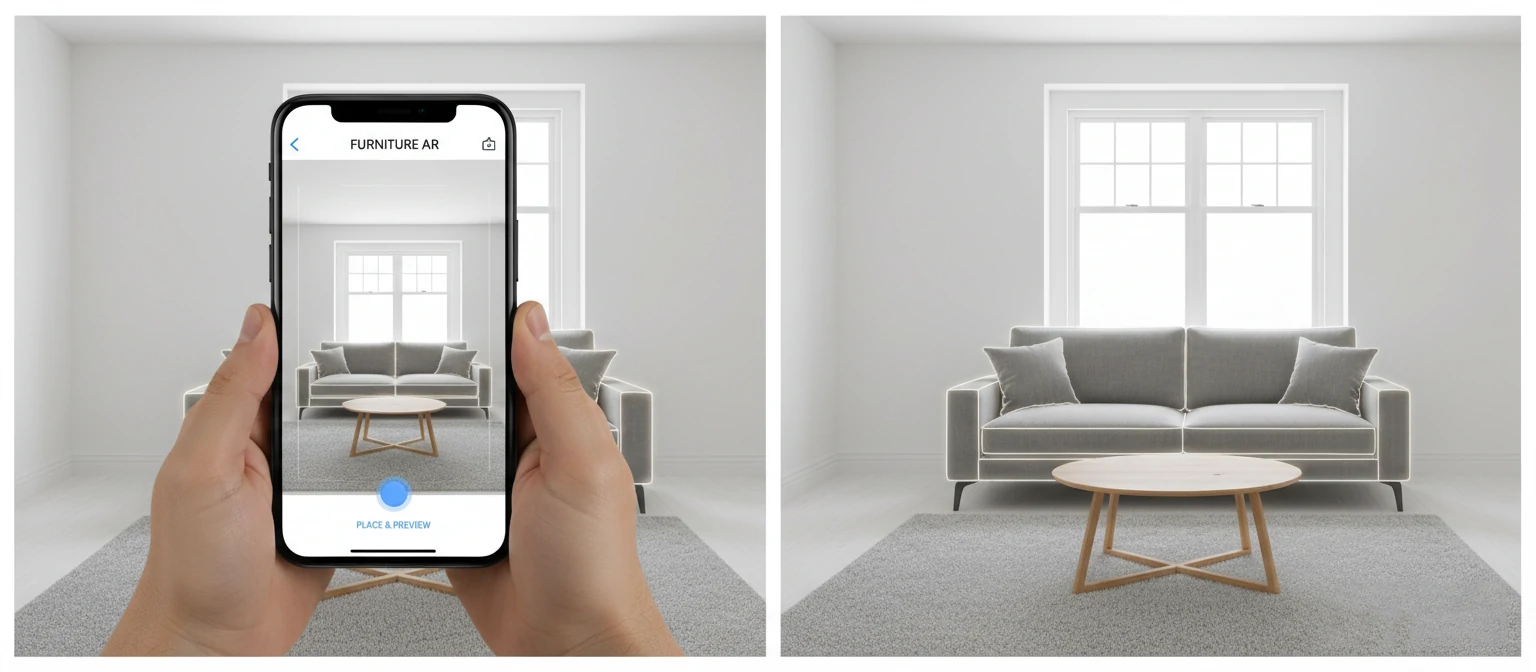
Furniture and home goods retailers have transformed their customer experience through spatial AR. Rather than imagining how a couch might look in your living room, you can place a photorealistic 3D model in your actual space. Walk around it, view it from different angles, check if it blocks the window, see if the color complements your existing decor—all before purchasing.
This capability extends beyond aesthetics to practical considerations. Will this dining table fit with chairs pulled out? Does this refrigerator leave enough clearance for the door swing? AR answers these questions definitively, turning uncertain purchases into confident decisions. Major retailers report that products viewed in AR have significantly lower return rates than traditional online purchases.
Retail AR Impact: Studies show customers who use AR visualization are 94% more likely to convert and 40% less likely to return products. For high-consideration purchases like furniture, AR engagement can increase average order value by over 25%.
Healthcare and Medical Applications
Healthcare AR scenarios often represent the most consequential applications of the technology. When accuracy directly impacts patient outcomes, AR's ability to overlay precise digital information onto physical reality becomes genuinely life-saving. Medical professionals increasingly rely on augmented reality across the continuum of care.
Surgical Navigation and Guidance
Surgeons wearing AR headsets can now see patient imaging data—CT scans, MRIs, and real-time monitoring—superimposed directly onto the patient during procedures. Rather than looking away at screens, they maintain focus on the surgical field while accessing crucial information in their line of sight. This reduces cognitive load and improves precision during complex operations.
AR in Surgical Procedures
Orthopedic Surgery
AR guides precise implant placement, showing optimal positioning angles and depth in real-time.
Neurosurgery
Visualize tumor boundaries, blood vessels, and critical brain structures during delicate procedures.
Cardiovascular Procedures
Overlay cardiac imaging to guide catheter placement and visualize blood flow patterns.
Vein Visualization and Patient Care
Finding veins for blood draws and IV insertion challenges healthcare providers daily, particularly with pediatric, elderly, or dehydrated patients. AR-enabled vein finders project vein maps directly onto the patient's skin using near-infrared imaging, making difficult vascular access routine. This reduces patient discomfort from multiple attempts and speeds clinical workflows.
Beyond immediate procedures, AR supports patient education and communication. Physicians can show patients 3D visualizations of their conditions, explaining what's happening inside their bodies in intuitive visual terms. This shared understanding improves treatment compliance and reduces anxiety about medical conditions.
"AR in healthcare isn't about replacing clinical judgment—it's about augmenting human expertise with perfect information at the moment of decision."
Education and Training Transformation
Education faces an eternal challenge: abstract concepts often resist understanding through traditional instruction. AR dissolves this barrier by making the invisible visible, the abstract tangible, and the distant immediate. From elementary classrooms to corporate training facilities, augmented reality is revolutionizing how people learn.
Interactive Learning Experiences
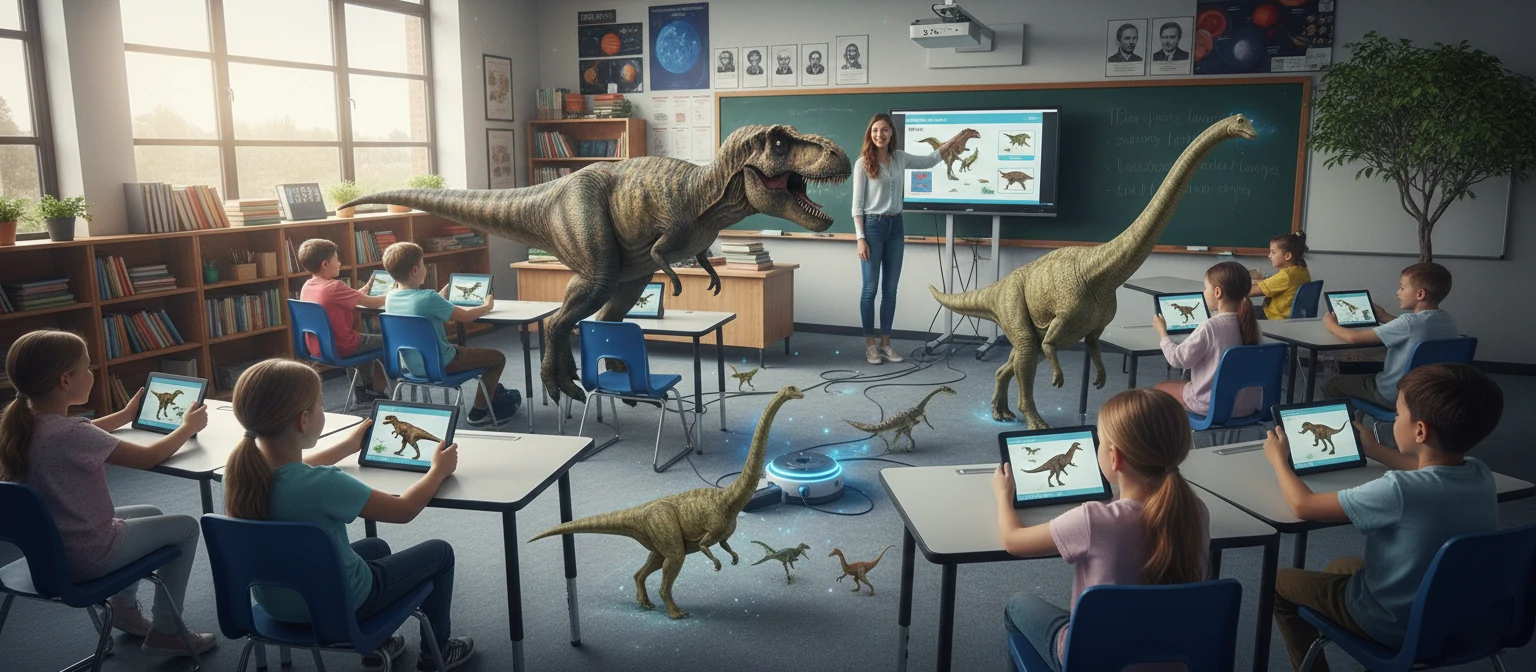
Imagine studying the solar system by having planets orbit around your classroom, sized to scale. Or learning anatomy by exploring a life-sized human body you can walk through, examining organs from any angle. AR makes these scenarios reality. Students engage with material actively rather than passively absorbing information, leading to dramatically improved retention and understanding.
Science Education
Visualize molecular structures, chemical reactions, physics principles, and biological processes in interactive 3D. Students can manipulate virtual elements to see cause and effect.
History & Geography
Walk through historical events, explore ancient civilizations reconstructed in 3D, and interact with terrain models of geographic features.
Mathematics
Transform abstract equations into visual representations. See geometry in physical space, manipulate 3D graphs, and understand calculus through animated visualization.
Language Learning
Point at objects to see translations and hear pronunciations. Practice conversations with AR characters. Immerse in culturally contextualized language scenarios.
Professional and Technical Training
Corporate training scenarios benefit enormously from AR's ability to provide realistic practice without real-world consequences. Medical students practice procedures on AR patients. Mechanics learn to repair complex machinery with step-by-step AR guidance. Emergency responders train for crisis scenarios overlaid onto familiar environments.
The "see one, do one, teach one" model accelerates when AR provides consistent, repeatable training experiences. Every trainee receives identical instruction quality. Dangerous or expensive scenarios become safe to practice repeatedly. Performance can be tracked precisely, identifying skill gaps for targeted improvement.
Training Efficiency: Organizations report 40-60% faster skill acquisition with AR-assisted training compared to traditional methods. More importantly, knowledge retention improves significantly, with trainees demonstrating better long-term performance.
Manufacturing and Industrial AR
Industrial AR scenarios often deliver the most measurable return on investment. When workers can access information hands-free while maintaining focus on physical tasks, efficiency improvements compound across entire operations. Manufacturing, field service, and logistics have embraced AR as a competitive advantage.
Assembly and Manufacturing Guidance
Complex assembly processes traditionally require workers to consult paper manuals or computer screens, looking away from their work repeatedly. AR overlays eliminate this context-switching by projecting instructions directly onto the work area. Arrows point to the correct components, animations demonstrate assembly sequences, and confirmation indicators verify each step's completion.
Industrial AR Applications
Remote Expert Assistance
When field technicians encounter problems beyond their expertise, AR enables real-time collaboration with remote experts. The technician's AR glasses stream their point-of-view to specialists who can annotate the live feed, drawing arrows, circles, and instructions that appear anchored in the technician's physical space. This "see what I see" capability reduces downtime and eliminates many service calls.
This scenario proved particularly valuable during recent global disruptions when expert travel became restricted. Organizations maintained operational continuity by connecting on-site personnel with remote expertise through AR collaboration tools. The efficiency gains have made this approach permanent for many companies, even as travel restrictions eased.
Navigation and Wayfinding Solutions
Traditional navigation presents information abstractly—a blue dot on a map, turn-by-turn text instructions. AR navigation overlays guidance directly onto the real world you're looking at, eliminating the mental translation between map and environment. This intuitive approach reduces wrong turns and navigation stress while enabling entirely new location-based experiences.
Pedestrian and Vehicle Navigation
Walking navigation through unfamiliar cities transforms when your phone shows arrows floating above the actual street you should take, restaurant names hovering over their entrances, and transit information appearing at bus stops. You understand your surroundings contextually rather than abstractly.
Vehicle AR navigation, increasingly built into windshield displays, projects turn indicators and lane guidance onto the road ahead. Drivers maintain focus on traffic while receiving navigation information. Warning systems highlight pedestrians and obstacles in low visibility conditions, merging safety assistance with navigation guidance.
🏠 Indoor Navigation
Navigate complex buildings like hospitals, airports, and shopping malls with AR waypoints. Find specific stores, gates, or offices without consulting directories.
🗺️ Tourist Experiences
Point your phone at landmarks to see historical information, architectural details, and visitor tips overlaid on the actual structures.
Accessibility Applications
AR navigation provides particular value for people with visual impairments. Audio-augmented reality describes surroundings, identifies obstacles, and provides turn-by-turn guidance through spatial audio cues. Text recognition reads signs and labels aloud. Object recognition identifies products, faces, and points of interest. These accessibility scenarios demonstrate AR's potential to genuinely improve lives.
Entertainment and Gaming Experiences
Entertainment drove early AR adoption and continues pushing creative boundaries. From mobile gaming phenomena to immersive art installations, entertainment scenarios showcase AR's ability to transform ordinary spaces into extraordinary experiences.
Location-Based Gaming
Mobile AR games have demonstrated the technology's mass-market appeal. Millions of players explore their neighborhoods, hunting virtual creatures, conquering digital territories, and collaborating in location-based challenges. These games succeed by enhancing real-world exploration with game mechanics, encouraging physical activity and community engagement.
AR Entertainment Categories
Mobile Games
Location-based gameplay using smartphone AR
Theme Parks
AR-enhanced attractions and interactive queues
Live Events
Concert visuals, sports statistics, and crowd interactions
Art & Museums
Interactive exhibits and guided experiences
Immersive Storytelling
AR enables narrative experiences impossible in traditional media. Stories unfold in your living room, characters interact with your actual furniture, and plot elements respond to your environment. Publishers, studios, and independent creators experiment with AR storytelling that blurs boundaries between fiction and reality.
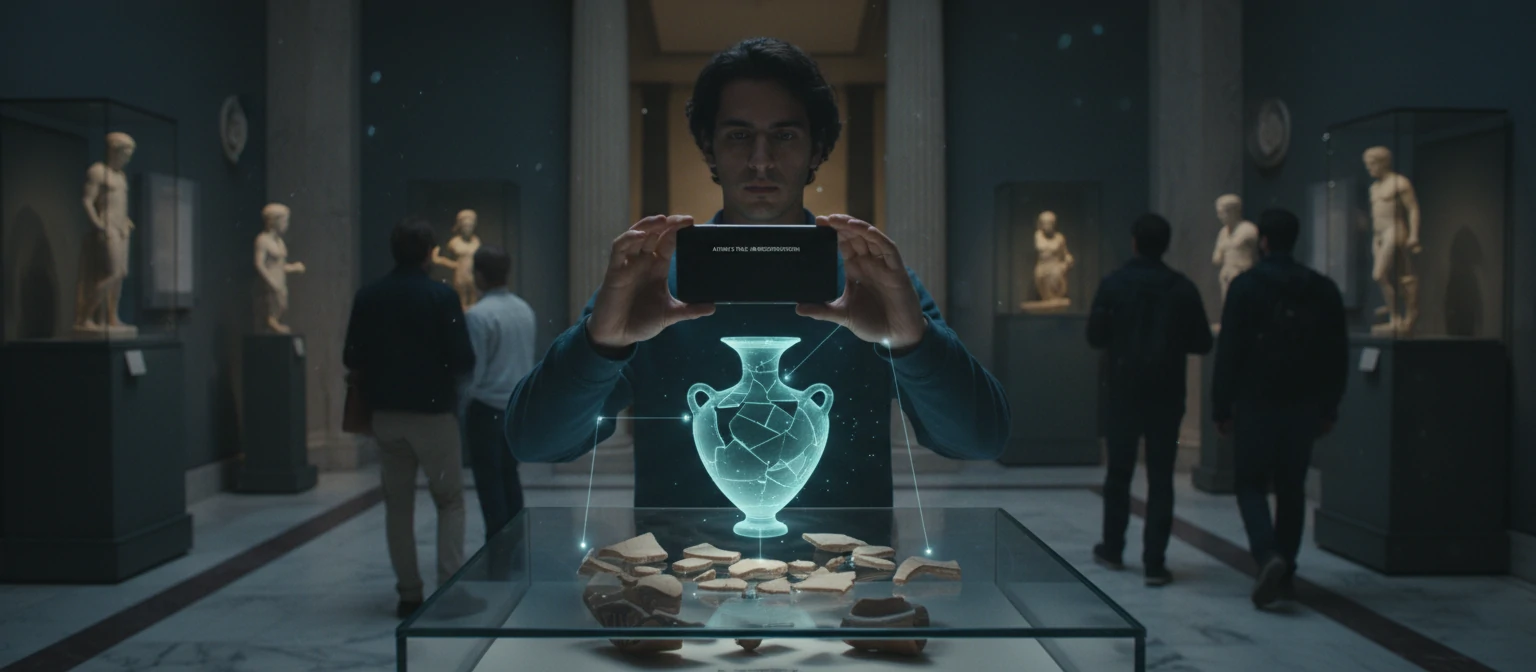
Museums and cultural institutions leverage AR to bring exhibits alive. Historical artifacts trigger contextual recreations—a Roman helmet might summon an AR centurion explaining its use. Dinosaur skeletons gain flesh and movement. Ancient cities rebuild themselves around visitors. These experiences attract new audiences while deepening engagement for traditional visitors.
Real Estate and Architecture Visualization
Real estate decisions rank among life's most significant, yet buyers traditionally make them based on limited information—empty rooms that require imagination to furnish, construction sites that demand visualization of future structures. AR transforms property evaluation by showing what will be, not just what is.
Property Visualization
Prospective buyers touring empty properties can now see them furnished through AR. Different furniture arrangements, design styles, and color schemes appear instantly, helping buyers envision themselves in the space. This capability proves particularly valuable for new construction where buyers must commit before seeing finished interiors.
For properties under construction, AR enables buyers to walk through completed buildings that exist only as digital models. Standing on an empty lot, they can tour their future home, checking sightlines from windows and understanding spatial relationships that floor plans can't communicate. This confidence accelerates purchasing decisions and reduces buyer's remorse.
Pre-Construction Sales
Walk through buildings before ground is broken. Experience unit layouts, views, and finishes in full scale.
Renovation Planning
Visualize proposed changes before committing. See how new kitchens, additions, or modifications will look.
Architecture and Design Review
Architects and their clients use AR to review designs at full scale in actual locations. Rather than interpreting 2D drawings or even 3D computer models, stakeholders can walk around proposed structures on their future sites. This spatial understanding catches design issues early and builds client confidence. Solar studies show shadow patterns throughout the day. Sight line analysis confirms privacy and view preservation.
Social Interaction and Remote Collaboration
AR is reshaping how people connect across distances. Beyond video calls that constrain participants to flat screens, AR collaboration creates shared spatial experiences where remote participants interact with common objects and environments. This evolution in communication has profound implications for work, education, and personal relationships.
Collaborative Workspaces
Remote teams using AR can gather around shared 3D models, manipulating designs as if physically present together. Product designers collaborate on prototypes that appear on each participant's desk. Architects walk clients through buildings together despite being continents apart. These interactions capture spatial understanding that flat screens cannot convey.
AR Collaboration Scenarios
Design Reviews
Multiple participants view and annotate the same 3D model in their respective spaces. Point at features, suggest changes, and see modifications in real-time.
Training and Mentorship
Experts guide trainees through procedures, drawing and pointing in the trainee's actual environment. Hands-on learning without physical presence.
Social Presence
Photorealistic avatars of remote participants appear in your space, enabling more natural conversation than traditional video. Body language and spatial positioning restore communication nuances.
Social AR Experiences
Consumer social platforms have integrated AR features that transform everyday communication. Shared AR experiences let friends create and inhabit spaces together. Multi-user AR games encourage in-person social interaction. AR filters and effects have become their own communication language, particularly among younger users who grew up with these tools.
Emerging AR Scenarios and Future Possibilities
Current AR scenarios merely hint at future possibilities. As hardware becomes lighter, more capable, and eventually invisible through smart contact lenses, AR will weave into daily life in ways that seem fantastical today. Several emerging scenarios preview this future.
Contextual Information Everywhere
Imagine glancing at any object and instantly understanding it. Look at a plant, and AR identifies its species, care requirements, and watering schedule. Examine a product and see reviews, price comparisons, and sustainability ratings. Meet someone and see their name, relationship context, and conversation topics you share. This ambient information layer will fundamentally change how we perceive and interact with our surroundings.
🌍 Environmental Awareness
See carbon footprints, energy consumption, and environmental impact of products and activities visualized in real-time.
🛠️ Self-Service Repair
Any device becomes repairable when AR guides you through diagnostics and repairs with step-by-step spatial instructions.
❤️ Personal Health
See nutritional information while eating, track physical metrics during exercise, and receive real-time health guidance.
🎨 Creative Expression
Create art that exists in physical locations, build sculptures only visible through AR, and share creations that others can experience in place.
The Spatial Computing Era
The transition from screen-based computing to spatial computing represents a paradigm shift comparable to the move from text interfaces to graphical user interfaces. Rather than confining digital experiences to rectangles, AR distributes information throughout physical space. Your workspace might expand across an entire room. Entertainment might fill your living room. Communication might place friends beside you regardless of distance.
"We're moving from a world where we access digital information through devices to one where digital information is accessible everywhere we look. AR doesn't just change how we use technology—it changes how we experience reality itself."
These possibilities raise important questions about privacy, attention, and human connection that society must address as AR capabilities expand. The scenarios emerging today will shape how we navigate these challenges, establishing norms and expectations for technology's role in augmented lives.
Frequently Asked Questions
What's the difference between AR and VR?
AR (Augmented Reality) overlays digital content onto the real world, enhancing what you see. VR (Virtual Reality) replaces your surroundings entirely with a digital environment. AR keeps you grounded in reality while adding information; VR transports you somewhere else entirely.
Do I need special glasses for AR?
Not necessarily. Most current AR experiences work through smartphones or tablets, using their cameras and screens. Dedicated AR glasses provide hands-free experiences and are increasingly used in industrial settings. Consumer AR glasses are becoming more available, but smartphone AR remains the most accessible option.
How expensive is implementing AR for business?
AR implementation costs vary dramatically based on complexity. Simple mobile AR experiences using existing platforms might cost a few thousand dollars. Custom industrial AR solutions with specialized hardware can reach six figures. Many platforms now offer no-code AR creation tools, making basic experiences increasingly affordable.
Is AR safe for eyes?
Current AR technology poses no known unique risks to eye health beyond normal screen use guidelines. The concern about eye strain applies similarly to all digital device use. AR glasses and headsets are designed with appropriate brightness and focus distances. As with any technology, taking breaks and following manufacturer guidelines is recommended.
What industries will AR impact most?
Healthcare, manufacturing, retail, and education are experiencing the most significant AR transformation currently. Any industry involving spatial understanding, complex procedures, or visualization benefits from AR. Emerging applications in architecture, logistics, field service, and entertainment continue expanding AR's reach across virtually every sector.
Embracing the Augmented Future
The AR scenarios explored throughout this guide share a common thread: they succeed by solving real problems or creating genuine value. Whether helping a surgeon visualize critical structures, enabling a customer to furnish their apartment before purchasing, or guiding a technician through complex repairs, effective AR enhances human capability rather than replacing it.
As you consider AR for your organization or evaluate its role in your industry, focus on specific user needs and contexts. The most impactful AR implementations emerge from deep understanding of what people actually struggle with—the information they lack when they need it, the visualization they can't achieve naturally, the guidance they require in the moment of action.
We stand at an inflection point where AR transitions from novelty to necessity across multiple domains. The scenarios succeeding today establish patterns for the spatial computing era ahead. By understanding these applications—their capabilities, limitations, and evolving possibilities—you position yourself to navigate and shape how augmented reality transforms our world.