
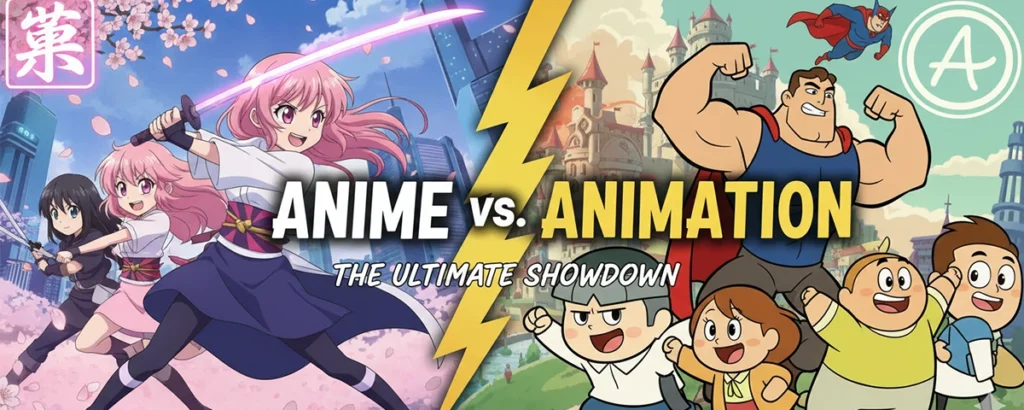
A Comprehensive Exploration of Two Beloved Art Forms
Introduction
In the vibrant world of moving pictures, two terms often spark passionate debates among enthusiasts: anime and animation. While both involve the art of bringing static images to life, they represent distinct cultural phenomena that have shaped entertainment, art, and storytelling across the globe.
Anime, derived from the English word "animation," specifically refers to animated productions originating from Japan, characterized by distinctive art styles, storytelling techniques, and cultural elements. Animation, in its broader sense, encompasses all forms of moving imagery created through various techniques, from traditional hand-drawn cel animation to cutting-edge computer-generated imagery (CGI).
This comprehensive exploration will take you on a journey through the fascinating worlds of both anime and animation, examining their historical roots, artistic approaches, cultural significance, and economic impact. Whether you're a seasoned otaku, an animation enthusiast, or simply curious about these captivating art forms, you'll discover the unique characteristics that define each medium and the surprising ways they influence each other.
"Animation is not the art of drawings that move but the art of movements that are drawn." - Norman McLaren
Historical Context
The Birth of Animation
Animation's roots trace back to ancient times, with cave paintings depicting movement and early optical toys like the zoetrope. However, modern animation began in the early 20th century with pioneers like Émile Cohl and Winsor McCay. McCay's "Gertie the Dinosaur" (1914) is often considered the first animated character with personality, setting the foundation for character-driven storytelling in animation.
The 1920s and 1930s marked animation's golden age in the West, with Walt Disney revolutionizing the industry. Disney's innovations included synchronized sound in "Steamboat Willie" (1928), the first full-color cartoon "Flowers and Trees" (1932), and the groundbreaking feature-length film "Snow White and the Seven Dwarfs" (1937). These achievements established animation as a legitimate art form and entertainment medium.
The Rise of Anime
Japan's animation journey began in 1917 with Jun'ichi Kōuchi's "The Dull Sword," but the medium truly flourished after World War II. The pivotal figure in anime history is Osamu Tezuka, often called the "God of Manga." Tezuka's "Astro Boy" (1963) became the first successful Japanese animated television series, establishing many conventions still used in anime today.
Key Anime Milestones
- 1963: Astro Boy debuts
- 1979: Mobile Suit Gundam
- 1988: Akira gains global recognition
- 1997: Princess Mononoke
- 2001: Spirited Away wins Oscar
Animation Milestones
- 1937: Snow White (first feature)
- 1995: Toy Story (first CGI feature)
- 2001: Shrek popularizes CGI
- 2009: Avatar advances motion capture
- 2018: Spider-Verse innovates style
Tezuka's influence extended beyond storytelling to production techniques. Facing budget constraints, he developed cost-effective methods like limited animation, reusing backgrounds, and strategic camera movements. These techniques became hallmarks of anime production, allowing for more content creation with smaller budgets compared to Western animation.
The 1980s and 1990s saw anime's international breakthrough. Films like Akira (1988) and Ghost in the Shell (1995) introduced Western audiences to anime's mature themes and sophisticated storytelling. Meanwhile, Studio Ghibli, founded by Hayao Miyazaki and Isao Takahata, created films that achieved both critical acclaim and commercial success worldwide.
Artistic Styles and Techniques
Visual Aesthetics: East Meets West
The most immediately recognizable difference between anime and Western animation lies in their visual aesthetics. Anime characters typically feature large, expressive eyes, smaller noses and mouths, and distinctive hair styles that often defy gravity. This style, influenced by both traditional Japanese art and early Disney animations, creates an instantly recognizable look that has become synonymous with Japanese animation.
Anime Visual Characteristics
- Eyes: Large, detailed, emotionally expressive
- Hair: Vibrant colors, gravity-defying styles
- Facial Features: Simplified, stylized proportions
- Body Language: Exaggerated expressions and gestures
- Color Palettes: Bright, saturated colors
- Backgrounds: Detailed, atmospheric settings
- Lighting: Dramatic, mood-enhancing effects
- Symbolism: Visual metaphors and cultural references
Western animation, particularly from major studios like Disney, Pixar, and DreamWorks, tends to favor more realistic proportions (within stylized parameters), rounder character designs, and a focus on three-dimensional depth. The evolution from 2D to 3D CGI has further distinguished Western animation, with studios pushing the boundaries of photorealistic rendering and complex lighting systems.
Animation Techniques and Production Methods
The production philosophies between anime and Western animation reflect their different cultural and economic contexts. Anime production often employs limited animation techniques, where fewer frames per second are used compared to Western "full animation." This approach, born from budget constraints, has evolved into an artistic choice that creates a distinctive rhythm and pacing.
Anime Techniques
- Limited Animation: 8-12 fps vs 24 fps
- Static Shots: Characters talking without mouth movement
- Speed Lines: Motion blur effects
- Panning Shots: Camera movement over still backgrounds
- Symbolic Imagery: Abstract representations of emotions
Western Animation Techniques
- Full Animation: 24 fps for smooth movement
- Squash and Stretch: Exaggerated deformation
- Anticipation: Preparatory movements
- Follow Through: Realistic physics simulation
- 3D Integration: CGI and traditional animation blend
Anime's approach to cinematography draws heavily from live-action film techniques, with dynamic camera angles, close-ups, and dramatic lighting that create cinematic experiences. Directors like Satoshi Kon and Mamoru Oshii have pushed these techniques to create visually stunning and psychologically complex narratives.
Western animation has increasingly embraced technological innovation, with studios like Pixar leading advances in computer graphics, realistic physics simulation, and complex lighting models. Recent films like "Spider-Man: Into the Spider-Verse" have experimented with mixed media approaches, combining 3D CGI with comic book aesthetics and traditional animation techniques.
Cultural Impact
Anime as Cultural Ambassador
Anime has become one of Japan's most powerful cultural exports, introducing global audiences to Japanese values, traditions, and social concepts. Through series like "Naruto," "Dragon Ball," and "One Piece," viewers worldwide have been exposed to concepts like bushido (the way of the warrior), the importance of friendship and perseverance, and Japanese social hierarchies.
The phenomenon of "Cool Japan" - the country's soft power strategy - has positioned anime as a cornerstone of cultural diplomacy. Anime conventions, cosplay culture, and Japanese language learning have all surged globally, creating communities of enthusiasts who develop deep connections with Japanese culture through animated media.
Global Anime Impact Statistics
Western Animation's Universal Appeal
Western animation, particularly from Disney and other major studios, has historically focused on universal themes and values that transcend cultural boundaries. Films like "The Lion King," "Finding Nemo," and "Frozen" have achieved global success by addressing fundamental human experiences: coming of age, family bonds, and personal growth.
The cultural impact of Western animation extends beyond entertainment into education and social commentary. Shows like "The Simpsons" and "South Park" have influenced political discourse, while educational programs like "Sesame Street" have shaped childhood development approaches worldwide.
Cross-Cultural Pollination
The boundaries between anime and Western animation have increasingly blurred, creating fascinating hybrid works. Studio Ghibli's collaboration with Disney for international distribution brought anime aesthetics to mainstream Western audiences, while shows like "Avatar: The Last Airbender" and "Castlevania" demonstrate Western creators adopting anime-inspired storytelling and visual styles.
Anime Influence on West
- Complex, serialized storytelling
- Mature themes in animation
- Distinctive visual aesthetics
- Character-driven narratives
- Emotional depth and philosophy
Western Influence on Anime
- Advanced 3D animation techniques
- Global distribution strategies
- Merchandising approaches
- Cross-media storytelling
- International co-productions
Target Audiences and Themes
Anime's Demographic Diversity
One of anime's most distinctive features is its sophisticated demographic targeting system, which recognizes that animation can appeal to audiences far beyond children. This system categorizes anime into specific demographic groups, each with distinct themes, storytelling approaches, and visual styles.
Kodomomuke
Children's anime with educational and moral themes
Shonen
Young male audience, action, adventure, friendship
Shojo
Young female audience, romance, relationships
Seinen/Josei
Adult audiences, complex themes, mature content
Shonen anime like "Dragon Ball Z," "Naruto," and "My Hero Academia" emphasize themes of perseverance, friendship, and personal growth through conflict. These series often feature tournament arcs, power scaling, and the classic hero's journey adapted for serialized storytelling.
Shojo anime such as "Sailor Moon," "Fruits Basket," and "Ouran High School Host Club" focus on emotional relationships, personal development, and often feature strong female protagonists navigating complex social dynamics.
Seinen and Josei anime target adult audiences with sophisticated narratives exploring psychological complexity, social issues, and philosophical questions. Series like "Monster," "Psycho-Pass," and "March Comes in Like a Lion" demonstrate anime's capacity for mature, nuanced storytelling.
Western Animation's Evolving Demographics
Traditionally, Western animation was primarily associated with children's entertainment, but this landscape has dramatically evolved. The success of shows like "The Simpsons," "Rick and Morty," and "BoJack Horseman" has proven that animation can effectively address adult themes and complex social commentary.
Western Animation Categories
Family Entertainment
- Disney/Pixar films
- DreamWorks productions
- Universal themes
- Multi-generational appeal
Adult Animation
- Prime-time comedies
- Satirical content
- Social commentary
- Mature themes
Streaming Originals
- Netflix productions
- Experimental formats
- Diverse storytelling
- Global perspectives
Thematic Convergence and Divergence
While both anime and Western animation explore universal themes like love, friendship, and personal growth, their cultural contexts create distinct approaches to these subjects. Anime often incorporates concepts like mono no aware (the pathos of things), emphasizing the transient nature of life and beauty, while Western animation frequently focuses on individual achievement and overcoming obstacles.
The treatment of failure and redemption also differs significantly. Anime characters often experience profound defeats that lead to introspection and gradual improvement, while Western animated characters typically follow more straightforward redemption arcs with clear resolution.
Technological Advances
The Digital Revolution
The transition from traditional cel animation to digital production has transformed both anime and Western animation, though each has adapted these technologies differently. The shift began in the 1990s and accelerated through the 2000s, fundamentally changing how animated content is created, distributed, and consumed.
In anime production, digital tools have enabled more efficient workflows while maintaining the distinctive hand-drawn aesthetic. Studios like Studio Ghibli initially resisted digital techniques, with Miyazaki famously preferring traditional methods, but eventually embraced digital coloring and compositing while preserving hand-drawn animation for character movement.
Key Technological Milestones
Anime Technology
- 1990s: Digital ink and paint
- 2000s: 3D backgrounds integration
- 2010s: Motion capture adoption
- 2020s: AI-assisted animation
Western Animation Tech
- 1995: First full CGI feature (Toy Story)
- 2000s: Photorealistic rendering
- 2010s: Real-time rendering
- 2020s: Virtual production techniques
3D Integration and Hybrid Techniques
The integration of 3D computer graphics has followed different paths in anime and Western animation. Western studios, led by Pixar, embraced full 3D CGI as the new standard, pushing for increasingly photorealistic rendering and complex physics simulations. Films like "Avatar" and "The Jungle Book" (2016) demonstrate the pinnacle of this approach, blending live-action with photorealistic CGI.
Anime studios have taken a more selective approach to 3D integration, often using CGI for mechanical objects, vehicles, and backgrounds while maintaining 2D character animation. This hybrid approach preserves anime's distinctive aesthetic while leveraging 3D technology's efficiency for complex scenes. Recent productions like "Demon Slayer" and "Attack on Titan" showcase masterful integration of 2D and 3D elements.
Streaming and Distribution Revolution
The rise of streaming platforms has revolutionized how both anime and Western animation reach audiences. Netflix, Crunchyroll, and other platforms have enabled global simultaneous releases, breaking down geographical barriers that previously limited anime's international reach. This has led to increased investment in original animated content and more diverse storytelling approaches.
Streaming has also enabled new formats and experimental approaches. Limited series, anthology formats, and interactive content have emerged as viable alternatives to traditional theatrical releases or broadcast television. Shows like "Love, Death & Robots" demonstrate how streaming platforms can support diverse animation styles and mature content that might not find traditional distribution channels.
Future Technologies
Emerging technologies like AI-assisted animation, virtual reality experiences, and real-time rendering engines are poised to further transform both anime and Western animation production, potentially democratizing high-quality animation creation while opening new storytelling possibilities.
Economic Aspects
Production Models and Budgets
The economic structures underlying anime and Western animation production reveal fundamental differences in approach, scale, and market strategy. Western animation, particularly major studio productions, typically operate with significantly larger budgets but also face higher financial risks and expectations for global box office performance.
Anime Economics
- TV Series: $100K-300K per episode
- Films: $5-20M typical budget
- Revenue Sources: Merchandise, licensing, streaming
- Production Committees: Risk-sharing model
- International Sales: Growing revenue stream
Western Animation Economics
- TV Series: $1-5M per episode (prime time)
- Films: $50-200M+ typical budget
- Revenue Sources: Box office, streaming, merchandise
- Studio System: Centralized production model
- Global Distribution: Primary revenue focus
Anime's production committee system distributes financial risk among multiple stakeholders, including TV networks, toy companies, music labels, and publishers. This model enables more experimental content creation but can also lead to creative compromises when committee members have conflicting interests.
Merchandising and Licensing
Both industries have developed sophisticated merchandising ecosystems, but with different emphases. Anime merchandising often focuses on character goods, figures, and collectibles that appeal to dedicated fan communities. The concept of "otaku economics" recognizes that passionate fans will spend significantly on high-quality merchandise, supporting niche productions that might not achieve mainstream success.
Western animation merchandising typically targets broader demographics with toys, clothing, and lifestyle products. Disney's merchandising empire demonstrates this approach's potential, with character licensing generating billions in revenue across diverse product categories.
Streaming Wars and Global Markets
The streaming revolution has dramatically altered the economic landscape for both anime and Western animation. Netflix's investment in original anime content, including partnerships with renowned studios and creators, has injected significant capital into the industry while expanding global reach. Similarly, Disney+ has become a major platform for Western animated content, leveraging both classic properties and new original productions.
Market Size Comparison (2023)
Conclusion
The exploration of anime versus animation reveals not a competition between superior and inferior art forms, but rather a fascinating dialogue between different cultural approaches to visual storytelling. Both mediums have evolved from humble beginnings to become powerful forces in global entertainment, each contributing unique perspectives, techniques, and innovations to the broader animation landscape.
Anime's strength lies in its demographic sophistication, cultural specificity, and willingness to tackle complex themes across all age groups. Its distinctive visual language and storytelling approaches have created a global community of enthusiasts who find depth and meaning in animated narratives that extend far beyond simple entertainment.
Western animation's achievements in technological innovation, universal storytelling, and production scale have established animation as a legitimate and profitable entertainment medium. The industry's evolution from children's entertainment to sophisticated adult content demonstrates animation's versatility as an artistic medium.
Perhaps most importantly, the increasing cross-pollination between anime and Western animation suggests a future where the boundaries between these traditions continue to blur. As creators draw inspiration from both Eastern and Western approaches, audiences benefit from increasingly diverse and innovative animated content.