
Discover the last residential project of Mexico’s greatest architect — a symphony of color, light, and water that continues to move every visitor who steps through its narrow entrance into an extraordinary world of emotional architecture.
Table of contents
- Who Was Luis Barragán
- The Story of Casa Gilardi
- Design Philosophy & Elements
- Room by Room Experience
- The Meaning of Color
- The Iconic Pool & Dining Room
- Planning Your Visit
- Photography Guide
- Barragán Architecture Trail
- Materials & Construction
- Legacy & Global Influence
- Insider Tips & Best Practices
- Frequently Asked Questions
- Experience Barragán’s Final Masterpiece
Who Was Luis Barragán
Luis Barragán (1902–1988) is widely considered the most important Mexican architect of the twentieth century and one of the most influential architects in modern history. His work earned him the Pritzker Architecture Prize in 1980 — architecture’s highest honor — with the jury praising his ability to create spaces of profound emotional impact through minimal means. Born in Guadalajara, Jalisco, Barragán initially trained as an engineer before traveling to Europe in the 1920s, where he encountered the work of Ferdinand Bac, the gardens of the Alhambra in Spain, and the emerging modernist movement that would transform his understanding of what architecture could achieve.
What set Barragán apart from his contemporaries was his unwavering belief that architecture should evoke deep emotion. While other modernists focused primarily on function and structural expression, Barragán spoke passionately of “emotional architecture” — spaces that could inspire serenity, joy, wonder, and introspection. His work drew from Mexican haciendas, colonial monasteries, and vernacular buildings, filtering these ancestral traditions through a sophisticated modernist sensibility that created something entirely new and profoundly beautiful.
Light as Material
Barragán treated natural light not as mere illumination but as a primary building material, choreographing its movement through spaces with the precision of a stage director controlling spotlights across a theatrical production.
Bold Color Palettes
Drawing from Mexican folk traditions and the saturated hues of bougainvillea, jacaranda, and desert landscapes, Barragán elevated color from mere decoration to a fundamental structural and emotional element of architecture.
Water & Reflection
Pools, fountains, and water channels appear throughout Barragán’s work, serving as reflective surfaces that double the visual impact of colored walls and as acoustic elements that introduce meditative sound into silent spaces.
Sacred Silence
Inspired by Mexican monasteries and convents, Barragán designed spaces that actively cultivate silence and contemplation, using thick walls and introverted layouts to create sanctuaries from the noise of the modern world.
“I believe in an emotional architecture. It is very important for humankind that architecture should move by its beauty; if there are many equally valid technical solutions to a problem, the one which offers the user a message of beauty and emotion, that one is architecture.” — Luis Barragán
The Story of Casa Gilardi
In 1975, Francisco Gilardi and Martín Luque approached the seventy-three-year-old Barragán with a request that would produce the architect’s final residential masterpiece: design a house for their narrow lot in the Tacubaya neighborhood of Mexico City. Barragán initially declined the commission, as he had largely retired from residential projects and was focused on landscape architecture and urban planning. But when he visited the site and saw the magnificent jacaranda tree standing in the courtyard, everything changed. The tree captivated him so completely that he agreed to take on the project.
The clients made one non-negotiable demand that would prove to be the project’s greatest gift: the beloved jacaranda tree must remain untouched. For Barragán, this wasn’t a constraint but a profound inspiration. The entire house would be designed around the tree, honoring its presence as the spiritual heart of the home. Every room, every corridor, every opening was oriented to acknowledge the jacaranda’s seasonal transformations — its spectacular purple bloom in spring, its lush green canopy in summer, and its spare winter silhouette against the sky.
Timeline of Casa Gilardi
Francisco Gilardi commissions Barragán after the architect visits the site and falls in love with the existing jacaranda tree. Initial design work begins with the tree as the central organizing element of the entire composition.
Construction completed and the Gilardi family moves into their new home. The house immediately attracts attention from the international architectural community, with critics recognizing it as the culmination of Barragán’s lifetime of creative exploration.
Barragán receives the Pritzker Architecture Prize, the profession’s highest honor. Casa Gilardi is cited prominently as evidence of his mastery of emotional architecture and his singular ability to create spaces of transcendent beauty.
Still a private residence, the house welcomes visitors by appointment, maintaining Barragán’s original vision while generously sharing it with architecture enthusiasts, students, and cultural travelers from around the world.
What makes Casa Gilardi particularly significant is its status as Barragán’s final residential work. By this point in his career, he had refined his ideas to their essence. Every element in the house — every color choice, every angle of light, every spatial proportion — reflects decades of experimentation and philosophical inquiry distilled into pure, concentrated form. The house represents the definitive statement of an architect who had spent a lifetime learning to listen to what spaces want to become.
Design Philosophy & Elements
Casa Gilardi embodies Barragán’s mature philosophy: architecture as an emotional experience rather than a purely functional exercise. The house is modest in size — just under 350 square meters — but feels expansive and limitless due to his masterful manipulation of space, light, proportion, and color. Every design decision serves the overarching goal of creating a home that nourishes the soul as much as it shelters the body, demonstrating that profound architectural experiences can emerge from the simplest of means.
Built on a narrow plot just ten meters wide, the house uses its spatial constraints creatively, transforming what might have been limitations into virtues. Rooms flow sequentially along a linear axis, creating a carefully choreographed journey through progressively more dramatic encounters with color and light. The street-facing façade is deliberately austere — a monolithic pink wall with minimal openings that reveals nothing of the rich spatial world hidden within.
The Narrow Lot Strategy
Rather than fighting the ten-meter width, Barragán embraced it as an opportunity to create a processional sequence of spaces that unfold one after another, each building emotional intensity toward the dramatic pool hall at the rear of the property.
The Closed Façade
The street-facing exterior is a bold, pink wall with almost no openings. This deliberate austerity creates complete privacy from the urban environment and produces the powerful sense of entering a sacred, hidden sanctuary when visitors cross the threshold.
Nature Integration
The jacaranda tree isn’t merely preserved — it is celebrated as the spiritual center of the entire composition. The house wraps around the courtyard, with every major room carefully oriented to offer framed views of the tree through precisely positioned windows and openings.
Material Simplicity
Smooth stucco walls, wooden beams, volcanic stone floors, and simple hardware. Barragán chose humble, locally sourced materials but combined them with extraordinary color and masterful proportions to create something that transcends the ordinary entirely.
Room by Room Experience
Experiencing Casa Gilardi is a carefully choreographed journey through space and emotion. Barragán designed the sequence of rooms to create a progressive revelation — from the mystery and compression of the entrance through the golden warmth of the corridor to the breathtaking climax of the pool hall where color, light, and water converge in a moment of transcendent beauty that visitors consistently describe as one of the most powerful architectural experiences of their lives.
The Entrance & Vestibule
A narrow door in the pink façade leads to a deliberately compressed vestibule bathed in shadow. The transition from bright street to dimness creates immediate anticipation. Barragán believed entrances should slow visitors down, shifting their consciousness from the external urban world to the contemplative interior one. This threshold is the first act in a carefully constructed spatial drama that builds toward revelation.
The Yellow Corridor
Emerging from the entrance, you encounter the famous yellow corridor — one of Barragán’s most photographed and celebrated spaces. Sunlight pours through a skylight above, washing the stucco walls in warm golden light that changes character throughout the day. The effect is almost religious, evoking the luminous interiors of Mexican churches. This long, narrow passage functions as a processional nave, guiding visitors toward the sacred space that awaits beyond.
The Jacaranda Courtyard
The jacaranda tree dominates this outdoor room that serves as the breathing heart of the entire house. Pink and purple walls create a dramatic backdrop for the tree’s seasonal transformations. In spring, when the jacaranda erupts in spectacular purple blooms, the courtyard becomes a symphony of complementary colors that seem almost impossibly vivid. The tree’s canopy filters sunlight into dappled patterns that play across the colored walls throughout the day.
The Upper Bedrooms
The private rooms occupy the upper floors, each carefully proportioned and oriented to capture specific qualities of light at different times of day. Windows are positioned not for views of the street but for framed glimpses of the jacaranda and controlled admissions of natural light. Even the most functional spaces in the house reflect Barragán’s obsessive attention to proportion, color, and the emotional quality of light.
The Pool & Dining Room
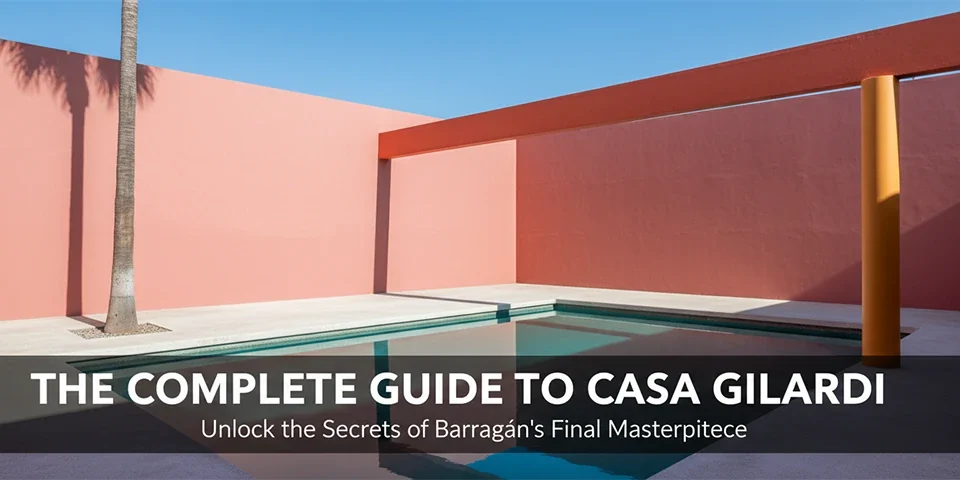
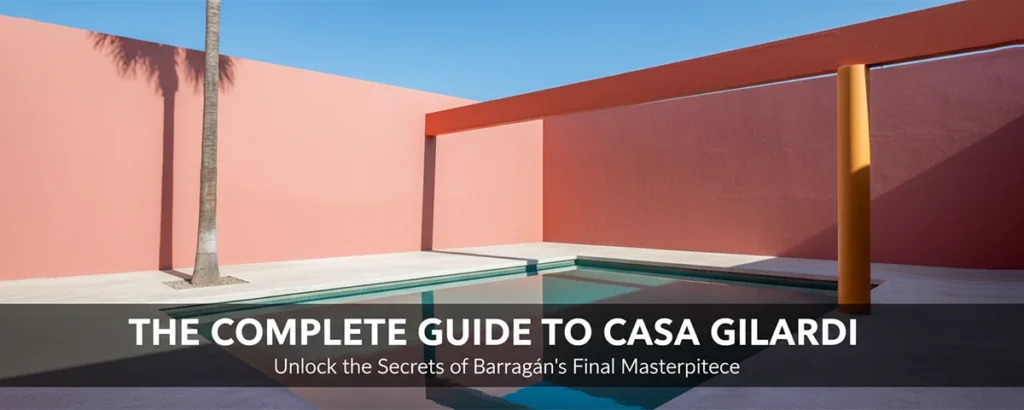
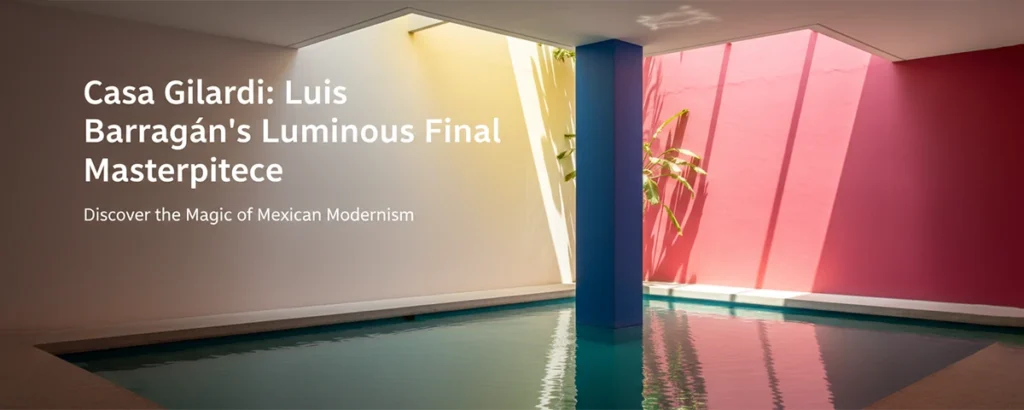
The climax of the spatial journey and the most famous room in the house. A swimming pool extends from outdoors to indoors, flanked by a bold red column and walls painted in intense pink and blue. A simple wooden dining table sits beside the water. Light filtered through a yellow glass ceiling casts an otherworldly golden glow over everything. This single space encapsulates everything Barragán believed about the power of architecture to transform ordinary life into something extraordinary.
The Meaning of Color
Color in Barragán’s architecture is never decorative — it is structural, emotional, and deeply meaningful. At Casa Gilardi, each hue was chosen to evoke specific psychological states and create particular relationships with natural light as it shifts throughout the day. The colors were mixed by Barragán himself, often requiring multiple attempts to achieve the exact shade he envisioned. He insisted on natural pigments that would age gracefully and interact beautifully with the changing quality of Mexican sunlight.
Barragán didn’t invent using bold colors in architecture — Mexican vernacular buildings have always embraced vibrant pigments that celebrate life and honor cultural traditions. But he elevated this indigenous practice into a sophisticated architectural language, demonstrating to the international community how color could transform simple plastered walls into surfaces of extraordinary emotional resonance that change character with every hour of the day.
Yellow
Joy, warmth, and spiritual illumination. The corridor transforms sunlight into a golden embrace that evokes the luminous interiors of Mexican baroque churches, creating a sense of divine presence through purely architectural means.
Pink
Mexican identity, earthiness, and the warmth of traditional adobe. The signature pink references bougainvillea flowers, colonial-era pigments, and the deep cultural connection between color and Mexican life that runs through centuries of architectural tradition.
Blue
Water, sky, infinity, and contemplative depth. The blue walls in the pool room create a sense of boundless space and coolness that contrasts with the warmth of pink, establishing a powerful chromatic dialogue between opposites.
Red
Energy, passion, and dramatic anchoring. The free-standing red column in the pool room is structurally unnecessary but emotionally essential, functioning as pure sculpture that concentrates the viewer’s attention and creates spatial drama.
The Iconic Pool & Dining Room
If there is one image that defines Casa Gilardi — and arguably Barragán’s entire career — it is the extraordinary pool and dining room at the rear of the house. This single space encapsulates everything the architect believed about the power of architecture: the integration of water as a reflective and acoustic element, the drama of saturated color used at monumental scale, the spiritual quality of carefully controlled natural light, and the profound beauty that emerges when these elements are orchestrated by a master at the peak of his creative powers.
Visitors consistently describe entering this space as a transformative experience. The combination of still water reflecting the intense colors of the surrounding walls, the otherworldly golden glow cast by the yellow glass ceiling, and the dramatic presence of the free-standing red column creates an atmosphere that transcends ordinary architectural experience entirely. Many visitors report feeling a profound sense of peace, wonder, and emotional openness that stays with them long after they leave the house.
The Pool
The water extends from outdoors to indoors, blurring boundaries between interior and exterior. Its still surface reflects the colored walls and filtered light above, doubling the visual impact and creating a sense of infinite depth that makes the space feel much larger than its physical dimensions.
The Red Column
A bold, free-standing column painted deep red rises from the water. It serves no structural purpose whatsoever — it is pure sculpture, an architectural gesture that creates drama, anchors the composition, and draws the eye with its intense chromatic presence amid the pink and blue surrounding walls.
The Dining Area
A simple wooden table sits beside the pool, where the Gilardi family takes their daily meals accompanied by the water’s reflections, the shifting light, and the subtle play of chromatic interactions across every surface. Ordinary dining becomes an extraordinary ceremony in this remarkable setting.
The Golden Light
A yellow glass ceiling filters daylight into an otherworldly golden glow that bathes every surface in warm luminosity. Combined with reflections off the water and the chromatic intensity of the colored walls, the light quality in this room has been described as nothing less than miraculous by visitors and architects alike.
Planning Your Visit
Casa Gilardi remains a private residence, generously opened to visitors by the Gilardi family who understand the cultural importance of sharing Barragán’s final masterpiece with the world. Visits are by appointment only and typically conducted as small group tours, creating an intimate experience that honors the contemplative spirit of the house. Because availability is limited, advance planning is essential for securing your visit.
Visitor Information
| Detail | Information |
|---|---|
| Address | General Antonio León 82, San Miguel Chapultepec, Mexico City |
| Admission | Approximately $20–$30 USD per person (prices may vary) |
| Reservations | Required — book via email at least 1–2 weeks in advance |
| Tour Duration | Approximately 45 minutes to 1 hour |
| Group Size | Small groups only (typically 4–8 people maximum) |
| Languages | Spanish and English tours available |
Send an Email Request
Contact Casa Gilardi through their official website or recognized architecture tour operators in Mexico City. Include your preferred dates, group size, language preference, and any special requirements. Be flexible with scheduling, as popular time slots fill up quickly during peak season.
Await Confirmation
Wait for confirmation of your time slot. Popular times fill up quickly, especially during spring when the jacaranda is in full bloom. If your first-choice date is unavailable, ask about alternative slots. Weekday mornings typically offer the best combination of availability and optimal lighting conditions.
Arrive Punctually & Prepared
Arrive exactly at your scheduled time — this is a private home, and the family manages visits carefully. Being punctual shows respect for their generosity. Wear comfortable, quiet shoes and dress respectfully. Read about Barragán’s philosophy before your visit to deepen your appreciation of every design choice you encounter.
⚠️ Important Notice
Because Casa Gilardi is a functioning private home, tour availability can be limited or occasionally suspended without notice. Book well in advance, especially for spring visits when the jacaranda is blooming. Be prepared for potential schedule changes and always confirm your reservation before traveling.
Photography Guide
Casa Gilardi is extraordinarily photogenic, and photography is generally permitted during tours. However, the saturated colors, dramatic light contrasts, and intimate scale of the spaces present unique technical challenges that require thoughtful preparation. The colors are so vivid that they can appear oversaturated in photographs unless you approach the task with care and understanding.
🌄 Best Time of Day
Late morning to early afternoon when sunlight penetrates the skylights most dramatically. The yellow corridor is most stunning around 10–11 AM when golden light floods in from above. The pool room transforms throughout the day, but midday offers the most balanced illumination.
📷 Equipment Tips
Wide-angle lenses between 16mm and 35mm capture the tight spaces most effectively. Smartphones work surprisingly well for the colorful walls due to their computational processing. Never use flash — natural light is absolutely essential to experiencing and documenting Barragán’s vision accurately.
🎨 Color Accuracy
Shoot in RAW format to preserve the full dynamic range of the colored walls and light reflections. Manual white balance is recommended, as automatic settings often struggle with the extreme chromatic saturation. You may need to reduce saturation in post-processing to match what your eyes actually see.
🤝 Photography Etiquette
Always follow your guide’s instructions about photography rules. Some areas may be restricted depending on current household preferences. Be mindful of other visitors and avoid monopolizing prime photography positions. Remember that this is someone’s private home and treat it accordingly.
Barragán Architecture Trail
Make the most of your architectural pilgrimage by visiting other Barragán works in Mexico City and its surroundings. Several masterpieces are within easy reach of Casa Gilardi, and together they provide a comprehensive view of the architect’s evolution from early regionalism through mature emotional architecture. Each project illuminates different facets of his genius and helps visitors understand the design principles that reached their fullest expression in his final residential work.
Casa Luis Barragán (UNESCO)
Barragán’s own home and studio, designated a UNESCO World Heritage Site in 2004. The essential starting point for understanding his work, located just one kilometer from Casa Gilardi in Tacubaya. Book well in advance as tours are extremely popular.
Cuadra San Cristóbal
An equestrian estate in Los Clubes featuring Barragán’s most dramatic use of water and color planes in a landscape setting. The famous pink wall reflected in the horse trough is one of the most iconic images in twentieth-century architecture worldwide.
Torres de Satélite
Monumental colored towers designed with sculptor Mathias Goeritz that mark the entrance to Ciudad Satélite. This public work demonstrates Barragán’s ability to apply his color philosophy at urban scale, creating a landmark visible from the highway.
Capilla de las Capuchinas
A small chapel for a convent in Tlalpan featuring Barragán’s most masterful and spiritual use of filtered light. The interplay of yellow-gold illumination and deep shadow creates an intensely sacred atmosphere that reveals the architect’s deepest convictions about the relationship between architecture and the divine.
Materials & Construction
Barragán’s material palette in Casa Gilardi is deliberately restrained, favoring honest, locally sourced materials that connect the building to its Mexican context while achieving a timeless quality that transcends any particular era. The construction relies on traditional masonry techniques — concrete block walls plastered with smooth stucco, then painted in those remarkable saturated colors that have become synonymous with the architect’s name worldwide.
The thick, solid walls serve multiple purposes beyond enclosure: they provide thermal mass that naturally regulates interior temperatures in Mexico City’s variable climate, they create acoustic isolation from the busy street outside, and they form the monolithic surfaces on which color and light perform their daily choreography. Floors throughout the house feature volcanic stone, a material deeply rooted in Mexican building tradition that adds both visual warmth and tactile richness to every room. Wooden beams and doors introduce organic texture that softens the geometric precision of the stucco walls.
Key Materials
| Material | Use | Significance |
|---|---|---|
| Stucco Plaster | Wall surfaces | Creates smooth surfaces for color projection |
| Volcanic Stone | Flooring | Connects to Mexican building heritage |
| Yellow Glass | Pool room skylight | Filters light into golden glow |
| Tropical Hardwood | Doors and beams | Adds organic warmth to geometric forms |
| Natural Pigments | Wall paint | Ages gracefully with changing light |
Legacy & Global Influence
Casa Gilardi’s influence extends far beyond Mexico’s borders, inspiring architects, designers, and artists across continents and generations. The house proved to the international architectural community that color, light, and emotional resonance could serve as primary design tools rather than secondary decorative concerns. This demonstration has fundamentally shaped contemporary thinking about the relationship between space and human experience across the entire built environment.
Architects such as Tadao Ando, Peter Zumthor, and Ricardo Legorreta have all acknowledged Barragán’s profound influence on their work. The emphasis on sensory experience, material honesty, and emotional atmosphere that characterizes much of today’s best architecture traces a direct lineage back to buildings like Casa Gilardi. In architectural education, the house is studied at leading universities worldwide as a masterclass in color theory, spatial sequencing, phenomenological design, and the integration of nature with built form.
Contemporary Architecture
Barragán’s legacy lives on in the work of architects worldwide who have embraced his vision of emotional architecture. From minimalist Japanese designs to colorful Latin American projects, his influence on contemporary practice continues to grow with each passing decade.
Interior Design Revolution
The bold use of saturated color in contemporary interior design owes much to Barragán’s example. Casa Gilardi proved that intense color could be sophisticated and refined rather than garish, opening doors for designers worldwide to embrace more daring chromatic palettes.
Art & Photography
The house has been the subject of countless photographic essays, art installations, and academic publications. Its spaces have been captured by leading architectural photographers, and its influence extends into contemporary light art, installation art, and color field painting.
Insider Tips & Best Practices
These recommendations come from extensive experience visiting Casa Gilardi across multiple seasons and lighting conditions. Following these tips will help you maximize the depth and richness of your encounter with Barragán’s final masterpiece, transforming a brief tour into an experience that will stay with you for a lifetime.
🌸 Visit in Spring (March–April)
The jacaranda tree blooms in late March through April, transforming the courtyard into a cascade of purple that creates stunning contrast with the pink and colored walls. This is when Barragán’s color choices make the most intuitive sense and the house reveals its deepest beauty.
📚 Study Barragán Beforehand
The more you understand Barragán’s philosophy before visiting, the more the spaces will resonate with you. Even reading his Pritzker Prize acceptance speech provides invaluable context for experiencing Casa Gilardi as the architect intended it to be received.
⏰ Take Your Time & Observe
Within the tour’s constraints, move slowly and deliberately. Let your eyes adjust to each space before moving on. The play of light changes constantly — wait and watch as colors shift and reflections dance across surfaces. These spaces were designed for contemplation.
👂 Listen to the Silence
Barragán valued silence as a fundamental design element. Despite being located in bustling Mexico City, the house creates profound quiet through its thick walls and introverted layout. Notice how the urban noise simply disappears once you cross the threshold.
🎁 Show Genuine Appreciation
The Gilardi family opens their private home to strangers out of a sincere desire to share Barragán’s extraordinary legacy with the world. A heartfelt thank you and treating the space with genuine respect honors their remarkable generosity and ensures future visitors can enjoy this privilege.
Frequently Asked Questions
Is Casa Gilardi the same as Casa Luis Barragán?
No, they are different buildings in the same Tacubaya neighborhood. Casa Luis Barragán was the architect’s personal home and studio, now a UNESCO World Heritage museum. Casa Gilardi was designed for the Gilardi family and remains their private residence. Both are essential to understanding Barragán’s work and can be visited on the same day.
Can visitors swim in the pool?
No. The pool is a functional element of the private home, not a visitor amenity. During tours, you observe the pool room from designated areas but cannot enter the water. The Gilardi family still uses the pool for swimming in their daily life, which is part of what makes this a living work of architecture rather than a museum piece.
Is the house wheelchair accessible?
Unfortunately, the house has stairs and narrow passages that make full wheelchair access difficult. Contact the tour operators directly to discuss your specific needs, as they may be able to accommodate certain mobility requirements or provide alternative arrangements for experiencing portions of the house.
How do I get to Casa Gilardi?
The house is located in the San Miguel Chapultepec neighborhood of Tacubaya, Mexico City. Take a taxi or ride-share service directly to the address on General Antonio León. The nearest Metro stations are Constituyentes and Tacubaya, each about a fifteen-minute walk through the quiet residential neighborhood.
What is the best season to visit?
Late March to early April offers the most spectacular experience when the jacaranda tree is in full purple bloom. For photography, book a late-morning slot between 10 and 11 AM when light fills the yellow corridor most dramatically. Avoid rainy season afternoons from June through September when cloud cover reduces the light effects that are so central to the architectural experience.
How long does a tour last?
Standard tours last approximately forty-five minutes to one hour, which provides sufficient time to experience all the major spaces including the entrance, yellow corridor, courtyard, and the famous pool room. Some specialized architectural tours may offer extended visits with more detailed commentary for professionals and serious enthusiasts.
Is photography permitted during tours?
Photography is generally permitted during tours, but policies may vary depending on the tour operator and current household preferences. Always confirm photography rules when booking. Flash photography is universally prohibited as it disrupts the natural light conditions that are essential to experiencing Barragán’s design as he intended.
Can I combine Casa Gilardi with other Barragán visits?
Absolutely. Casa Luis Barragán is just one kilometer away and can easily be visited on the same day. Several tour operators offer combined Barragán tours that include both houses plus other nearby sites. Plan a full day to truly immerse yourself in the architect’s extraordinary body of work within the Tacubaya neighborhood and beyond.
Rafael Córdoba
Architectural Historian & Writer
Rafael is an architectural historian specializing in Latin American modernism. He studied at UNAM and has written extensively about Luis Barragán, Ricardo Legorreta, and other masters of Mexican architecture. He leads architectural tours of Mexico City and teaches design history at the Instituto Tecnológico de Monterrey.