
Why 71% of B2B researchers start with generic searches—and how specialized SEO services can put your solution in front of decision-makers at the exact moment they're ready to buy.
Table of contents
Written by Daniel Morrison
B2B Marketing Strategist | 12 years driving pipeline growth for SaaS, manufacturing, and professional services | Former VP of Demand Gen
When our cybersecurity SaaS company hired our first SEO agency, I was skeptical. We sold complex enterprise software with six-figure contracts and 9-month sales cycles. "Our buyers don't Google things," I told my CEO. "They get referrals. They attend conferences." Three years later, organic search had become our largest source of qualified pipeline—generating more revenue than our entire outbound sales team. The lesson I learned transformed how I think about B2B marketing: B2B SEO isn't about rankings. It's about intercepting decision-makers during their research journey and positioning your solution as the obvious answer.

Why B2B SEO Is Fundamentally Different
Let me be clear upfront: most SEO advice you read online doesn't apply to B2B companies. The tactics that work for e-commerce stores and local businesses will waste your budget and frustrate your team when applied to complex B2B sales environments.
These statistics reveal the core truth about B2B buying: your prospects are researching extensively before they ever talk to your sales team. And increasingly, that research happens through search engines.
The Key Differences from B2C SEO
💡 The Low-Volume Paradox
One of the biggest mindset shifts in B2B SEO: a keyword with only 50 monthly searches might be your most valuable target. If those 50 searchers are CTOs actively looking for your exact solution, capturing even 10% of that traffic could mean $500,000+ in pipeline. Don't dismiss low-volume keywords—evaluate them by buyer intent and potential deal size.
Core B2B SEO Services Explained
Understanding what B2B SEO services actually include helps you evaluate agencies and set realistic expectations. Here's what a comprehensive B2B SEO engagement should cover:
🔧 Technical SEO Audit & Optimization
The foundation of any B2B SEO initiative. Enterprise websites often have complex architectures, multiple subdomains, and legacy technical debt that prevent proper indexing and ranking.
- ✓ Site architecture analysis and optimization recommendations
- ✓ Crawlability and indexation auditing
- ✓ Core Web Vitals and page speed optimization
- ✓ Schema markup implementation for B2B content types
- ✓ International SEO and hreflang configuration
- ✓ Security and HTTPS implementation
- ✓ Mobile optimization for mobile-first indexing
🔑 Keyword Research & Strategy
B2B keyword research goes beyond search volume to understand buyer intent, stakeholder roles, and purchase stage alignment.
- ✓ Buyer persona keyword mapping
- ✓ Purchase funnel keyword categorization
- ✓ Competitor keyword gap analysis
- ✓ Long-tail opportunity identification
- ✓ Industry-specific terminology research
- ✓ Question-based query targeting
- ✓ Keyword prioritization by revenue potential
📝 Content Strategy & Development
Creating content that serves the extended B2B research process while demonstrating expertise and building trust with multiple stakeholders.
- ✓ Content gap analysis against competitors
- ✓ Editorial calendar development
- ✓ Thought leadership content creation
- ✓ Technical documentation optimization
- ✓ Case study and use case development
- ✓ Comparison and evaluation content
- ✓ Content refresh and consolidation
🔗 B2B Link Building
Earning authoritative backlinks through industry relationships, original research, and genuine thought leadership rather than manufactured tactics.
- ✓ Industry publication outreach
- ✓ Original research and data studies
- ✓ Expert commentary and quotes
- ✓ Partnership and co-marketing links
- ✓ Resource page link building
- ✓ Broken link reclamation
- ✓ Digital PR for B2B brands
📊 Analytics & Reporting
Connecting SEO performance to actual business outcomes—pipeline, revenue, and customer acquisition—rather than vanity metrics.
- ✓ CRM integration for lead tracking
- ✓ Multi-touch attribution modeling
- ✓ Pipeline and revenue reporting
- ✓ Competitor visibility monitoring
- ✓ Custom dashboard development
- ✓ Quarterly business reviews
- ✓ Executive reporting and insights
📊 Analytics & Reporting
Connecting SEO performance to actual business outcomes—pipeline, revenue, and customer acquisition—rather than vanity metrics.
- ✓ CRM integration for lead tracking
- ✓ Multi-touch attribution modeling
- ✓ Pipeline and revenue reporting
- ✓ Competitor visibility monitoring
- ✓ Custom dashboard development
- ✓ Quarterly business reviews
- ✓ Executive reporting and insights

Mapping SEO to the B2B Buyer Journey
The B2B buyer journey isn't linear, but understanding the general research progression helps you create content that captures prospects at every stage. Here's how SEO content maps to the typical B2B decision process:
🔍 Problem Awareness Stage
"Why is our customer churn increasing?" | "Manufacturing efficiency best practices"
📚 Solution Research Stage
"Customer success software features" | "Predictive maintenance systems comparison"
⚖️ Vendor Evaluation Stage
"Gainsight vs Totango" | "Top industrial IoT platforms 2024"
✅ Decision Stage
"[Company] pricing" | "[Product] implementation timeline"
Content Types for Each Stage
🔍 Problem Awareness Content
Blog posts, industry reports, and guides that address symptoms and challenges your prospects experience. Focus on educational value without pushing your solution. Example: "The Hidden Costs of Manual Inventory Management" for a warehouse automation company.
📚 Solution Research Content
Comprehensive guides, feature explanations, and methodology content that helps buyers understand solution categories. Example: "The Complete Guide to Customer Success Platforms: Features, Benefits, and ROI" for a CS software company.
⚖️ Vendor Evaluation Content
Comparison pages, case studies, and ROI calculators that help buyers evaluate options. Don't shy away from competitor comparisons—if you don't create them, someone else will. Example: "[Your Product] vs [Competitor]: An Honest Comparison for Enterprise Teams."
✅ Decision Stage Content
Pricing pages, implementation guides, security documentation, and procurement resources. These pages often have the highest conversion rates but require the right visitor intent. Example: "Enterprise Security & Compliance Overview" or "Implementation Process & Timeline."
Content Strategy for Complex B2B Sales
Content is the fuel of B2B SEO. But the content that ranks and converts in B2B contexts is fundamentally different from what works in consumer markets.
The Expert-First Approach
B2B buyers are sophisticated. They can spot thin, AI-generated, or outsourced content immediately—and it destroys trust. The content that works involves your actual subject matter experts:
- Original research and data: Survey your customers, analyze your platform data, or conduct industry studies. Original data attracts backlinks, media coverage, and positions you as a thought leader.
- Expert interviews and insights: Feature your engineers, product managers, and executives. Their unique perspectives can't be replicated by competitors.
- Customer stories with real metrics: Generic testimonials don't convert. Detailed case studies with specific ROI figures do.
- Technical depth: Don't water down content for SEO. B2B buyers want comprehensive, technical information that answers their real questions.
📈 The 10x Content Standard
For competitive B2B keywords, your content needs to be dramatically better than what currently ranks—not just slightly different. This might mean 5,000 words instead of 1,500, original graphics instead of stock photos, video walkthroughs instead of text descriptions, or downloadable tools instead of static guides.
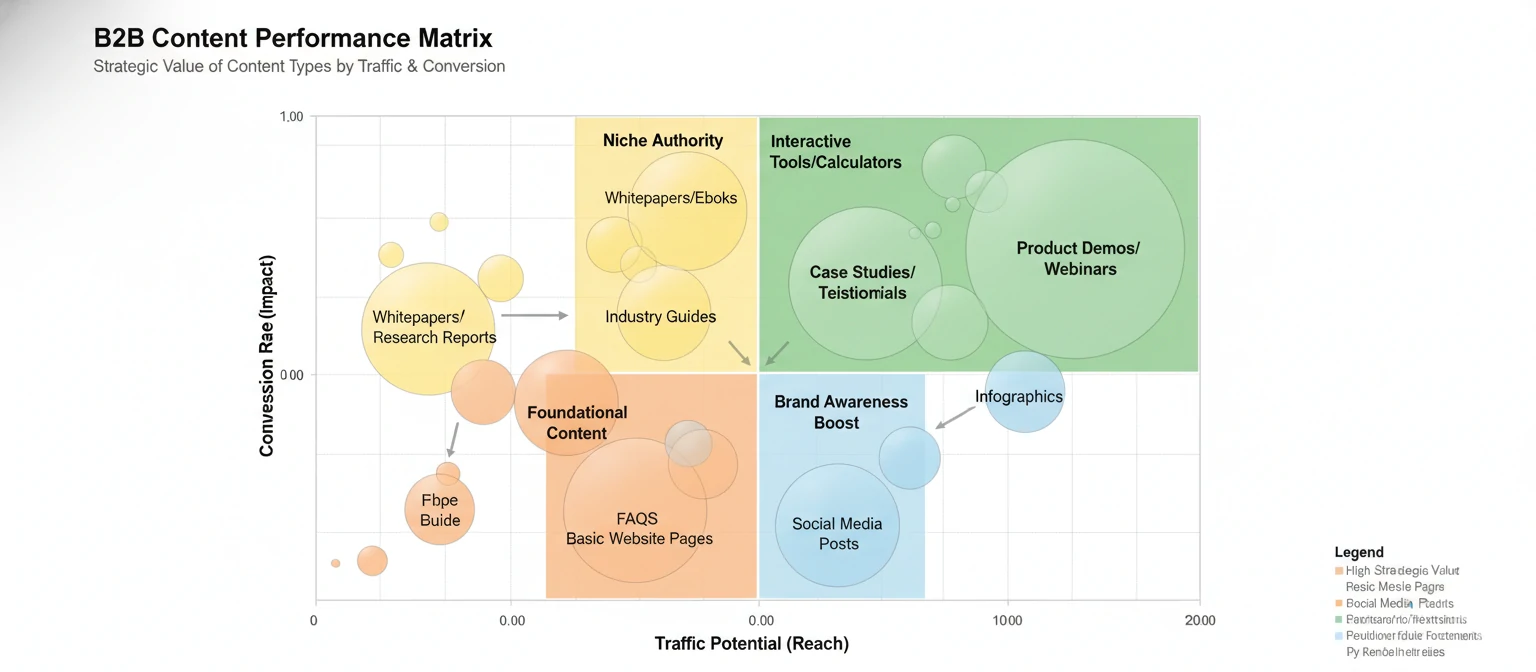
Content Types That Drive B2B Results
Ultimate Guides & Resources
Comprehensive resources that become the definitive reference for a topic. These attract links naturally and establish topical authority. Think "The Complete Guide to Enterprise Data Governance" rather than "5 Data Governance Tips."
Comparison & Alternative Pages
Pages targeting "[Competitor] alternatives" or "[Product A] vs [Product B]" capture high-intent evaluation traffic. These pages often have the highest conversion rates of any content type.
Industry-Specific Landing Pages
Vertical-focused pages like "Manufacturing ERP Software" or "Healthcare Analytics Platform" target industry buyers who want solutions built for their specific needs.
Use Case & Solution Pages
Pages organized by job function or problem: "Sales Intelligence for Account Executives" or "Compliance Automation for Financial Services." These align with how buyers actually search.
Original Research & Benchmarks
Annual reports, benchmark studies, and industry surveys generate links, media mentions, and position your brand as the authoritative source. "State of [Industry] Report" formats work exceptionally well.
Technical SEO for Enterprise Websites
Enterprise B2B websites often present unique technical challenges that require specialized expertise. Here's what to prioritize:
Common Enterprise Technical Issues
⚠️ JavaScript-Heavy Websites
Many modern B2B websites use React, Angular, or Vue.js frameworks that can create indexing problems. Ensure proper server-side rendering or pre-rendering for critical pages. Google has improved JavaScript crawling, but it's still not perfect—especially for dynamically loaded content.
⚠️ Complex Site Architecture
Enterprise sites with thousands of pages, multiple product lines, and various audience segments need careful information architecture. Poor structure leads to crawl budget waste and diluted page authority. Flatten deep hierarchies and use internal linking strategically.
⚠️ Subdomain Sprawl
Marketing uses one subdomain, docs live on another, the blog is somewhere else, and support has its own site. This fragments your domain authority and creates confusion for both users and search engines. Consolidate where possible.
Technical Priorities for B2B Sites
- Core Web Vitals: Page speed matters for rankings and user experience. B2B pages often load slowly due to complex functionality—prioritize LCP, FID, and CLS optimization.
- Schema Markup: Implement Organization, Product, FAQ, HowTo, and Article schema to enhance search appearance and provide context to search engines.
- XML Sitemaps: Maintain separate sitemaps for different content types and ensure they're updated regularly as content is added or removed.
- Canonical Tags: Prevent duplicate content issues from URL parameters, session IDs, and filtered views common in B2B product catalogs.
- HTTPS Everywhere: All pages, including marketing microsites and legacy content, must use HTTPS.
Measuring B2B SEO Success
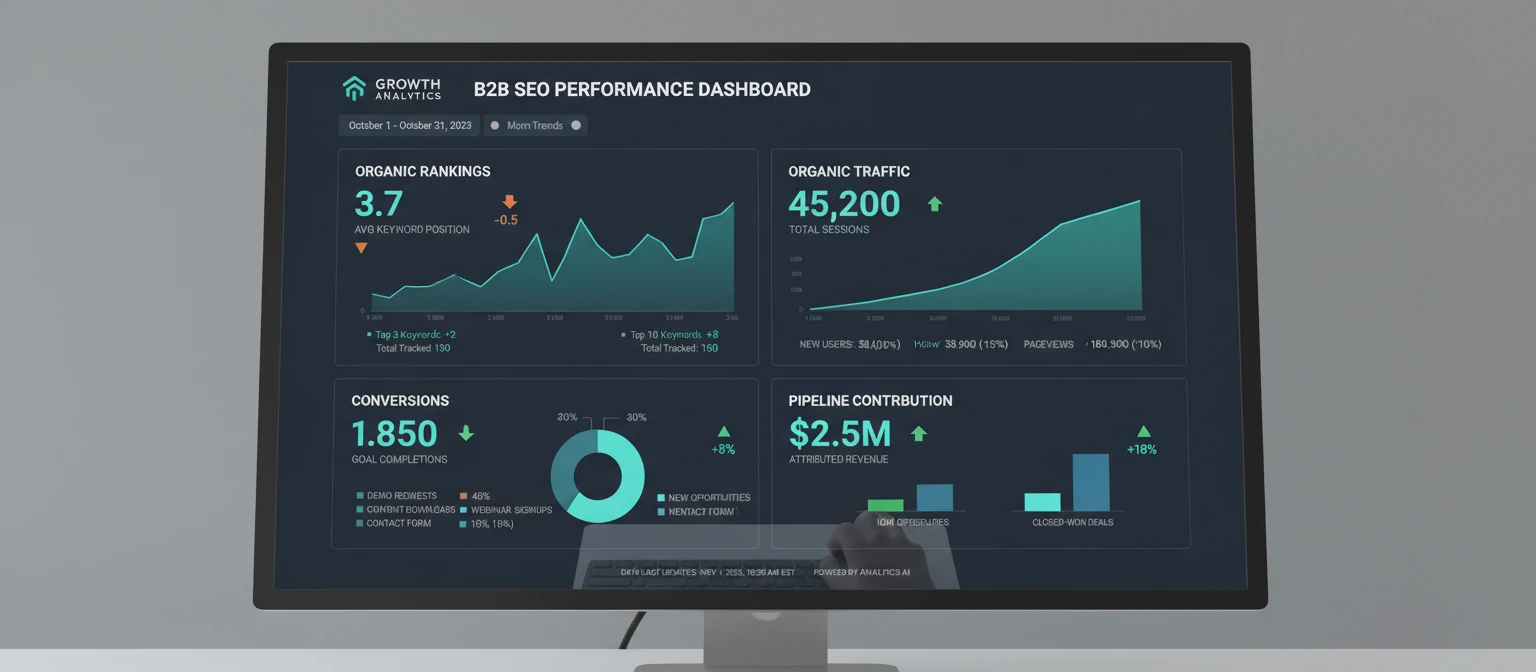
The biggest mistake in B2B SEO measurement is focusing on vanity metrics. Rankings and traffic matter only if they translate to business outcomes.
The Right Metrics Framework
Attribution Challenges in B2B
B2B attribution is messy. A buyer might find you through organic search, leave, return via email, attend a webinar, and finally request a demo from a paid ad. Who gets credit?
The answer: use multiple models and accept imperfection. Track:
- First-touch attribution: Which channel introduced buyers to your brand
- Last-touch attribution: Which channel triggered conversion
- Multi-touch attribution: How organic contributed throughout the journey
- Self-reported attribution: Ask leads "How did you hear about us?"
📊 The Pipeline Coverage Model
Instead of trying to attribute every deal precisely, track what percentage of your pipeline had organic touchpoints somewhere in their journey. If 60% of closed deals interacted with your organic content, you know SEO is contributing meaningfully—even if the exact attribution is complex.
Choosing the Right B2B SEO Partner
Most SEO agencies work primarily with B2C clients. Selecting a partner with genuine B2B expertise is critical to success.
What to Look For
Essential B2B SEO Agency Criteria
- ✅ Case studies specifically from B2B companies in complex sales environments
- ✅ Understanding of long sales cycles and multi-stakeholder buying processes
- ✅ Experience with CRM integration and pipeline attribution
- ✅ Content capabilities that can handle technical, expert-level topics
- ✅ Strategic thinking about buyer journey, not just keyword rankings
- ✅ References from B2B marketing leaders you can actually call
- ✅ Realistic timelines and expectations for B2B results
- ✅ Experience with enterprise website platforms and technical environments
Questions to Ask Potential Agencies
- What percentage of your clients are B2B vs. B2C?
- How do you approach keyword research for low-volume, high-intent B2B terms?
- Can you share examples of content you've created for technical B2B audiences?
- How do you measure success beyond rankings and traffic?
- What's your approach to integrating with sales and marketing teams?
- How do you handle industries with long sales cycles?
- What does your onboarding process look like for understanding our business?
Common Mistakes to Avoid
After working with dozens of B2B companies on SEO, I've seen the same mistakes repeatedly. Here's what to avoid:
⚠️ Chasing High-Volume Keywords
A manufacturing company spent months trying to rank for "supply chain management"—a term with 15,000 monthly searches. They eventually ranked on page 2 and got traffic... from students writing papers. The low-volume term "enterprise procurement software" with 200 searches generated actual demos.
⚠️ Creating Generic, Thin Content
Publishing three blog posts per week doesn't help if they're 600-word overviews that don't differentiate you from competitors. One comprehensive, expert-driven piece per month outperforms a constant stream of mediocre content.
⚠️ Ignoring Bottom-of-Funnel Content
Most B2B companies over-invest in awareness content and under-invest in evaluation and decision content. Comparison pages, detailed pricing information, and implementation guides often convert at 5-10x the rate of blog posts.
⚠️ Not Involving Subject Matter Experts
Your sales engineers, product managers, and customer success team have insights that outside writers can't replicate. Effective B2B SEO programs include processes for capturing and scaling expert knowledge.
⚠️ Expecting Quick Results
B2B SEO typically takes 6-12 months to show meaningful results. If you need pipeline next quarter, invest in paid advertising while building organic. Companies that give up at month 4 never see the compounding returns that come at months 12-24.
Building Your B2B SEO Roadmap
Based on everything we've covered, here's a practical roadmap for implementing B2B SEO:
Months 1-2: Foundation
Technical audit and fixes, keyword research, competitor analysis, content gap assessment, and strategy development. Ensure analytics and attribution are properly configured.
Months 3-4: Quick Wins
Optimize existing high-potential pages, create comparison content for evaluation-stage buyers, improve bottom-of-funnel pages. Target keywords where you're already ranking 6-20.
Months 5-8: Content Expansion
Develop cornerstone content for priority topics, create industry and use case pages, build internal linking structure. Begin outreach for link building.
Months 9-12: Scale & Optimize
Expand content to secondary keywords, refresh and update existing content, analyze what's working and double down. Connect SEO leads to pipeline outcomes.
Year 2+: Compound & Dominate
By now, organic should be a significant and growing channel. Focus on defending rankings, expanding topical coverage, and increasing conversion rates on existing traffic.
🎯 Key Takeaways
- ✓ B2B SEO is fundamentally different from B2C—low-volume, high-intent keywords often matter more than broad terms
- ✓ Map content to all stages of the buyer journey, not just awareness
- ✓ Invest heavily in bottom-of-funnel content: comparison pages, pricing, and implementation guides
- ✓ Involve your subject matter experts—their unique insights can't be replicated
- ✓ Measure success by pipeline and revenue, not just rankings and traffic
- ✓ Choose an SEO partner with specific B2B experience and case studies
- ✓ Expect 6-12 months before seeing significant results—but the compounding returns are worth it
- ✓ Technical excellence matters—enterprise websites have unique challenges that require specialized attention
📚 Additional Resources
B2B Keyword Research Template
Spreadsheet for organizing keywords by buyer stage, intent, and priority with revenue potential scoring.
Content Brief Framework
Template for briefing writers on B2B content with SEO requirements, audience context, and SME input.
SEO-Pipeline Attribution Guide
Step-by-step instructions for connecting organic traffic to CRM pipeline data.
Agency Evaluation Scorecard
Criteria and questions for evaluating B2B SEO agencies with scoring methodology.

About Daniel Morrison
Daniel has spent over a decade helping B2B technology companies build predictable pipeline through organic search. As former VP of Demand Generation at two venture-backed SaaS companies, he's experienced the challenges of B2B marketing firsthand. He now consults for growth-stage B2B companies looking to scale their organic acquisition channels.