
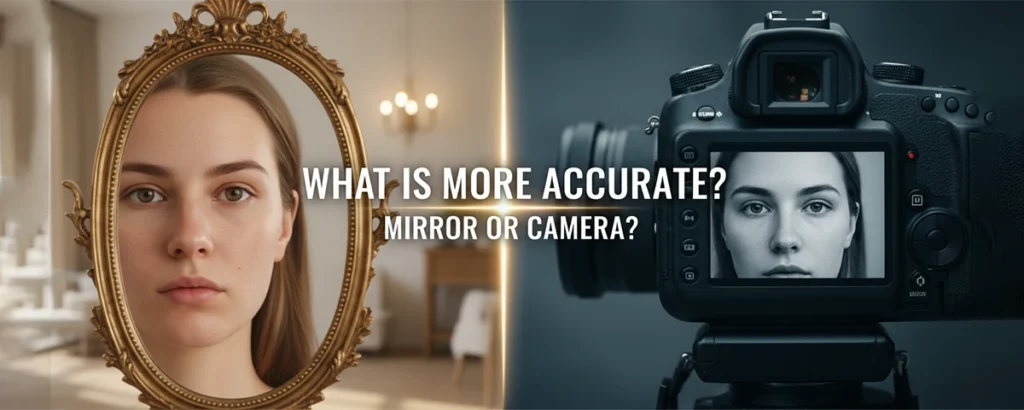
Have you ever looked amazing in the mirror, only to be disappointed by a photo? You're not alone. This comprehensive guide explores the science, psychology, and truth behind how we perceive ourselves.
Table of contents
The Quick Answer
Neither is perfectly "accurate." Mirrors show a real-time, horizontally flipped (laterally inverted) reflection of you. Cameras capture a 2D, unflipped image that is affected by lens distortion, lighting, and angle. The "real" you is somewhere in between—and neither matches exactly how others see you due to the complexities of human perception.
Why Does This Question Matter?
If you've ever winced at a candid photo of yourself while thinking, "That doesn't look like me at all," you've experienced one of the most common perceptual conflicts of modern life. The mirror in your bathroom shows you one version of yourself. The photos on your phone show another. Your passport photo? A third, arguably less flattering, interpretation.
This isn't just about vanity. Understanding the difference between how mirrors and cameras represent us can help with self-acceptance, better photography, and even psychological well-being. Many people genuinely distress over why they look "worse" in photos than in the mirror—not realizing that there are scientific and optical reasons for the discrepancy.
In this deep dive, we'll explore the physics of mirrors, the mechanics of cameras, the psychology of self-perception, and finally, attempt to answer the age-old question: Which one shows the "real" you?

How Mirrors Work: The Reflected Self
A mirror is a smooth, reflective surface—typically glass coated with a thin layer of aluminum or silver. When light bounces off your face and hits the mirror, it reflects back at the same angle, creating an image that your eyes perceive. This image is what we call a "virtual image"—it appears to exist behind the mirror but doesn't actually occupy physical space there.
The Flip: Lateral Inversion
Mirrors don't flip you "upside down," but they do flip you "left to right." This is called lateral inversion. When you raise your right hand in front of a mirror, your reflection appears to raise its left hand. This means you never see yourself the way others see you—you see a reversed version. While this might seem minor, it's actually a significant difference.
What Mirrors Get Right
- Real-time Accuracy: A mirror shows you exactly what's happening in that moment. There's no shutter lag, no processing delay.
- 3D Perception: Because you're looking at your reflection with both eyes, you retain depth perception. You see the contours of your face, the way light falls on your cheekbones, in three dimensions.
- Dynamic Self: You see yourself in motion—blinking, smiling, turning. This moving image feels more "alive" and natural than a frozen photograph.
What Mirrors Get Wrong
- The Flip: You don't see what others see. If you have a mole on your right cheek, you're used to seeing it on the left in the mirror. When someone takes a photo, the mole appears where it actually is—on the right—and it can look "off" to you.
- Lighting Conditions: The lighting in your bathroom is not the same as outdoor light or flash photography. Mirror lighting is often softer and more flattering.
- Familiarity Bias (Mere-Exposure Effect): We'll get into this more later, but because you see your mirrored self so frequently, you prefer that version. It feels "right."
How Cameras Work: Capturing Reality?
A camera captures light through a lens, focusing it onto a sensor (or film, in older cameras) to create a 2D representation of a 3D scene. Unlike a mirror, which shows a real-time, floating virtual image, a camera produces a fixed, tangible output—a photograph. But is this output accurate?
📐 Lens Distortion
All camera lenses distort to some degree. Wide-angle lenses (like those on most smartphone front cameras) exaggerate features close to the lens, making noses appear larger. This is why your face might look "stretched" in close-up selfies.
💡 Lighting Dependence
Cameras are highly sensitive to lighting. Harsh overhead lighting can create unflattering shadows under your eyes and nose. Natural, diffused light is generally more forgiving and closer to how we perceive faces in real life.
What Cameras Get Right
- No Flip: Cameras show you how others actually see you—unflipped. This is theoretically more "accurate" to external observers.
- Fixed Moment: A photo captures a single instant, which can be studied and compared objectively. It's a record, not a fleeting reflection.
- Shareability: Photos are how the world sees you online. Whether fair or not, the camera's version is often considered your "official" face in the digital age.
What Cameras Get Wrong
- Lens Distortion: As mentioned, wide-angle lenses warp proportions. A telephoto lens (longer focal length) produces a more natural look, but most smartphones don't use these for selfies.
- Freezing Motion: Faces are dynamic. A photo captures a fraction of a second, which might include an awkward blink, a mid-word expression, or an unflattering angle. Mirrors let you see—and unconsciously correct—these moments.
- 2D Flattening: A photo has no depth. The subtle 3D contours of your face are compressed into a flat image, losing information that your eyes (and mirrors) naturally perceive.
The Psychology of Self-Perception
Beyond optics, there's a powerful psychological component to why you might prefer your mirror reflection over photos. It's not just about accuracy—it's about familiarity.
The Mere-Exposure Effect
Psychologist Robert Zajonc's research showed that people develop a preference for things simply because they are familiar with them. You've looked at your mirror image thousands of times. That flipped version is "your face" in your mind. When you see an unflipped photo, something feels subtly "off"—not because the photo is wrong, but because it's unfamiliar.
Facial Asymmetry
Human faces are not perfectly symmetrical. Your left eye might be slightly higher than your right. Your smile might tilt one way. In the mirror, you've internalized these asymmetries in their flipped form. A photo shows them "correctly," but it looks strange to you because it's the opposite of what you're used to. Interestingly, your friends and family are used to the unflipped version—they might prefer your photos over how you look in a mirror!
Dynamic vs. Static Self
In real life, no one sees you frozen. People see you laughing, talking, moving. A mirror captures this dynamism. A photo does not. A single frame might catch you blinking, speaking, or with an expression that is a fraction of a second away from your "resting" face. This is why video often feels more "accurate" than photos—it captures the movement that defines how we actually look to others.
So, Which Is More Accurate?
The answer, frustratingly, is: it depends on what you mean by "accurate."
If "accurate" means how others see you...
The camera is closer (assuming a proper lens and good lighting). Others see the unflipped version of your face, which is what a camera captures. However, a camera still introduces distortion, and a single photo doesn't capture your dynamic essence.
If "accurate" means a true 3D representation...
The mirror is better. It preserves depth, allows for stereo vision, and shows you in motion. The only caveat is the flip.
If "accurate" means what you're comfortable with...
The mirror wins. Due to the mere-exposure effect, you'll almost always prefer your reflection. It's not more accurate; it's just more familiar.
How to Look Better in Photos (Practical Tips)
1. Use a Longer Focal Length
If possible, use a camera with a 50mm or 85mm lens (or use the rear camera on your phone held further away). This reduces the "bulging" wide-angle effect.
2. Mind the Lighting
Face a window or natural light source. Avoid harsh overhead lights that cast shadows under your eyes and nose.
3. Angle Matters
Holding a camera slightly above eye level is generally more flattering than below (which can exaggerate the chin and nostrils).
4. Take Burst Photos
One shot might catch you mid-blink. Burst mode captures dozens of frames, increasing the chance of a natural, flattering expression.
Frequently Asked Questions
Why do I look weird in photos but good in the mirror?
This is primarily due to the mere-exposure effect. You're accustomed to your flipped mirror image. The unflipped photo looks subtly "wrong" because your facial asymmetries are reversed from what you expect.
Do other people see me the way I see myself in the mirror?
No. Others see the unflipped version of you—closer to what a camera shows. Your friends are actually more familiar with your camera face than your mirror face.
Is it true that cameras add 10 pounds?
This saying relates to lens distortion and the flattening of 3D to 2D. Wide-angle lenses can make objects appear larger. Poor lighting and certain angles can also be unflattering. A camera doesn't literally add weight, but it can create that illusion.
Is video more accurate than photos?
Yes, in many ways. Video captures your dynamic expressions and movements, which is closer to how you appear in real life. A single photo is just one frozen moment that may not represent you accurately.
Final Thoughts: Embracing Both Versions
The quest to determine whether a mirror or camera is "more accurate" ultimately leads to a deeper truth: accuracy is relative. Neither device shows a perfectly objective version of you. Mirrors flip you; cameras flatten you. Both are influenced by lighting, angles, and the moment.
Perhaps the most important takeaway is this: you are not just an image. You are a dynamic, three-dimensional, moving human being whose essence cannot be fully captured by any single mirror or photograph. The people who know you don't see you as a frozen frame—they see you in motion, in conversation, in life.
So the next time you cringe at a photo and think, "That doesn't look like me," you're right—but so is the person who took it and sees you every day. The "real" you exists somewhere between the mirror and the camera, in the space where light, perception, and human connection meet.