
Creating Consistent Global Campaign Imagery
In today's competitive marketplace, captivating visual content is paramount for brand recognition and consumer engagement.
3D rendering has emerged as an indispensable tool in marketing strategies, enabling companies to create stunning, consistent global campaign imagery across various platforms. From architectural visualization to product demos, 3D design and rendering professionals are transforming ideas into photorealistic visuals that resonate with audiences worldwide.
This comprehensive guide explores the nuances of 3D rendering for marketing, including key techniques, tools, and services that help brands produce scalable and consistent imagery across global campaigns.
Understanding 3D Rendering in Marketing
3D rendering is the process of generating realistic images from 3D models using specialized software. It involves transforming digital 3D design data into 2D visual content that approximates real-world appearances or fantastical concepts with high fidelity.
Why 3D Rendering Matters for Modern Marketing
- Cost Efficiency: Eliminate expensive photoshoots and physical prototypes
- Unlimited Iterations: Make changes instantly without reshooting
- Global Consistency: Maintain brand identity across all markets
- Pre-Launch Marketing: Promote products before manufacturing
- Impossible Shots: Create perspectives impossible with traditional photography
Key Applications of 3D Rendering in Marketing
Architectural Visualization
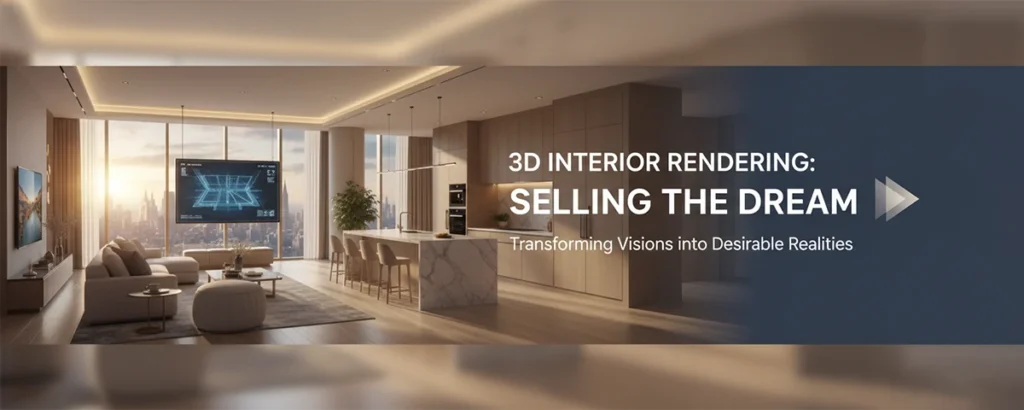
Showcasing building designs, interior layouts, and development projects with detailed realism. Perfect for real estate marketing, urban planning presentations, and construction proposals.
Product Visualization
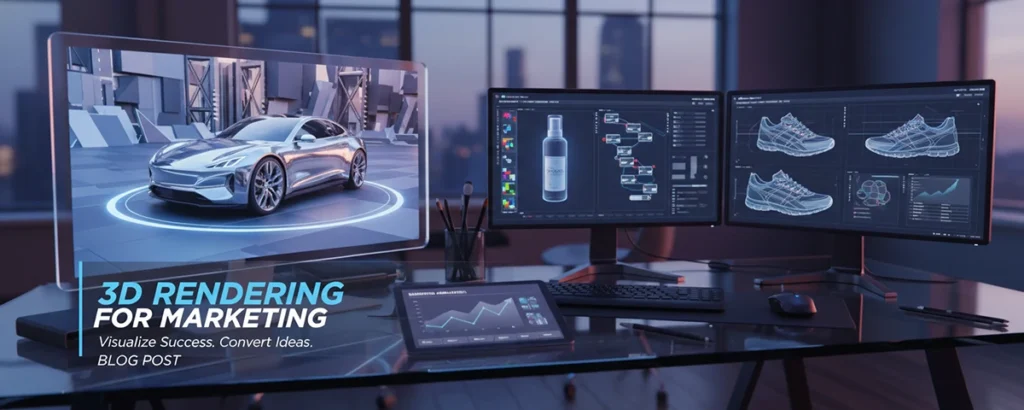
Demonstrating new products in high detail before manufacturing or launch. Ideal for e-commerce, catalogs, and product configurators that let customers customize options.
CG Rendering
Creating digital scenes for advertising campaigns, print, web, and social media. Enables fantastical environments and scenarios impossible to photograph.
3D Animation
Producing animated ads or explainer videos that demonstrate product features, tell brand stories, or simplify complex concepts for audiences.
VR/AR Rendering
Offering immersive experiences that bring products or spaces to life. Customers can virtually place furniture in their homes or explore properties remotely.
GIS Visualization
Utilizing geographic data for spatial marketing or urban planning presentations. Combines mapping data with 3D rendering for location-based campaigns.
💡 Industry Insight
According to recent market research, the global 3D rendering market is projected to reach $8.9 billion by 2028, growing at a CAGR of 22.5%. This explosive growth is driven by increasing demand for photorealistic marketing content and the rise of e-commerce platforms requiring high-quality product visualization.
Core Elements of 3D Design
Achieving visual consistency across international marketing campaigns necessitates mastery of several foundational components. Each element plays a crucial role in creating compelling, photorealistic imagery that maintains brand integrity across diverse markets and platforms.
1. 3D Modeling: The Foundation
3D modeling is the art and science of constructing detailed digital representations of products, architectural structures, or environments. This foundational step determines the accuracy and scalability of all subsequent marketing materials.
Types of 3D Modeling Techniques:
- Polygonal Modeling: Building models from vertices, edges, and faces - ideal for hard-surface objects like electronics and furniture
- NURBS Modeling: Using mathematical curves for smooth, organic shapes - perfect for automotive design and product curves
- Sculpting: Digital clay-like manipulation for organic forms - excellent for character design and natural elements
- Procedural Modeling: Algorithm-based generation for complex patterns and structures - efficient for architectural details
Precise modeling ensures that visuals are accurate and scalable across all marketing touchpoints. A well-constructed 3D model can be repurposed for print ads, web banners, social media content, and even interactive AR experiences without loss of quality.
2. Texturing and PBR Materials
Texturing breathes life into 3D models by defining how surfaces appear and interact with light. Physically Based Rendering (PBR) materials have revolutionized this process by using real-world physics to create authentic surface qualities.
Albedo/Base Color
The raw color of the surface without lighting effects
Roughness/Glossiness
Controls how smooth or rough a surface appears
Metallic Properties
Defines whether a surface behaves like metal or dielectric
Normal Maps
Adds surface detail without additional geometry
Ambient Occlusion
Simulates soft shadows in crevices and corners
Displacement
Actually deforms geometry for true depth
PBR workflows ensure that materials look consistent under different lighting conditions, which is crucial for maintaining brand consistency across global campaigns with varying lighting scenarios
3. Lighting in 3D: The Art of Illumination
Lighting is arguably the most critical element in creating compelling 3D renders. Proper lighting setups simulate real-world conditions and evoke specific moods that align with brand messaging.
Essential Lighting Techniques:
Three-Point Lighting: The classic setup using key light, fill light, and rim light to create depth and dimension. This technique is fundamental for product photography-style renders.
HDRI Lighting: High Dynamic Range Images provide realistic environmental lighting with accurate reflections and ambient illumination. Essential for outdoor scenes and automotive visualization.
Studio Lighting: Controlled artificial lighting setups that highlight product features and create clean, professional imagery for e-commerce and catalogs.
Natural Lighting: Simulating sunlight and skylight for architectural visualization and lifestyle product shots that feel authentic and inviting.
Advanced techniques like ray tracing accurately reproduce shadows, reflections, and refractions, enhancing realism to the point where renders become indistinguishable from photographs.
4. Scene Setup and Composition
Arranging models, lights, and cameras within the digital environment forms the basis for rendering. Consistent scene setup across campaigns guarantees a cohesive visual language that strengthens brand recognition.
Composition Best Practices:
- Rule of Thirds: Position key elements along imaginary grid lines for balanced, engaging compositions
- Leading Lines: Use architectural elements or product features to guide viewer attention
- Depth of Field: Control focus to emphasize products while creating cinematic bokeh effects
- Camera Angles: Establish consistent perspectives that become part of brand identity
- Negative Space: Allow breathing room around subjects for clean, professional aesthetics
🎯 Pro Tip: Creating Style Guides
Develop comprehensive 3D rendering style guides that document lighting setups, camera angles, material libraries, and composition rules. This ensures that multiple artists can produce consistent imagery across global campaigns, maintaining brand integrity regardless of who creates the renders.
Advanced Rendering Techniques
As technology advances, so do the techniques that enable spectacular visuals. Modern rendering technologies push the boundaries of what's possible in marketing visualization, creating experiences that captivate audiences and drive engagement.
Photorealistic Rendering
Photorealistic rendering produces images indistinguishable from real photographs, crucial for luxury branding and product launches where authenticity and quality perception are paramount.
Key Technologies:
- Path Tracing: Simulates light bouncing through scenes for ultimate realism
- Global Illumination: Calculates indirect lighting for natural-looking scenes
- Subsurface Scattering: Renders translucent materials like skin, wax, and marble
- Caustics: Creates realistic light patterns through transparent objects
Industries like automotive, jewelry, and high-end fashion rely heavily on photorealistic rendering to showcase products with the level of detail and luxury that their brands demand.
Ray Tracing: The Gold Standard
Ray tracing is an advanced rendering method that simulates the physical behavior of light rays, producing highly realistic reflections, refractions, and shadows. This technique has become increasingly accessible thanks to GPU acceleration and cloud rendering.
Benefits of Ray Tracing
- Accurate reflections on metallic and glass surfaces
- Realistic shadows with proper softness and color bleeding
- True-to-life refractions through transparent materials
- Natural ambient occlusion and indirect lighting
Marketing Applications
- Luxury product visualization
- Automotive exterior and interior renders
- Jewelry and watch marketing
- Architectural glass and water features
Real-Time Rendering Revolution
Real-time rendering enables quick previews and interactive experiences, vital for live presentations, configurators, and dynamic web content. Game engine technology has brought real-time photorealistic rendering to marketing applications.
Real-Time Use Cases:
Product Configurators:
Allow customers to customize products in real-time, seeing instant visual feedback as they change colors, materials, and options.
Virtual Showrooms:
Create immersive digital spaces where customers can explore products from any angle, zoom in on details, and experience scale.
Interactive Presentations:
Enable sales teams to demonstrate products dynamically during client meetings, adjusting views and configurations on the fly.
Web 3D Viewers:
Embed interactive 3D models directly into websites, allowing customers to examine products without leaving the page.
3D Animation for Dynamic Marketing
Animation adds motion to static images, creating engaging video advertising that demonstrates product features, tells brand stories, or simplifies complex concepts for audiences.
Animation Types for Marketing:
- Product Demonstrations: Show how products work, assemble, or transform
- Explainer Videos: Break down complex services or technologies into digestible visuals
- Brand Stories: Create emotional narratives that connect with audiences
- Architectural Walkthroughs: Guide viewers through spaces before construction
- Social Media Content: Produce eye-catching loops and shorts optimized for platforms
VR/AR Rendering: Immersive Experiences
Virtual and Augmented Reality rendering delivers immersive experiences that enhance customer interaction and product understanding. These technologies are transforming how consumers engage with brands before making purchase decisions.
Virtual Reality (VR)
Fully immersive environments where users can explore spaces, interact with products, and experience brand worlds in 360 degrees.
Perfect for: Real estate tours, automotive showrooms, trade show experiences, training simulations
Augmented Reality (AR)
Overlays digital content onto the real world, allowing customers to visualize products in their own environment through smartphones or tablets.
Perfect for: Furniture placement, makeup try-ons, packaging visualization, installation previews
Cloud Rendering & Scalability
Cloud rendering uses distributed computing resources to handle large-scale projects efficiently and cost-effectively. This technology democratizes access to high-end rendering capabilities without requiring massive hardware investments.
Advantages of Cloud Rendering:
⚡ Speed:
Render complex scenes in minutes instead of hours by distributing work across hundreds of machines.
💰 Cost-Effective:
Pay only for computing time used, eliminating need for expensive hardware upgrades.
📈 Scalability:
Handle massive campaigns with thousands of renders without workflow bottlenecks.
🌍 Accessibility:
Teams worldwide can access the same rendering resources, ensuring consistency.
Workflow Optimization
Efficient workflows are essential for maintaining consistency and meeting tight marketing deadlines. Understanding the journey from initial concept to final render helps teams optimize their processes and deliver exceptional results.
From CAD to Render: Streamlining the Pipeline
Transitioning from CAD or initial design files to polished renders involves a systematic workflow that ensures accuracy and efficiency. This CAD to render pipeline is crucial for product marketing and architectural visualization.
The Complete Workflow:
1. CAD Data Preparation
Clean up CAD files, remove unnecessary geometry, and optimize polygon counts. Convert engineering-focused models into render-ready assets.
2. Model Optimization
Retopologize meshes for efficient rendering, add subdivision surfaces where needed, and ensure proper UV mapping for textures.
3. Material Application
Apply PBR materials, create material libraries for consistency, and fine-tune surface properties to match real-world references.
4. Scene Assembly
Position models in environments, set up cameras following brand guidelines, and establish lighting schemes that enhance product features.
5. Rendering
Execute renders using appropriate quality settings, leverage render farms for large batches, and output in formats suitable for various marketing channels.
6. Post-Production
Color correction, compositing, adding effects, and final touches in image editing software to achieve the desired aesthetic.
Asset Management for Global Campaigns
Managing 3D assets across global campaigns requires robust systems for organization, version control, and collaboration. Proper asset management ensures consistency and enables efficient reuse of resources.
📁 Organization Strategies
- Standardized naming conventions
- Hierarchical folder structures
- Metadata tagging systems
- Version control protocols
- Centralized asset libraries
🔄 Collaboration Tools
- Cloud-based DAM systems
- Real-time review platforms
- Automated approval workflows
- Team communication channels
- Project management integration
Quality Control and Consistency
Maintaining visual consistency across thousands of renders requires systematic quality control processes. These checkpoints ensure that every image meets brand standards before reaching audiences.
Quality Assurance Checklist:
Technical Quality:
- ✓ Resolution meets output requirements
- ✓ No rendering artifacts or noise
- ✓ Proper anti-aliasing applied
- ✓ Color space correctly managed
Brand Compliance:
- ✓ Colors match brand palette
- ✓ Lighting follows style guide
- ✓ Composition adheres to standards
- ✓ Typography properly integrated
Content Accuracy:
- ✓ Product details are accurate
- ✓ Proportions and scale correct
- ✓ Materials match specifications
- ✓ No placeholder content visible
Output Optimization:
- ✓ File size optimized for use
- ✓ Correct format for platform
- ✓ Metadata properly embedded
- ✓ Naming convention followed
⚡ Efficiency Tip: Template Systems
Create template scenes with pre-configured lighting, cameras, and materials for different product categories. This dramatically reduces setup time for new renders while ensuring consistency. A well-designed template system can reduce production time by 60-70% for recurring campaign types.
Industry Applications
3D rendering has transformed marketing across numerous industries, each leveraging the technology in unique ways to solve specific challenges and create compelling customer experiences.
🛒 E-Commerce & Retail
Online retailers use 3D rendering to create consistent product imagery across thousands of SKUs without expensive photoshoots.
Key Applications:
- 360-degree product spins for detailed examination
- Lifestyle scene integration showing products in context
- Color and material variant generation
- AR try-before-you-buy experiences
- Seasonal campaign imagery without re-shooting
Business Impact: Reduce photography costs by 70% while increasing product visualization quality and consistency
🚗 Automotive
Car manufacturers showcase vehicles before production, create configurators, and produce marketing materials for global markets.
Key Applications:
- Photorealistic exterior and interior renders
- Interactive configurators with millions of combinations
- Virtual showrooms and test drive experiences
- Technical cutaway illustrations
- Animated feature demonstrations
Business Impact: Launch marketing campaigns 6-12 months before production begins, generating pre-orders and market interest
🏗️ Real Estate & Architecture
Developers market properties before construction, helping buyers visualize spaces and make confident purchase decisions.
Key Applications:
- Photorealistic exterior and interior visualizations
- Virtual property tours and walkthroughs
- Neighborhood and amenity visualization
- Customization options for buyers
- Time-of-day and seasonal variations
Business Impact: Sell properties off-plan with 40% higher conversion rates compared to traditional marketing methods
📱 Consumer Electronics
Tech companies demonstrate products with impossible camera angles and highlight features that are difficult to photograph.
Key Applications:
- Exploded view diagrams showing internal components
- Feature highlight animations
- Scale comparisons and size demonstrations
- Material and finish variations
- User interface mockups integrated with hardware
Business Impact: Create marketing materials immediately after design finalization, accelerating time-to-market
💎 Fashion & Jewelry
Luxury brands maintain consistent high-end imagery across global campaigns while showcasing intricate details.
Key Applications:
- Photorealistic material rendering (fabrics, metals, gems)
- Virtual fashion shows and lookbooks
- Customization and personalization visualizers
- Detailed close-ups of craftsmanship
- Seasonal collection previews
Business Impact: Maintain brand luxury perception while reducing sample production and photography logistics costs
🛋️ Furniture & Home Decor
Furniture brands enable customers to visualize products in their own spaces and offer extensive customization options.
Key Applications:
- Room scene staging with multiple products
- AR placement in customer homes
- Material and color configurators
- Scale and proportion demonstrations
- Lifestyle imagery for catalogs and websites
Reduce return rates by 35% through better pre-purchase visualization and expectation setting
Cross-Industry Trend: Sustainability
3D rendering significantly reduces the environmental impact of marketing by eliminating physical samples, reducing shipping, and minimizing photoshoot travel. Forward-thinking brands are highlighting their use of virtual production as part of their sustainability initiatives, resonating with environmentally conscious consumers.
Best Practices
Implementing 3D rendering successfully requires following proven best practices that ensure quality, consistency, and efficiency across global marketing campaigns.
Establishing Brand Visual Standards
Create comprehensive documentation that defines your brand's visual language in 3D space. This becomes the foundation for consistent global campaigns.
Essential Documentation:
📐 Technical Specifications
- ✓ Camera focal lengths and angles
- ✓ Lighting setups and HDRI libraries
- ✓ Render quality settings
- ✓ Output resolutions and formats
📋 Asset Standards
- ✓ Naming conventions
- ✓ File organization structures
- ✓ Version control protocols
- ✓ Metadata requirements
🎨 Visual Guidelines
- ✓ Color palettes and material libraries
- ✓ Composition rules and framing
- ✓ Depth of field standards
- ✓ Post-processing workflows
✅ Quality Benchmarks
- ✓ Reference images for comparison
- ✓ Approval workflows
- ✓ Revision processes
- ✓ Final delivery specifications
Optimizing for Multiple Platforms
Modern marketing requires imagery optimized for diverse platforms, from high-resolution print to mobile-optimized web content. Plan your rendering strategy to accommodate all touchpoints efficiently.
Print & OOH
Specs: High resolution (300+ DPI), CMYK color space, large file sizes acceptable
Key Considerations: Maximum detail, accurate color reproduction, bleed areas
Web & Digital
Specs: Optimized file sizes, RGB color space, responsive dimensions
Key Considerations: Fast loading, retina display support, progressive loading
Social Media
Specs: Platform-specific ratios, compressed formats, mobile-first
Key Considerations: Attention-grabbing, quick comprehension, vertical formats
Building Efficient Production Pipelines
Streamline your workflow to handle high-volume campaigns without sacrificing quality. Automation and smart resource allocation are key to scalability.
Efficiency Strategies:
🤖 Automation Opportunities
- Batch rendering scripts for variant generation
- Automated file naming and organization
- Template-based scene setup
- Post-processing action sets
⚡ Resource Optimization
- Proxy models for scene setup and preview
- Progressive rendering for quick approvals
- Cloud rendering for peak demand periods
- Asset instancing to reduce memory usage
👥 Team Collaboration
- Centralized asset libraries accessible to all team members
- Real-time review and annotation tools
- Clear role definitions and approval chains
- Regular sync meetings for alignment
Measuring Success and ROI
Track key metrics to demonstrate the value of 3D rendering investments and continuously improve your processes.
📊 Efficiency Metrics
- Time from concept to final render
- Cost per image vs. traditional photography
- Revision cycles and approval times
- Asset reuse rates across campaigns
💰 Business Impact
- Conversion rate improvements
- Reduction in product returns
- Time-to-market acceleration
- Customer engagement metrics
The Future of Marketing Visualization
3D rendering has evolved from a specialized tool to an essential component of modern marketing strategies. As technology continues to advance, the gap between virtual and real-world imagery continues to narrow, opening new possibilities for creative expression and customer engagement.
The integration of artificial intelligence, real-time rendering, and immersive technologies promises to make 3D visualization even more accessible and powerful. Brands that invest in building robust 3D rendering capabilities today position themselves to lead in tomorrow's increasingly visual and interactive marketing landscape.
Whether you're launching a global product campaign, building an e-commerce platform, or creating immersive brand experiences, 3D rendering provides the consistency, flexibility, and quality needed to succeed in competitive markets. The question is no longer whether to adopt 3D rendering, but how quickly you can integrate it into your marketing workflow to gain competitive advantage.